
The Bhagavad Gita’s Global Recognition: From Ancient Battlefield to UNESCO’s World Register
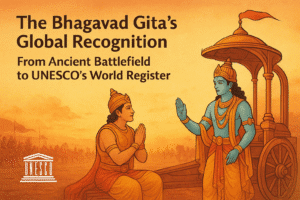
The Bhagavad Gita’s Global Recognition: From Ancient Battlefield to UNESCO’s World Register
The recent inscription of the Bhagavad Gita into UNESCO’s Memory of the World Register marks a significant moment of global recognition for a text that has shaped spiritual and philosophical thought for millennia. This honor, announced in April 2025, elevates the Gita beyond its status as a sacred Hindu scripture, affirming its universal value as part of humanity’s documentary heritage.
The UNESCO register aims to preserve and promote documentary collections of global significance, and India now has 14 inscriptions on this prestigious list. For many, this inclusion validates the Gita’s timeless wisdom, described by Prime Minister Narendra Modi as nurturing “civilisation and consciousness for centuries”. Yet, this ancient dialogue between Prince Arjuna and his divine charioteer, Krishna, set on a battlefield in the epic Mahabharata, continues to offer profound and often challenging insights for contemporary life.
Beyond the Battlefield: Understanding the Gita’s Historical Context
To fully appreciate the Bhagavad Gita’s depth, one must begin with its literary home: the Mahabharata, one of the two major Sanskrit epics of ancient India. This monumental work, which narrates the conflict between two groups of cousins—the Pandavas and the Kauravas—over the throne of Hastinapura, serves as the dramatic backdrop for the Gita’s philosophical discourse.
The Bhagavad Gita itself is a 700-verse dialogue that comprises chapters 23 to 40 of the Mahabharata’s sixth book. Scholarly consensus dates its composition to the period between the second century BCE and the second century CE, a time of significant philosophical development in India. The text opens on the field of Kurukshetra at the precipice of a catastrophic war. Arjuna, a famed warrior, is paralyzed by moral anguish at the prospect of fighting and killing his own relatives, teachers, and friends. His subsequent dialogue with Krishna, who reveals himself as an incarnation (avatar) of the god Vishnu, forms the core of the text.
This setting is not merely a dramatic device but a powerful metaphor. The battlefield represents the internal and external conflicts of human existence—the struggle between duty and desire, action and consequence, and the individual and society. As one modern interpretation suggests, the war is an allegory for “the struggles and vagaries of human life”.
Core Philosophical Teachings and Their Modern Relevance
The Bhagavad Gita is celebrated as a masterful synthesis of several key strands of Indian philosophy, including the Vedic concept of dharma (duty), Sankhya-based yoga, and bhakti (devotion). Its teachings are structured around several interconnected paths to spiritual realization and ethical living, which remain strikingly relevant today.
Key Philosophical Concepts of the Bhagavad Gita
| Concept | Sanskrit Term | Core Meaning | Contemporary Application |
| Selfless Action | Nishkama Karma | Performing one’s duty without attachment to personal rewards or outcomes. | Focus on effort and integrity in work, reducing anxiety over success or failure. |
| Steadfast Wisdom | Sthita-prajna | The state of being emotionally resilient, mentally steady, and undisturbed by adversity. | Cultivating psychological well-being and stability in a rapidly changing world. |
| Individual Duty | Svadharma | The personal, inherent duty based on one’s nature and position in life. | Encourages authentic leadership and commitment to one’s professional and social roles. |
| Social Harmony | Lokasamgraha | Acting for the maintenance of universal order, harmony, and welfare. | Underpins concepts of social responsibility and sustainable, ethical governance. |
| Path of Devotion | Bhakti Yoga | Achieving spiritual realization through loving devotion to the divine. | Suggests that purpose and connection can be found through dedication to a cause greater than oneself. |
At its heart, Krishna’s counsel to Arjuna resolves a central tension: how to live an active, dutiful life in the world while pursuing spiritual liberation. Krishna argues that inaction is impossible; the true path (yoga) is “skill in action” — performing one’s prescribed duties with discipline but without selfish attachment to the results. This is the essence of Nishkama Karma, a cornerstone of the Gita’s ethical framework.
The text systematically explores multiple yogas or paths to this end. Karma Yoga is the path of selfless action. Jnana Yoga is the pursuit of spiritual wisdom and discernment. Bhakti Yoga is the path of loving devotion to the divine. Raja Yoga, mentioned in later interpretations, involves meditation and mind control. The Gita presents these not as mutually exclusive, but as complementary approaches suitable for different temperaments.
A Text Transformed: Evolving Interpretations Through History
The Bhagavad Gita’s journey to becoming a universal guide is a story of dynamic reinterpretation across centuries. Its initial context is undeniably martial—Krishna persuades a hesitant warrior to fight a righteous war (dharma yuddha). For much of its early history, it was viewed within this framework.
A profound transformation in its global perception began in the 19th century. British colonial scholars, seeking to understand Hindu tradition, lauded it as the “Hindu equivalent of the New Testament“. Around the same time, American Transcendentalists like Ralph Waldo Emerson and Henry David Thoreau were deeply influenced by its philosophy, introducing it to Western intellectual circles.
However, the most significant modern reinterpretation came from Mahatma Gandhi. Facing the British colonial “invasion,” Gandhi, a self-proclaimed disciple of the Gita, radically reimagined its message. For him, the battlefield of Kurukshetra was an internal, spiritual one. The enemies to be slain were human weaknesses like lust, anger, and greed. He interpreted the call to arms as a call to engage in non-violent (ahimsa) but resolute action for truth and justice. This appropriation allowed the Gita to become a foundational text for India’s independence movement, transforming it from a treatise on warfare into a manual for peaceful, principled resistance.
This evolution highlights a crucial insight: the meaning of a classic text is often shaped by the needs and contexts of its readers. As one analysis notes, “interpreting texts… will very often mirror an individual’s cultural context”.
The UNESCO Inscription: Significance and the Path Forward
The inscription of the Bhagavad Gita into the Memory of the World Register in April 2025, alongside Bharat Muni’s Natyashastra (a foundational text on performing arts), is a landmark event. It places the Gita among 74 new documentary collections from 72 countries recognized for their outstanding universal value.
This recognition serves multiple important functions:
- Preservation: It underscores the need to safeguard ancient manuscripts and documentary traditions for future generations.
- Legitimization: It provides international validation of the text’s contribution to global philosophical and cultural heritage.
- Promotion: It encourages broader, cross-cultural study and dialogue around the text’s ideas.
Union Culture Minister Gajendra Singh Shekhawat aptly described these works as “philosophical and aesthetic foundations that have shaped Bharat’s worldview”. They join other esteemed Indian entries on the register, including the Rigveda manuscripts (2007) and the Ramcharitmanas (2024), creating a rich tapestry of the subcontinent’s intellectual history.
The Gita as a Living Guide for Contemporary Challenges
The Vice President’s statement that the Gita serves as a “Universal Guide offering Moral Clarity” points to its practical, living relevance today. Its teachings provide frameworks for navigating modern dilemmas:
- In Leadership and Ethics: The concept of Svadharma encourages leaders to act with integrity according to their role, while Lokasamgraha frames leadership as service for the greater social good.
- In Mental Well-being: The ideal of the Sthita-prajna—the person of steady wisdom who remains unperturbed by success or failure—offers a ancient blueprint for building emotional resilience and psychological stability.
- In Professional Life: The doctrine of Nishkama Karma is profoundly relevant in results-driven cultures. It advocates focusing on the quality and ethics of one’s work while detaching from the anxiety of uncontrollable outcomes, fostering both excellence and inner peace.
Ultimately, the Bhagavad Gita’s enduring power lies in its ability to speak to the individual at a crossroads. It does not provide easy answers but offers a rigorous framework for ethical decision-making when all choices are fraught. It asks us to examine our duties, purify our intentions, act with courage, and relinquish our clinging to how we think things should turn out.
Its new status on UNESCO’s register is not merely an accolade for a relic of the past. It is an invitation to the world to engage with a timeless conversation about duty, purpose, and the human spirit—a conversation that began on a mythical battlefield and continues to resonate in the quiet and noisy battles of our own lives.
You must be logged in to post a comment.