
The Battle for the Past: Inside the British Museum’s Decision to Remove ‘Palestine’ from Its Galleries
The Battle for the Past: Inside the British Museum’s Decision to Remove ‘Palestine’ from Its Galleries
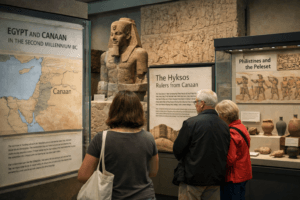
It was a quiet change, made without fanfare or public announcement. Sometime in 2025, visitors to the British Museum’s ancient Middle East galleries began encountering subtly different labels. A map that once illustrated Egyptian dominance in “Palestine” had been revised. A panel describing the Hyksos, a people who ruled parts of ancient Egypt, no longer referred to their “Palestinian descent” but rather their “Canaanite descent” . The word “Palestine,” it seemed, was being carefully, deliberately, removed from the deep past.
The news, first reported in detail in mid-February 2026, has ignited a firestorm of controversy, turning the hushed halls of one of the world’s greatest museums into the latest battlefield in the ongoing war of narratives over the Middle East . At the heart of the dispute is a single, deceptively simple question: what do we call a land, and who gets to decide?
The museum frames the changes not as a political act, but as a matter of historical precision. Following what it describes as “audience research,” the institution concluded that the term “Palestine,” while long used in Western scholarship as a geographical shorthand, is “no longer historically neutral” . For ancient periods, it has opted for what it considers more accurate terminology, using “Canaan” for the southern Levant in the second millennium BC and specifying the “kingdoms of Judah and Israel” for the subsequent Iron Age .
But for the change’s many critics, this is far more than a curatorial footnote. It is a stark example of political pressure dictating how history is presented, a move that they argue actively contributes to the erasure of Palestinian identity from the collective memory. The decision has pitted historians against legal advocates, sparked a petition with thousands of signatures, and forced the museum’s own director to distance himself from the process, calling himself “disgusted by the whole thing” .
The Legal Challenge: “A False Impression of Continuity”
The primary catalyst for the review was a letter sent to museum director Nicholas Cullinan in early February 2026 from UK Lawyers for Israel (UKLFI), a voluntary group of solicitors . The group raised what it termed “serious concerns” about the use of “Palestine” in displays covering the ancient Levant and Egypt, arguing that its application was anachronistic and historically misleading.
In their letter, UKLFI contended that applying the name “Palestine” retrospectively to a region across thousands of years “erases historical changes and creates a false impression of continuity” . They argued that before the Roman period, the area was known by other names, most notably Canaan, and later contained the Kingdoms of Israel and Judah. By using a single, later term, the museum was, in their view, “obscuring the history of Israel and the Jewish people” and “re-framing the origins of the Israelites… as erroneously stemming from Palestine” .
The group’s objection extended beyond geography. They pointed to a description of a doll wearing “Palestinian traditional dress” in an ancient context, arguing it implied an “uninterrupted cultural lineage” that was not supported by the historical record . For UKLFI, the changes are a victory for accuracy. A spokesperson for the group welcomed the museum’s “willingness to review and amend terminology which is inaccurate or liable to convey an incorrect meaning today,” adding that “museums play a vital role in public education, and it is essential that descriptions reflect the historical record with precision and neutrality” .
A Charge of Erasure: “Spine Tingling” Interference
To the museum’s critics, this argument of precision is a thin veil for a political campaign of erasure. Within days of the news, a Change.org petition was launched, calling on the museum to reverse its decision. The petition argues that the move is “not supported by historical evidence and contributes to a wider pattern of erasing Palestinian presence from public memory” .
Academics have rallied to this cause. Marchella Ward, a lecturer in classical studies at the Open University, stated emphatically, “I use the term ‘ancient Palestine’ frequently in my own research and will continue to do so.” She accused those who claim the term is illegitimate of telling “a lie” aimed at “the erasure of Palestinians” .
Perhaps the most powerful historical rebuke came from the acclaimed Scottish historian William Dalrymple. In a series of posts on X, he called the museum’s move “ridiculous, pathetic and appalling,” pointing out that the name “Palestine” has a greater antiquity than the word “British” . He cited the inscription on the Temple of Medinet Habu in Egypt from 1186 BCE, which refers to the “Peleset”—widely considered to be the Philistines, from whom the name “Palestine” is derived. “The first reference to Britain,” Dalrymple countered, “is the 4th century BC” .
The campaign group Energy Embargo for Palestine accused the museum of hypocrisy, arguing that an institution which looted artefacts from across the region during the colonial era is now “preparing itself to rewrite history, to erase Palestine, and its millions of people, out of the history books” . Trade unionist Howard Beckett captured the sentiment of many, posting on X, “The influence of Israeli lobby groups in the UK now stretches to museums & historical references. Spine tingling” .
The Director’s Dilemma and the Broader Pattern
Amidst the escalating war of words, a more nuanced picture began to emerge. The museum’s director, Nicholas Cullinan, reportedly told Dalrymple that he had not been aware of the specific letter from UKLFI until it became public and was “disgusted by the whole thing” . Dalrymple further clarified that after speaking with Cullinan, he learned the museum was not “cancelling” the name altogether, and that a current display on Palestine and Gaza remained in place . The museum itself vehemently denied it had removed the term wholesale, stating, “It is simply not true. We continue to use Palestine across a series of galleries, both contemporary and historic” .
This defense, however, has done little to quell the unease. For many, the incident at the British Museum is not an isolated event, but part of a well-documented pattern of pressure exerted by UKLFI on British institutions. The group, founded in 2011 to counter the Boycott, Divestment and Sanctions (BDS) movement, has a track record of targeting public bodies .
Earlier in February 2026, it was reported that Encyclopaedia Britannica had amended several entries on its children’s platform following representations from the group . In 2023, London’s Chelsea and Westminster Hospital removed an artwork created by children in Gaza after UKLFI filed a complaint—the only complaint the hospital received on the matter . The group has also been linked to the departure of the director of the Whitworth Art Gallery in Manchester after it challenged a pro-Palestinian exhibition .
According to the European Legal Support Centre (ELSC), which is compiling a database of anti-Palestinian repression in the UK, UKLFI appears in a significant number of over 900 documented cases between 2019 and 2025 . Giovanni Fassina, executive director at ELSC, described the targeting of the museum as part of a “very clear pattern” of using legal threats to chill expression .
Conclusion: Whose Neutrality? Whose History?
The British Museum now finds itself caught between two irreconcilable demands. On one side is the call for a clinically precise terminology that delineates the region’s shifting political entities—Canaanite city-states, Israelite kingdoms, Philistine coastal cities, and successive empires. On the other is the recognition that names are never just names; they are vessels of identity and memory. For millions of people today, the name “Palestine” is not merely a 19th-century scholarly convention; it is the anchor of their national existence.
The museum’s attempt to navigate this by adopting “Canaan” for the Bronze Age, “Judah and Israel” for the Iron Age, and “Palestine” only for more modern periods might seem like a reasonable compromise. But in the current climate, such curatorial choices are instantly politicized. The removal of a single word from a few panels, even if done in the name of “historical neutrality,” is perceived by many as a concession to a campaign that seeks to sever the deep-rooted connection between the land and the Palestinian people.
As the museum embarks on its long-term renovation of the Middle East galleries, the debate over what to call the past will only intensify . The labels it ultimately chooses will do more than inform visitors; they will serve as a powerful statement about who has the right to narrate history, and whose story is at risk of being quietly, neatly, erased. The battle for the past, it seems, is far from over.
You must be logged in to post a comment.