
The Battle for AI’s Soul: Mistral’s Mensch Warns of ‘Digital Colonialism’ as US Giants Dominate Delhi Summit
At the India AI Impact Summit, Arthur Mensch, CEO of French firm Mistral AI, issued a stark warning against the growing concentration of artificial intelligence power in the hands of a few American tech giants like OpenAI and Google, arguing that such “excessive leverage” threatens global geopolitical stability and risks creating a world where most nations are merely consumers rather than owners of AI infrastructure. His concerns stood in sharp contrast to the bullish, expansionist visions presented by US executives like Sam Altman, highlighting a fundamental divide between those building centralized AI empires and those, including European and Indian leaders, advocating for a decentralized, human-centric, and sovereign approach to the technology’s future.
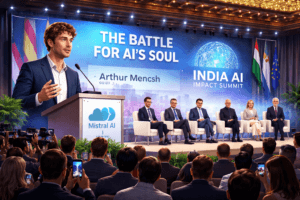
The Battle for AI’s Soul: Mistral’s Mensch Warns of ‘Digital Colonialism’ as US Giants Dominate Delhi Summit
By a European Technology Correspondent
NEW DELHI – The stage was set for a coronation. On the opening day of the India AI Impact Summit, the global tech aristocracy—Sam Altman of OpenAI, Dario Amodei of Anthropic, and Sundar Pichai of Google—shared the dais with world leaders. The air in the cavernous convention hall was thick with the promise of a new epoch. But amid the celebratory talk of artificial general intelligence and data-centre-powered intellectual capacity, a singular voice from Europe injected a note of stark geopolitical realism, warning that the future of humanity’s most powerful creation is at risk of being owned by a cartel.
Arthur Mensch, the soft-spoken but steely CEO of France’s Mistral AI, stepped up to the microphone not to boast of his company’s valuation, but to sound an alarm. “I would say that we are at a risk today of facing too much concentration of power in artificial intelligence,” he told a hushed audience of delegates and dignitaries on Thursday. “We don’t want to be in a world where three or four enormous companies actually own the deployment and making of AI.”
His words landed like a stone in a still pond, creating ripples that contrasted sharply with the bullish, techno-optimist waves generated by his American counterparts. The summit, intended as a global dialogue on the future of technology, had inadvertently become a vivid display of the very fault line Mensch was describing: a world divided between those building the future and those who fear they will merely be renting it.
The $500bn Elephant in the Room
To understand the gravity of Mensch’s warning, one only has to look at the numbers. The United States currently commands a staggering 74 percent of the world’s AI computing power. China follows with 14 percent. The European Union, home to nearly 450 million people and some of the world’s most advanced economies, languishes at just five percent.
This computational asymmetry translates directly into economic and geopolitical leverage. While Mensch’s Mistral AI is valued at a respectable €11.7 billion, it is dwarfed by the financial firepower of its US rivals. OpenAI, which Mensch implicitly referenced, is embarking on the Stargate Project, a monumental $500 billion (€422 billion) investment over the next few years to build out AI infrastructure. This isn’t just about building better chatbots; it’s about owning the digital land, the energy grids, and the computational resources that will power the 21st century.
In his keynote, Altman painted a picture of a future so transformative it borders on the sublime. “If we are right, by the end of 2028, more of the world’s intellectual capacity could reside inside of data centres than outside of them,” he declared. It was a statement of breathtaking ambition, suggesting a future where the locus of human cognition shifts from the biological to the digital—a future owned and operated by his company and a few others.
It was against this backdrop of immense, concentrated capital that Mensch made his case for a decentralised future. He didn’t just see a market monopoly; he saw a threat to global stability. “It [AI] is going to change the equilibrium in the world,” he argued. “And in order for the equilibrium to remain sustainable and stable, we need to ban excessive leverage.”
Mensch’s use of the word “leverage” is critical. In geopolitical terms, leverage is the ability to compel another actor to do something they would not otherwise do. If a handful of American companies control the foundational models and the infrastructure upon which the rest of the world builds its AI applications, they—and by extension, the US government—hold unprecedented sway over the economic and political destiny of nations.
The Human Element: A Tale of Two Visions
The contrast in messaging was not lost on attendees. The American tech leaders, for all their talk of democratising AI and preventing a digital divide, projected an air of manifest destiny. Theirs was a vision of a world reshaped in their image, a future they were building for everyone else.
This competitive, winner-take-all mentality was inadvertently captured in a moment of awkward theatre. During a photo opportunity with Indian Prime Minister Narendra Modi, both Altman and Amodei conspicuously refused to hold hands with their host or each other, standing rigidly as Modi gestured for a unified front. The image, which quickly went viral on Indian social media, was a potent symbol: these are rivals, not partners, locked in a battle where the spoils are the future itself.
Mensch’s vision is fundamentally different. It is rooted in the European tradition of public goods, sovereignty, and regulated markets. He champions open-source models, allowing countries and communities to own and tailor their own AI, rather than relying on black-box systems controlled from Silicon Valley.
“We need to make sure that every country, every economic community, actually has a strategy to own a part of it,” he insisted. This is not just a business strategy for Mistral; it is a survival strategy for a multipolar world. For Europe, which has watched its digital sovereignty erode over the past two decades at the hands of American social media and cloud giants, AI represents a last stand. To cede this ground is to become a permanent digital colony.
The Political Tightrope: Safety, Sovereignty, and the MANAV Principle
As the CEOs debated ownership, the political leaders on stage grappled with a different but related problem: governance. The summit served as a platform for a fascinating triangulation of interests between the Global South, represented by host nation India, a Europe seeking relevance, and the unspoken dominance of the US.
Prime Minister Narendra Modi, ever the strategic pragmatist, positioned India not as a passive consumer but as a potential third way. He unveiled the acronym MANAV—a Sanskrit word for “human”—to outline India’s vision for the technology. It must be Market-friendly, Accessible, Non-discriminatory, Accountable, and Value-based.
This is a shrewd play. India, with its vast pool of engineering talent and its own burgeoning tech ecosystem, is wary of being reduced to a market for Western products. Modi’s message was clear: India wants to co-create, not just consume. It wants the code, the capability, and the capacity to build AI that reflects its own diverse, multilingual, and multi-cultural society.
French President Emmanuel Macron, standing alongside Modi, seized the opportunity to defend Europe’s often-maligned regulatory approach, embodied by the landmark EU AI Act. While critics, including many in the US tech industry, paint the Act as a bureaucratic straitjacket that stifles innovation, Macron offered a compelling counter-narrative.
“Europe is not blindly focused on regulation,” he asserted. “Europe is a space for innovation and investment. But it is a safe space. And safe spaces win in the long run.”
Macron’s argument is that trust is a premium asset. In a world increasingly worried about deepfakes, algorithmic bias, and job displacement, a “safe” AI ecosystem—one with clear rules and accountability—will attract users and businesses seeking stability. He framed the Franco-Indian partnership as a union of civilisational states that can shape an AI “with humanity,” a direct rebuke to the more utilitarian, efficiency-at-all-costs approach emanating from the US.
This sentiment was echoed by Spain’s Prime Minister Pedro Sánchez, who reinforced the human-centric mantra: “AI should expand human freedom, democracy, rights, not undermine them.”
The Unspoken Truth: Why This Summit Mattered
Beneath the polished speeches and diplomatic handshakes, the India AI Impact Summit was a raw display of a world grappling with a power shift unlike any since the Industrial Revolution. The presence of eight EU leaders—from Estonia, Croatia, Finland, Greece, the Netherlands, and Spain—alongside Macron, underscored the bloc’s anxiety. They came to New Delhi not just to talk about AI, but to strengthen ties with a major economic partner following the recent EU-India free trade agreement, hedging against a future where they might be squeezed between US technological might and Chinese authoritarian capitalism.
Mensch’s speech resonated so powerfully because he gave voice to this anxiety. He articulated the fear that without a deliberate strategy for diffusion and decentralisation, AI will not be a rising tide that lifts all boats, but a massive wave that swamps all but the largest vessels.
The summit concluded with commitments to collaboration and high-minded ideals. But the lingering image is not of Modi and Macron holding hands, nor of the promises of a human-centric AI. It is of Altman and Amodei, arms at their sides, refusing to bridge the few inches between them—a perfect metaphor for an industry whose leaders are racing towards a singular, concentrated future, leaving the rest of the world to either catch up or be left behind.
Mensch’s warning is a call to action for a “digital decolonisation.” The question it poses to every nation outside the US-China duopoly is stark: Will you build your own AI future, or will you live in one built for you? The answer will determine the global equilibrium for generations to come.
You must be logged in to post a comment.