
The Baton and the Burden: Why Succession Remains India’s Greatest Family Business Dilemma
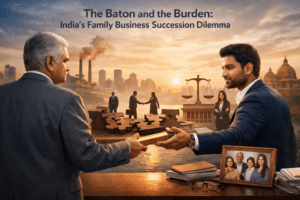
The Baton and the Burden: Why Succession Remains India’s Greatest Family Business Dilemma
In the bustling economic narrative of India, family businesses are the steadfast engines of growth, accounting for over 79% of the national GDP and employing millions. They are celebrated for their resilience, long-term vision, and deep-rooted values. Yet, beneath this veneer of dynastic strength lies a simmering, often painful, paradox: the very families that built these empires frequently struggle to pass them on. Succession planning—the seemingly straightforward act of handing over the reins—is emerging as the most complex and human challenge facing Indian business families today.
A recent PwC survey casts this struggle in stark relief. While an astonishing 91% of Indian family businesses are bullish about growth, a deep fissure exists within. A staggering 52% cite resistance from the senior generation as a primary hurdle in preparing the next generation—a figure nearly double the global average of 29%. This isn’t just a business problem; it’s a deeply emotional tug-of-war where legacy, identity, and familial love collide with ambition, modernity, and change.
The Founder’s Curse: When Business Becomes Identity
To understand this resistance, one must first understand the Indian promoter-founder. For many, like Vijaypat Singhania of Raymond, the business is not an asset; it is an incarnation of their life’s purpose. Built from the ground up in a era of license Raj and economic volatility, these empires were forged through personal intuition, relentless hustle, and an almost patriarchal control. The business is their biography. Letting go, therefore, feels not like a retirement but an erasure of self.
This “founder’s curse” creates a structural impasse. The leadership style that built the company—centralized, instinct-driven, and deeply personal—is often at odds with the professionalized, delegated, and tech-savvy approach the next generation may advocate. The senior generation fears that their legacy will be dismantled; the younger chafes under micromanagement and outdated methods. This clash of paradigms, if not managed, can freeze the transition process for years, leaving the business in a dangerous state of limbo.
When Private Grief Becomes Public Spectacle
The tragedy of these unresolved tensions is how often they spill from boardrooms into courtrooms and headlines, transforming private grief into public spectacle. The Raymond saga is perhaps the most poignant, evolving from a corporate succession to a Shakespearean drama of alleged betrayal and isolation. Similarly, the decades-long dispute within the KK Modi Group, involving accusations spanning boardroom coups to assault allegations, showcases how inheritance battles can eclipse the business itself.
These public battles do more than damage reputations. They erode shareholder confidence, destabilize management, and divert crucial energy and resources from innovation and growth. The Ambani brothers’ very public feud in the mid-2000s, though eventually resolved, sent shockwaves through the markets, illustrating how familial discord can become a national economic concern.
The Silent Challenge: The Disinterested Heir
Beyond the dramatic clashes lies a quieter, perhaps more insidious, challenge: the simply disinterested heir. As veteran banker Uday Kotak has observed, India’s economic “animal spirits” risk fading as the next generation increasingly views wealth management as a more attractive pursuit than empire-building. Many scions, educated at global institutions, return with diverse aspirations—to be venture capitalists, tech entrepreneurs, or simply stewards of a family office rather than operators of a manufacturing plant or a textile mill.
The PwC survey notes that 27% of businesses face a lack of interest from the next generation. This isn’t always rebellion; it is often a misalignment of personal purpose with the family trade. When the founder’s dream is not inherited, it leaves a vacuum no amount of planning can easily fill.
The Gender Bias: An Unaddressed Fault Line
The succession narrative in India is also inherently gendered. The case of Valli Arunachalam in the Murugappa Group laid bare a pervasive bias. Despite being a qualified professional and an equal shareholder, her quest for a board seat was met with resistance, highlighting a traditional preference for male succession. While her battle culminated in a settlement, it forced a national conversation on the vast, untapped leadership potential often sidelined by archaic norms. For many family businesses, true succession planning cannot begin without addressing this foundational inequity.
Navigating the Chasm: Pathways to a Smother Transition
The solution lies not in avoiding the emotional complexity but in institutionalizing processes around it. The most resilient family businesses are those that treat succession not as a singular event but as a deliberate, decades-long journey.
- Start Early, Dialogue Often: Conversations about values, vision, and roles must begin years, if not decades, before the planned handover. This isn’t about naming a successor; it’s about aligning expectations and allowing the next generation to earn their stripes within and outside the family business.
- Professionalize Governance: Introducing independent boards, clear family constitutions, and formal governance structures creates a neutral space. It depersonalizes difficult decisions and ensures the business’s interests are separated from family dynamics. The Kalyani group’ quieter, legal-path settlements, though challenging, show the role of structured mechanisms.
- Create Multiple Pathways: Not every family member needs to be in the CEO’s chair. Defining clear roles—some in business operations, others in governance, philanthropy, or new ventures—can harness diverse talents and reduce conflict. It respects individual aspirations while safeguarding collective legacy.
- Embrace Meritocracy, Especially for Women: Actively mentoring and placing capable female family members in leadership roles based on merit is no longer just progressive; it is a strategic imperative for talent and sustainability.
- Leverage External Guidance: Family business advisors, coaches, and mediators can provide the objective, third-party perspective that is impossible to maintain within the emotional family system.
Conclusion: The Ultimate Test of Legacy
For India’s family businesses, the coming decade is one of unparalleled opportunity. Yet, their greatest threat may not be competition or market cycles, but internal transition. Passing the baton successfully requires moving beyond seeing the business as a personal fiefdom to viewing it as a societal institution with its own perpetual life. It demands from the senior generation the courage to let go, and from the next, the respect to carry forward the core values while forging a new path.
The true legacy of a founder is not just in the empire they built, but in the grace and wisdom with which they pass it on. Navigating this human dilemma with foresight and empathy will determine whether these iconic businesses remain vibrant family legacies or become cautionary tales in the annals of Indian industry. The baton, after all, is not just a symbol of power, but of trust—and that is the hardest thing to hand over.
You must be logged in to post a comment.