
The Assassination of Haytham Ali Tabatabai: Israel’s Strike at the Heart of Hezbollah
On November 23, 2025, Israel escalated its ongoing shadow conflict with Hezbollah by conducting an airstrike in Beirut’s southern suburbs that killed Haytham Ali Tabatabai, the militant group’s chief of staff, a move that critically targeted a key figure responsible for Hezbollah’s post-ceasefire military reconstitution and risked unraveling the fragile year-long truce by striking at the very heart of the organization’s command structure.
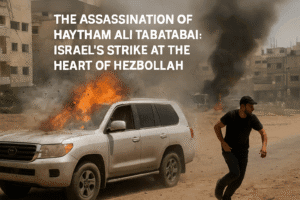
The Assassination of Haytham Ali Tabatabai: Israel’s Strike at the Heart of Hezbollah
On November 23, 2025, an Israeli airstrike in the southern suburbs of Beirut killed Haytham Ali Tabatabai, a senior Hezbollah commander described as the organization’s chief of staff. The strike marked a significant escalation in tensions between Israel and Hezbollah, coming exactly one year after a ceasefire ended their previous conflict .
The attack targeted a residential building in the Haret Hreik neighborhood, a known Hezbollah stronghold, killing five people and wounding 28 others according to Lebanon’s Health Ministry . The Israeli military confirmed it “eliminated the terrorist Haytham Ali Tabatabai, Hezbollah’s chief of general staff,” whom they accused of leading the group’s efforts to rebuild its military capabilities .
The Man Known as Abu Ali Tabatabai
Haytham Ali Tabatabai, better known as Abu Ali Tabatabai, was no ordinary Hezbollah operative. At 57 years old, he was part of Hezbollah’s founding generation, having joined the organization as a teenager in the early 1980s . Born in Beirut to an Iranian father and Lebanese mother, Tabatabai possessed extensive military experience gained across multiple conflict zones in the Middle East .
His career trajectory reveals why Israel considered him such a high-value target:
- Commander of the Radwan Force: Tabatabai previously led Hezbollah’s elite special forces unit, responsible for the group’s most sophisticated military operations .
- International operations: He commanded Hezbollah’s special forces in both Syria and Yemen, providing training and support to Iranian-backed militias and Houthi forces .
- Survivor: Tabatabai had survived an Israeli assassination attempt in January 2015 in Syria’s Quneitra province, an attack that killed senior Iranian IRGC officer Jihad Mughniyeh .
- U.S. Designation: In 2016, the U.S. Department of State designated him as a Specially Designated Global Terrorist, offering a $5 million reward for information about him .
Table: Haytham Ali Tabatabai’s Key Roles in Hezbollah
| Period | Position/Role | Significance |
| Pre-2024 | Commander of Radwan Force | Led Hezbollah’s elite special forces unit |
| 2015-2016 | Operations in Syria & Yemen | Commanded Hezbollah forces supporting Assad and Houthis |
| Post-2024 ceasefire | Chief of Staff | Oversaw rebuilding of military capabilities after war |
| 2023-2024 | Senior operations commander | Rose through ranks as other leaders were eliminated |
The Strategic Context: A Fragile Ceasefire Unraveling
The assassination occurred against a backdrop of deteriorating calm between Israel and Hezbollah. Despite a ceasefire agreement that ended fourteen months of conflict in November 2024, the situation had remained tense throughout 2025 .
Israel had launched increasingly frequent airstrikes in southern Lebanon, claiming they were necessary to prevent Hezbollah from rebuilding its military infrastructure . The Israeli defense establishment argued that Hezbollah had partially reconstituted its offensive capabilities, particularly short- and medium-range rocket systems destroyed during the 2024 war .
From Israel’s perspective, Hezbollah’s rearmament violated both the ceasefire provisions and UN Security Council Resolution 1701, which requires armed groups to withdraw north of the Litani River . Israeli Defense Minister Israel Katz echoed this sentiment after the strike, stating, “We will continue to act forcefully to prevent any threat to the residents of the north and the state of Israel” .
The strike represented the first Israeli attack on Beirut since June 2025, when Israel targeted what it claimed were Hezbollah drone production facilities . This return to striking the Lebanese capital signaled a significant escalation in Israel’s campaign against Hezbollah’s reconstitution efforts.
Hezbollah’s Leadership Crisis and Tabatabai’s Rise
Tabatabai’s assassination continues Israel’s systematic targeting of Hezbollah’s leadership structure. The group suffered devastating losses during the 2023-2024 war, including the killing of its longtime leader Hassan Nasrallah in a September 2024 airstrike in Beirut .
By the time of the ceasefire, Israeli strikes had “wiped out much of Hezbollah’s senior leadership,” creating a power vacuum that Tabatabai had helped fill . He was described as Hezbollah’s “second-in-command after Naim Qassem” . His extensive military and operational experience contrasted with other surviving leaders like Muhammad Haydar, who lacked similar combat credentials .
Tabatabai’s rise to prominence illustrates how Hezbollah has been forced to promote from within its surviving ranks after the devastating leadership losses. According to the Alma Research Center, Tabatabai had replaced Ali Karaki as commander of Hezbollah’s Southern Front following his assassination and was appointed as acting Chief of Staff .
Regional Implications: Between Deterrence and Escalation
The assassination of such a senior Hezbollah figure risks significant escalation, though all parties appear to be calculating their responses carefully.
Hezbollah’s Dilemma
Hezbollah faces a challenging calculus in determining its response:
- Domestic pressure: Lebanon’s economy remains near collapse, and another full-scale war could further damage Hezbollah’s social legitimacy .
- Military readiness: Despite rebuilding efforts, the group may not yet be prepared for another major confrontation with Israel.
- Iranian influence: Tehran, which views Hezbollah as its most capable regional proxy, may prefer to maintain the group as a credible deterrent rather than risking it in another devastating conflict .
Hezbollah’s initial statement described the killing as “a treacherous Israeli attack” but stopped short of announcing retaliation . Earlier, Hezbollah official Mahmoud Qamati had warned that the strike “opens the door to an escalation of assaults all over Lebanon” .
Israel’s Strategic Calculations
For Israel, the strike serves multiple purposes:
- Disrupting command structure: Eliminating experienced commanders like Tabatabai degrades Hezbollah’s operational effectiveness.
- Deterrence signaling: Demonstrating the capability to strike at the heart of Hezbollah’s strongholds reinforces Israeli deterrence.
- Political messaging: With Prime Minister Benjamin Netanyahu facing domestic criticism over security failures, a strong stance against Hezbollah plays well to his political base .
International Reaction
The international community faces renewed challenges in managing Lebanon-Israel tensions. Lebanese President Joseph Aoun condemned the strike and called on the international community to “intervene with strength and seriousness to stop the attacks on Lebanon and its people” .
The United States, which had designated Tabatabai as a terrorist in 2016, was reportedly not notified in advance about the strike, though senior officials indicated Washington had known for days that Israel was planning escalated strikes in Lebanon .
Historical Parallels and the Cycle of Violence
Targeted assassinations of Hezbollah figures have a long history, with varying consequences. The 2008 killing of Imad Mughniyeh led to significant retaliation campaigns, while more recent eliminations have been absorbed with limited response as Hezbollah focused on survival and reconstitution.
What makes Tabatabai’s elimination particularly significant is his central role in Hezbollah’s post-war rebuilding efforts. As chief of staff, he was responsible for restoring the group’s military readiness—a process Israel is determined to disrupt .
The Human Toll and Civilian Impact
Beyond the geopolitical implications, the strike caused significant civilian casualties and damage. The attack on a residential building in a densely populated neighborhood left five dead and 28 wounded . An AFP journalist described debris littering the streets, burned-out cars, and rescue workers evacuating victims, including at least three wounded women .
Such collateral damage reinforces Hezbollah’s narrative of Israel targeting Lebanese civilians, potentially strengthening the group’s domestic position even as it suffers leadership losses.
Looking Ahead: Pathways to Escalation or Containment
The aftermath of Tabatabai’s killing leaves several potential scenarios:
- Controlled escalation: Hezbollah may respond with limited rocket attacks or targeted operations, followed by Israeli retaliation and eventual return to tense calm.
- Strategic restraint: Hezbollah might absorb the loss without major retaliation, prioritizing longer-term rebuilding over immediate response.
- Major conflict: A significant Hezbollah response could trigger another round of intense fighting, though this appears least likely given both sides’ apparent desire to avoid all-out war.
The timing of the strike, coming just days before Pope Leo XIV’s scheduled visit to Lebanon, adds another layer of complexity to the situation .
Conclusion: An Unfinished Conflict
The assassination of Haytham Ali Tabatabai represents more than just the elimination of a senior Hezbollah commander—it symbolizes the unresolved tensions at the heart of the Israel-Lebanon relationship. Despite the ceasefire agreement reached a year earlier, neither side has moved toward genuine accommodation.
Israel remains determined to prevent Hezbollah from regaining its pre-war military capabilities, while Hezbollah continues to rebuild under the protection of Lebanon’s political system. The Lebanese state remains caught between international pressure to disarm Hezbollah and the domestic reality of the group’s entrenched power.
As communities on both sides of the border continue rebuilding from the last war—with Israeli border towns like Metula still missing nearly half their pre-war populations—the cycle of violence threatens to undo fragile progress .
The elimination of Tabatabai may temporarily set back Hezbollah’s military revival, but it does little to address the underlying dynamics that sustain the group’s power in Lebanon. Without a political solution that addresses both Israeli security concerns and Lebanon’s sovereignty, targeted killings alone cannot break the cycle of conflict. As one Israeli officer stationed near the border noted, “As long as the Lebanese army is not there, then we will have to be there” —a succinct summary of the security dilemma that ensures this latest assassination is unlikely to be the last.
You must be logged in to post a comment.