
The Artificial Ceiling: Why India’s Air Quality Index Stops at 500 While the Air Gets Worse
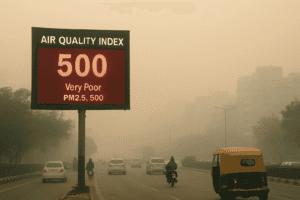
India caps its official Air Quality Index (AQI) at 500, a “severe” classification, due to a policy decision made over a decade ago that was intended to avoid public panic by treating any level beyond this threshold as a uniform emergency. However, this artificial ceiling creates a significant discrepancy, as private international monitors often report far higher numbers, sometimes exceeding 1,000, because they do not impose such a limit.
The contradiction is further compounded by differences in monitoring technology—India uses highly accurate but limited government-grade instruments, while private networks rely on more widespread sensor-based monitors—and by India’s more lenient pollutant thresholds compared to stricter international standards like those from the WHO. Consequently, the 500 cap flattens critical data, failing to communicate the escalating health risks of extreme pollution levels and leaving the public without a true measure of the hazardous air they are breathing.
The Artificial Ceiling: Why India’s Air Quality Index Stops at 500 While the Air Gets Worse
Every November, a familiar ritual unfolds across Northern India. The morning sun struggles to pierce a thick, ochre haze. The air carries a metallic, ashy taste. For millions, the day begins not just with a cup of tea, but with a frantic check of a smartphone screen: just how bad is the air today?
But the answer they get is far from straightforward. On the government’s official SAFAR app, the Air Quality Index (AQI) might read a “severe” 500. Yet, on a global platform like IQAir or a local sensor, the same location could show a staggering 700, 800, or even cross the 1,000 mark.
This numerical dissonance creates a crisis of confidence. Which number is real? Why does the government’s reading seem to hit an invisible ceiling while independent monitors suggest a reality far more toxic? The truth lies at the intersection of science, public policy, and a deliberate design choice made over a decade ago.
The 500 Cap: A Decision Rooted in “Avoiding Panic”
India’s National Air Quality Index (NAQI), launched in 2014, was a significant step towards demystifying pollution data for the public. It converts complex measurements of key pollutants—PM2.5, PM10, Nitrogen Dioxide, Ozone, and others—into a single, color-coded number.
The scale is designed to be intuitive:
- 0-50 (Good): Minimal impact.
- 201-300 (Poor): Breathing discomfort to most people on prolonged exposure.
- 401-500 (Severe): Affects healthy people and seriously impacts those with existing diseases.
And then, it stops.
The cap at 500 was not an oversight but a conscious decision. Dr. Gufran Beig, the founder director of SAFAR, confirms this. “It was assumed that the health impact would be the same no matter how much higher it goes because we had already hit the worst,” he explains. The primary motivation was to avoid creating public panic. In this framework, anything beyond 500 is treated as a uniform “emergency” situation, triggering a standard set of mitigation protocols, like the Graded Response Action Plan (GRAP).
However, this approach creates a critical data flattening effect. When the official AQI reads 500, the actual concentration of PM2.5—the most dangerous microscopic particles that lodge deep in the lungs—could be 300 micrograms per cubic metre, or it could be 900. The public-facing number remains the same, masking the true scale of the hazard.
Beyond the Cap: The Trust Deficit and the Hardware Divide
The discrepancy isn’t just about a numerical cap; it’s also about the very tools used to measure the air.
India’s Central Pollution Control Board (CPCB) relies primarily on Beta Attenuation Monitors (BAMs). These are high-grade, reference-grade instruments that physically draw in air, capture particles on a filter tape, and measure the mass attenuation of beta radiation to provide a highly accurate, gravimetric reading. They are rigorously calibrated and maintained, representing the gold standard for regulatory monitoring.
In contrast, many private and global platforms like IQAir depend on a network of low-cost sensor-based monitors. These devices typically use laser scattering (nephelometers) to estimate particle concentration by measuring how light is dispersed. While improving, these sensors are more susceptible to environmental factors like humidity and require frequent calibration to maintain accuracy.
Abhijeet Pathak, a former scientist with India’s pollution control board, highlights this distinction. “The sensor is a different tool, and it is not possible to calibrate them for every run. Sensor-based air quality monitoring has not yet been approved by the Indian government for regulatory purposes.”
This creates a “trust deficit.” The government labels non-official data as potentially unreliable, while citizens see the higher, more granular numbers from private monitors as a more honest reflection of what they can physically feel—the burning in their eyes and the tightness in their chests.
A Global Comparison: Why India’s “Severe” Isn’t the World’s “Hazardous”
Compounding the confusion is the fact that there is no single, global AQI standard. Different countries have built their indices based on their own pollution challenges, economic considerations, and public health goals.
- The World Health Organization (WHO): Provides health-based guidelines, recommending that 24-hour average PM2.5 levels should not exceed 15 µg/m³. This is a strict, idealistic target for protecting human health.
- United States AQI: Aligns closely with WHO ideals. Its “Good” range (0-50) corresponds to PM2.5 levels up to 12 µg/m³.
- India’s AQI: Its “Good” range (0-50) permits PM2.5 levels up to 30 µg/m³—double the US standard. More critically, the “Severe” category begins at 250 µg/m³ for PM2.5.
This means an AQI reading of 150 in Delhi (classified as “Moderate”) would be considered “Unhealthy” in the US, and a catastrophic violation of WHO guidelines. This divergence makes cross-border comparisons misleading and can downplay the severity of the situation for an international audience.
The Human Cost of the Data Void
The most critical flaw of the 500 cap is its failure to communicate escalating risk. Medical science is clear: the relationship between pollution exposure and health impact is not binary; it’s a continuum.
“The idea that health impacts plateau after 500 is a dangerous oversimplification,” says a pulmonologist from a leading Delhi hospital, who wished to remain anonymous. “When PM2.5 levels jump from 500 to 800 µg/m³, we see a corresponding and sharp increase in emergency room visits for acute asthma attacks, COPD exacerbations, and ischemic heart events. The inflammatory response in the body intensifies. Telling people it’s just ‘severe’ beyond a point is a disservice to public health.”
For the vulnerable—the elderly, children, and those with pre-existing conditions—this lack of granular information can mean the difference between taking extreme precautions and unknowingly engaging in risky behavior, like prolonged outdoor exercise.
The Path Forward: Recalibrating for Reality
Experts agree that India’s air quality framework, largely unchanged since 2009, is due for a comprehensive overhaul.
- Remove the Cap: The most immediate step is to eliminate the 500 ceiling. Countries like China have scales that extend far beyond their highest category, providing a more honest numerical representation of extreme pollution events.
- Revise the Index: A recalibration of the AQI bands themselves, moving them closer to WHO guidelines, would provide a more health-protective and realistic assessment of daily air quality.
- Integrate New Technology: Instead of dismissing them, the government could work to create a hybrid network. Reference-grade BAMs could be used to validate and calibrate a wider, denser network of low-cost sensors, providing hyper-local data that is still scientifically robust. As Abhijeet Pathak notes, “The National Air Quality index will need to be revised if we want to include the sensor-based data.”
Conclusion: Seeing Beyond the Number
In the end, the AQI cap at 500 is a metaphor for a larger challenge: the gap between official data and lived experience. It’s a well-intentioned but outdated tool that now obscures more than it reveals.
For the citizens of Northern India, the real AQI is written in the stinging eyes, the persistent cough, and the obscured skyline. The official number may stop at 500, but the pollution—and its damage to our health and our environment—does not. Recognizing this, and demanding a measurement system that truly reflects the scale of the crisis, is the first step toward breathing easier, in every sense of the word. Until then, when the app reads 500, it’s wise to assume the reality is far, far worse.
You must be logged in to post a comment.