
The Art of the Unreliable Deal: How Trump’s India Tactics Are Accidentally Polishing Canada’s Brand
The Trump administration’s mishandling of a recent trade agreement with India—unilaterally adding false commitments about Russian oil purchases, inflating trade figures to half a trillion dollars, and making unauthorized claims about agricultural concessions that embarrassed Indian officials—has inadvertently highlighted Canada’s comparative reliability as a trading partner, creating an opening for Ottawa to position itself as a trustworthy alternative that honors its commitments and builds relationships based on mutual benefit rather than transactional unpredictability.
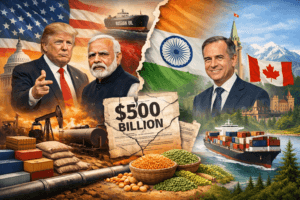
The Art of the Unreliable Deal: How Trump’s India Tactics Are Accidentally Polishing Canada’s Brand
When a “Historic” Trade Agreement Unravels in Public View
The diplomatic cable traffic between Washington and New Delhi earlier this month must have made for some genuinely bewildering reading on the subcontinent.
One day, U.S. and Indian officials stood shoulder-to-shoulder announcing an interim trade agreement they collectively described as a “historic milestone.” It was supposed to reset a relationship that had grown increasingly strained under the weight of tariff disputes and protectionist impulses on both sides. Prime Minister Narendra Modi’s government had reason to celebrate—concessions secured, market access expanded, the world’s two largest democracies finding common commercial ground.
Then the White House published its fact sheet.
And suddenly,那份 carefully negotiated understanding seemed to dissolve into something closer to a wish list written by one party alone.
This wasn’t diplomacy. This was something else entirely—a unilateral rewriting of what had supposedly been mutually agreed, presented to the world as fait accompli. The kind of move that leaves seasoned trade negotiators reaching for something stronger than chai.
The Russian Oil That Wasn’t on the Table
The most explosive addition to Washington’s fact sheet concerned Russian crude. According to the White House, India had supposedly committed to stop purchasing Russian oil—a significant concession that would have fundamentally altered New Delhi’s energy strategy and its delicate geopolitical balancing act between Western powers and Moscow.
There was just one problem: India’s negotiators had never agreed to this. At all. The word “Russia” appeared nowhere in their joint statement. The commitment existed only in the American interpretation of what should have been discussed.
For those watching from Ottawa, the moment carried a particular resonance. Canada has spent months urging India to reconsider its energy relationship with Russia, emphasizing the moral and strategic imperatives of isolating the Kremlin’s war machine. But there’s a vast difference between diplomatic persuasion and what the Trump administration attempted—essentially inventing a concession and announcing it as fact.
The practical reality, which seemed lost in Washington’s fact-sheet frenzy, is that global energy markets don’t reorganize themselves overnight. Countries don’t simply sever decades-old supply relationships because a fact sheet demands it. Russian oil flows into India because it makes economic sense for a rapidly industrializing nation with massive energy needs and price sensitivity. Telling India to stop buying Russian crude is like telling someone to stop breathing—it requires an alternative, and alternatives take time to develop.
Half a Trillion Dollars in Aspirational Trade
Then came the numbers. The White House claimed India had committed to purchasing more than US$500-billion in American products, with energy prominently featured.
Half a trillion dollars.
To put that in perspective, India’s total annual imports from all countries hover around US$600-billion. The suggestion that it would suddenly direct nearly all of that procurement toward the United States alone strained credulity past the breaking point. When Indian officials protested that they had made no such “ironclad commitment,” the U.S. text received a quiet modification: India “intends” to do so. From obligation to aspiration in a single editorial stroke.
This matters beyond the obvious diplomatic embarrassment. Trade relationships built on inflated expectations and misrepresented commitments cannot sustain themselves. When American exporters begin planning around those US$500-billion in anticipated sales, when supply chains reconfigure based on numbers that were never real, the eventual reckoning hurts everyone. Farmers who planted for markets that don’t materialize. Manufacturers who expanded capacity for demand that was always phantom.
The Pulses Problem and Political Embarrassment
Perhaps the most culturally specific point of contention involved pulses—the dried legumes (lentils, chickpeas, beans) that form the protein backbone of the Indian diet. Dal, the lentil soup served in virtually every Indian household, isn’t just food; it’s identity, comfort, and sustenance rolled into one.
The White House fact sheet took the liberty of suggesting that India’s plan to reduce tariffs on American agricultural products included “certain pulses.” This landed like a diplomatic grenade in the middle of Indian domestic politics.
Agriculture Minister Shivraj Singh Chouhan found himself in an impossible position. He had recently announced a new pulses policy framed explicitly as a roadmap toward self-sufficiency. “Currently, we have to import pulses from abroad,” he had told Parliament. “If we have to import pulses from foreign countries, it is not a matter of joy for us, but shame.”
Now, thanks to an American fact sheet, it appeared his government had quietly agreed to do exactly what he had characterized as shameful. Farmers protested. Opposition politicians sharpened their knives. The ruling party scrambled to contain the damage.
The White House eventually removed the pulse reference from its document. But the political fallout in India’s countryside—where farmer sentiment translates directly into electoral outcomes—could not be so easily erased.
For Canadian pulse exporters, who have long supplied Indian markets with lentils and peas, the episode carried an implicit lesson: American unpredictability creates opportunities for those who play straight. When Indian buyers need reliable suppliers, when they need to know that today’s agreement won’t be rewritten tomorrow by someone in Washington with a different agenda, they remember who showed themselves trustworthy.
Textile Preferences and the Bangladesh Comparison
Yet another irritant emerged around textiles. Indian officials discovered, reportedly to their vexation, that the United States had extended preferential trade treatment to Bangladesh on its garment exports. India eventually secured similar concessions, according to local media, but the optics were terrible.
Bangladesh, which has long enjoyed trade advantages in Western markets as a developing nation, represents both competitor and cautionary tale for India. Dhaka’s garment industry has flourished precisely because of preferential access. India, despite its massive textile sector, has struggled to compete on price in markets where Bangladesh faces lower tariffs.
That Washington would grant preferences to Bangladesh while simultaneously negotiating with India sent an unmistakable signal about the transactional nature of the relationship. India wasn’t being treated as a strategic partner whose commercial interests deserved consideration. It was being played against a regional competitor, with concessions dangled and withdrawn based on American convenience.
The Unintentional Branding of Canada
Which brings us to the central irony of this entire episode. By demonstrating, in excruciatingly public fashion, exactly how not to conduct trade diplomacy, the Trump administration has inadvertently elevated the reputation of countries that do things differently.
Canada, in particular, emerges from this mess looking almost quaintly reliable.
This isn’t mere patriotic cheerleading. It’s a reflection of how the world actually works when contracts need signing, shipments need moving, and relationships need sustaining across decades. Business requires predictability. Trade requires trust. When one party demonstrates a willingness to unilaterally rewrite agreements after the cameras stop rolling, every counterparty takes notice—and begins seeking alternatives.
Prime Minister Mark Carney’s January address in Davos captured this positioning with characteristic precision: “We are a stable, reliable partner—in a world that is anything but—a partner that builds and values relationships for the long term.”
The phrasing matters. “In a world that is anything but” acknowledges the Trump-era reality without directly naming it. It recognizes that reliability has become稀缺 enough to constitute competitive advantage. When everyone else is unpredictable, simple consistency becomes remarkable.
The Verma Analysis and the “Carney Moment”
Sanjay Kumar Verma, India’s former ambassador to Canada, has articulated this opportunity with unusual frankness in a recent piece for the India Narrative site. His framing of the “Carney Moment” deserves attention.
Verma points to the concrete numbers: Canadian pulse exports to India already run roughly US$600-million annually. But the potential extends far beyond lentils. India’s appetite for Canadian oil and natural resources is growing, driven by the same economic expansion that has made it the world’s fastest-growing major economy. Its middle class, now numbering in the hundreds of millions, craves exactly the kind of products and services Canadian companies can provide.
“Greater regulatory facilitation of Indian exports in pharmaceuticals, digital services, engineering goods, and refined petroleum products would significantly expand Indian market access in Canada,” Verma writes. “Reciprocally, India is expected to further open market space for Canadian exports in energy resources, potash, pulses, timber, and advanced agricultural technology.”
This is the vocabulary of mutual benefit, not extraction. It describes a relationship where both sides gain, where concessions flow both directions, where agreements stick because they serve everyone’s interests.
And crucially, Verma emphasizes what he calls “people-to-people trust”—the intangible but essential foundation beneath any sustained strategic cooperation. That trust doesn’t develop overnight. It accumulates through countless small interactions, through agreements honored and commitments kept, through the simple reality that when Canadians say something, they mean it.
The Reliability Dividend
What might this reliability dividend look like in practice?
Consider energy. India imports roughly 85 percent of its oil requirements, making energy security a permanent preoccupation for policymakers in New Delhi. Diversifying away from dependence on any single supplier—including Russia—represents strategic common sense. But diversification requires partners who won’t suddenly change terms, who won’t attach unpredictable political条件, who won’t publish fact sheets claiming commitments that were never made.
Canada, with its vast oil sands reserves and expanding LNG capacity, could become exactly that partner. The geography isn’t ideal—shipping from Alberta to Gujarat involves long sea routes. But for a country prioritizing reliability over convenience, the extra transit time may seem a small price.
Or consider technology. India’s digital economy is booming, with everything from payment systems to government services migrating online. Canadian companies offering cybersecurity, AI solutions, and educational technology could find receptive markets—if the trade relationship supports their entry. Indian pharmaceutical manufacturers, meanwhile, seek assured access to Western markets for their generic drugs, which keep healthcare costs manageable in Canada and beyond.
In each case, the fundamental requirement is the same: predictability. Companies making investment decisions need to know that today’s tariff rates won’t triple tomorrow. Governments planning procurement need confidence that supply agreements will hold. Neither can afford the kind of diplomatic whiplash India just experienced with Washington.
The Modi-Trump Bromance, Withering
The personal dimension shouldn’t be overlooked. Donald Trump and Narendra Modi once seemed destined for diplomatic romance. Both are strongmen leaders who project muscular nationalism. Both relish the spotlight and dominate their respective political landscapes. Both have shown willingness to upend conventional norms in pursuit of their objectives.
Their meetings produced the kind of visuals both men crave: stadium rallies, enthusiastic crowds, the optics of two powerful figures bonding on the world stage. The “bromance” label stuck because it captured something真实 about their apparent chemistry.
Yet trade tensions have a way of cooling even the warmest personal relationships. When American demands clash with Indian interests, when Washington’s negotiating tactics leave New Delhi publicly embarrassed, the warmth dissipates quickly. The fact-sheet fiasco suggests this relationship has entered a more transactional phase—and transactionalism, when practiced by Trump, tends to favor the larger party at the smaller’s expense.
For Canada, the lesson is straightforward: personal relationships matter, but institutional reliability matters more. Modi may enjoy Carney’s company or not—that’s largely irrelevant. What matters is that Canadian commitments hold regardless of who occupies 24 Sussex Drive. What matters is that Indian companies can plan around Canadian market access without fearing sudden reversals.
The Limits of Canadian Opportunity
None of this should suggest that Canada can simply walk into the space America vacates and claim India as a natural trading partner. The obstacles remain substantial.
Diplomatic tensions between Ottawa and New Delhi have real roots, including ongoing disagreements over Sikh separatist movements and the treatment of Canadian diplomats. These aren’t trivial irritants; they represent genuine differences in how each country views sovereignty, dissent, and the limits of diplomatic engagement.
Trade negotiations between Canada and India have historically moved at glacial pace, bogged down in bureaucratic细节 and competing domestic interests. The Comprehensive Economic Partnership Agreement, first proposed more than a decade ago, remains unfinished. Neither side has demonstrated the urgency required to push through the final obstacles.
And India itself, for all its economic dynamism, remains a challenging market for foreign companies. Its regulatory environment can be opaque. Its bureaucracy retains formidable power to delay or block projects. Its保护主义 instincts, particularly in agriculture and retail, have frustrated generations of foreign negotiators.
The question is whether the Trump administration’s unreliability creates sufficient impetus to overcome these obstacles. If Indian companies and policymakers conclude that American promises carry diminishing weight, they may invest more heavily in alternatives—including Canada. If they decide that diversifying away from U.S. dependence requires cultivating relationships with other reliable partners, Canada stands to benefit.
The Art of Being Boring
There’s a reason bankers praise boring. There’s a reason investors prize stability over excitement. There’s a reason countries that keep their word, that don’t surprise their partners, that maintain consistent policies across electoral cycles, tend to attract more trade and investment than their raw economic size would predict.
Boring works.
Canada’s challenge is to make boring compelling. To convince India and other trading partners that predictability constitutes its own form of competitive advantage. To translate institutional stability into commercial opportunity. To demonstrate, through actions rather than rhetoric, that “reliable” doesn’t mean “static”—that Canada can adapt to changing circumstances without abandoning its commitments.
The Trump administration’s India misadventure provides an opening. By demonstrating exactly how not to conduct trade diplomacy, Washington has inadvertently highlighted the value of countries that do it better. By rewriting agreements after they’re signed, by claiming commitments that were never made, by treating partners as marks rather than allies, the United States has reminded the world why reliability matters.
Canadian officials should thank their American counterparts—privately, diplomatically, without gloating—for making their case so effectively.
A Final Word on Masti
The columnist who originally chronicled this episode suggested it calls for a little “made-in-Canada masti”—the Hindi word for mischief. There’s something appealing about that framing: Canada as the playful but principled alternative, quietly benefiting from American overreach without overtly exploiting it.
But the better approach may be simpler still. No mischief required. No clever gamesmanship needed. Just steady reliability, consistent messaging, and the quiet confidence that comes from knowing your word means something.
In a world where trade deals get rewritten after the fact, where fact sheets invent commitments that were never made, where half-trillion-dollar promises evaporate into aspiration, being boringly reliable starts to look almost radical.
Canada should lean into that radicalism. Not with triumphalism, not with lectures, not with self-righteousness—just with the steady accumulation of agreements honored and relationships sustained. Let Washington practice the art of the unreliable deal. Ottawa can practice something older and more durable: keeping its word.
The Indian market, like every market, ultimately rewards those who deliver what they promise. In Donald Trump’s America, that simple proposition can no longer be taken for granted. In Canada, it remains the foundation of everything.
That’s not mischief. That’s just the way business should work.
You must be logged in to post a comment.