
The Art of Dissent: Why 200 Venice Biennale Participants Are Risking Everything to Challenge Israel’s Inclusion
The Art of Dissent: Why 200 Venice Biennale Participants Are Risking Everything to Challenge Israel’s Inclusion
There is a particular kind of silence that settles over the Giardini della Biennale in the weeks before opening—the quiet hum of last-minute installations, the murmured conversations between curators adjusting sightlines, the careful arrangement of works that have traveled continents to find their temporary home. It is a silence pregnant with anticipation, with the rituals of artistic celebration that have repeated themselves every two years since 1895.
But this year, that silence has been shattered.
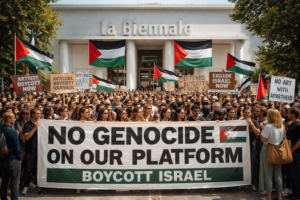
With less than two months until the 61st Venice Biennale opens its gates, nearly 200 artists, curators, and staff participating in the exhibition have done something that disrupts the carefully choreographed machinery of the art world’s most prestigious event. They have signed an open letter demanding Israel’s exclusion from this year’s program—a move that pits them directly against the Biennale Foundation’s leadership, the Italian government, and decades of diplomatic protocol governing national participation.
The letter, released today by the Art Not Genocide Alliance (ANGA) collective, is remarkable not merely for what it demands but for who is demanding it. The signatories include artists representing national pavilions: Yto Barrada for France, Isabel Nolan for Ireland, Asmaa Jama for Somalia. They include artists featured in the central exhibition curated by Carlo Riva: Carolina Caycedo, Gala Porras-Kim, Alfredo Jaar. These are not fringe figures agitating from outside the gates. They are the Biennale itself.
The Artists Speak
“The Venice Biennale’s complicity with the attempted destruction of Palestinian life must end,” the letter states with uncompromising clarity. “No artist or cultural worker should be asked to share a platform with this genocidal state.”
When I reached Carolina Caycedo, the Los Angeles-based Colombian artist whose work appears in this year’s central exhibition, her response came through email with the directness that characterizes her environmentally engaged art practice. “Signing this letter is the minimum I can do in the face of genocide and ecocide,” she wrote.
For Caycedo, the act of signing transcends political gesture. “For me, making art and showing it in art exhibitions is not a neutral process. Art is a form of re-existence and solidarity, and I sign this letter in response to the call from Palestinian civil society to denounce the normalization of Israel’s crimes against human rights and the rights of nature.”
Her words point to something fundamental about this moment: the collapse of the fiction that art exists in a realm apart from politics. For decades, the Biennale has operated on a model of national representation that mirrors the United Nations—a gathering of sovereign states showcasing their cultural production within a framework of diplomatic neutrality. But neutrality, these artists argue, is itself a political position when one state is engaged in what multiple human rights organizations have designated as apartheid and what the International Court of Justice has found to plausibly constitute genocide.
The Weight of Precedent
The letter invokes history with surgical precision. It points to 1974, when the entire Venice Biennale was devoted to the liberation of Chile in protest of General Pinochet’s coup d’état. It reminds readers that apartheid South Africa was excluded from the exhibition from 1968 to 1993. The Biennale has, in other words, a tradition of taking political stands when the moral calculus demands it.
These precedents matter because the Biennale Foundation has consistently argued that it cannot exclude nations recognized by the Italian Republic. In response to ANGA’s 2024 petition—which gathered over 24,000 signatures globally, nearly 2,000 of them from previous Biennale participants—the Foundation issued a statement declaring that the exhibition “may not take into consideration any petition or call to exclude the participation of Israel.”
That was last year. This year, something has shifted.
The Foundation’s recent confirmation that Russia would be included in the 61st Biennale—after being notably absent from the previous two editions—sparked immediate outrage and threatened the institution’s financial support from the European Union. Russia loaned its pavilion to Bolivia in 2024; in 2022, its representing artists withdrew in protest of the invasion of Ukraine. Now, with war continuing in Ukraine, the decision to readmit Russia has exposed what ANGA calls the Biennale’s “clear double standards.”
“The Biennale’s recent attempt to reintroduce Russia has triggered a political crisis in Italy, revealing two facts that can no longer be concealed,” the collective wrote in a press statement. “First, that the Biennale is not a neutral platform but a political space; and second, that it continues to operate through clear double standards.”
If Russia can be excluded for its actions in Ukraine, the logic follows, why not Israel for its actions in Gaza? The question hangs in the air, unanswered by the Foundation, which did not immediately respond to requests for comment.
The Ceasefire That Wasn’t
The timing of this letter matters. It arrives in a moment of fragile, shattered hope. While killing hundreds in Iran and Lebanon in joint attacks with the United States, Israel continues to launch deadly strikes in Gaza and exacerbate the humanitarian crisis in spite of the declared ceasefire and Hamas’s release of remaining Israeli hostages. A recent report from the Lancet Global Health medical journal states that over 75,000 Palestinians were violently killed in the first 15 months of Israel’s decimation of Gaza.
This is the context in which Romanian-born Israeli sculptor Belu-Simion Fainaru will represent Israel in a temporary pavilion in the Arsenale complex—the permanent Giardini pavilion currently undergoing renovation. This is the context in which artists who have spent years developing their work, who have secured the funding and institutional backing required to participate in the world’s most prestigious art exhibition, are now asking to share a platform with him.
A Question of Complicity
Matteo Norzi, co-curator for Perú’s national pavilion featuring the geometric kené art of Shipibo-Konibo artist Soi Biri (Sara Flores), signed the letter along with the artist and his fellow curator Issela Ccoyllo. When I asked about his decision, he turned the question back on those who chose differently.
“To be candid, I believe the question is best directed to those who chose not to sign the petition,” Norzi wrote. “In light of the horror that has happened, and continues to happen, it is difficult to understand how one could choose not to sign.”
This is the uncomfortable truth at the heart of this moment. Every participant in the Biennale will, by April, have to make a choice. Not to sign a petition, perhaps, but about what it means to share a platform. About whether the rituals of artistic celebration can proceed as normal when a state facing credible allegations of genocide is participating in those rituals. About whether complicity is something that happens to artists or something they actively choose.
Caycedo framed it in terms of being “dragged into a position of complicity.” The passive construction is telling. For artists who have spent years preparing for this moment—who have secured institutional backing, developed relationships with curators, created work intended for these specific spaces—the demand to speak out arrives as an imposition. But it is an imposition they are choosing to accept.
The Architecture of National Representation
The Biennale’s structure is itself a political artifact. The Giardini, with its permanent national pavilions arranged like diplomatic missions, embodies a vision of the world organized into sovereign states, each presenting its cultural achievements for international recognition. This model emerged from the same 19th-century nationalism that produced world’s fairs and universal expositions—events designed to showcase the supposed superiority of imperial powers.
Today, that architecture reveals its contradictions. Palestine does not and cannot have a national pavilion. Neither can the Kurdish regions, Catalonia, or any of the countless nations without state recognition. The Biennale’s structure thus reproduces the inequalities of the international state system, granting cultural legitimacy to those with diplomatic recognition while excluding those without.
This is not a new observation, but it gains particular force when a state facing allegations of genocide is granted a platform while the people it is accused of targeting have no such platform. The absence of a Palestinian pavilion is not a neutral fact—it is a structural feature of the Biennale’s organization that reflects and reinforces the political exclusion of Palestinians from international institutions.
Beyond the Signatures
The 178 signatories represent a cross-section of the contemporary art world’s most engaged practitioners. They include artists working in radically different modes—from Caycedo’s environmental installations to Barrada’s archival investigations to Porras-Kim’s institutional critiques to Jaar’s political interventions. What unites them is a willingness to risk the relationships, funding streams, and institutional support that make participation in the Biennale possible.
Because make no mistake: there are consequences to this kind of public dissent. Artists who sign open letters are not always invited back. Curators who speak out find funding harder to secure. Institutions that rely on government support must navigate complex political pressures. The art world talks a great deal about freedom of expression, but it often punishes those who exercise it in ways that threaten established power.
And yet, they sign. Nearly 200 of them, with more reportedly considering adding their names. They sign because, as Caycedo said, art is not a neutral process. They sign because the minimum in the face of genocide cannot be silence. They sign because the alternative is to become complicit in the very systems of exclusion and violence their work often critiques.
What Happens Next
The Biennale Foundation now faces a choice. It can maintain its position that nations recognized by Italy are welcome to participate, regardless of the actions of those nations. It can attempt to wait out the controversy, hoping that the opening of the exhibition will shift attention to the art itself. It can hope that the artists who signed will nonetheless install their work, participate in the preview events, and allow the machinery of the Biennale to proceed as planned.
But the signatories have made clear that they will not simply move on. They have invoked the Biennale’s own history of political engagement, its past exclusions of apartheid states, its recent crisis over Russian participation. They have aligned themselves with Palestinian civil society’s call for cultural boycott. They have forced a conversation that the Biennale’s leadership has spent two years trying to avoid.
For the artists who signed, the calculus is simple. Norzi put it plainly: “In light of the horror that has happened, and continues to happen, it is difficult to understand how one could choose not to sign.”
The Biennale has always been a place where artists ask difficult questions through their work. This year, the question is being asked in open letters and press statements, in the signatures at the bottom of a document, in the simple act of refusing to treat a platform as neutral ground. Whether the Biennale’s leadership will listen remains to be seen. But the artists have made themselves clear: silence is not an option. Neutrality is not possible. And art, when it matters most, demands something more than the quiet hum of preparation in the weeks before the gates open.
You must be logged in to post a comment.