
The Aravalli Tilt: How a 15-Year Judicial Effort to Protect India’s Ancient Hills Was Undone in a Single Ruling
The Aravalli Tilt: How a 15-Year Judicial Effort to Protect India’s Ancient Hills Was Undone in a Single Ruling
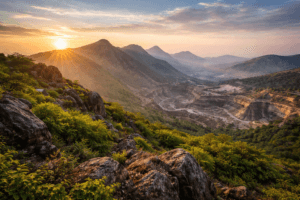
For over 2.5 billion years, the Aravalli range has stood as India’s ancient, stoic backbone. Worn down by eons, these hills are not the soaring, snow-capped peaks of the Himalayas, but a vast, wrinkled landscape of ridges, tablelands, and seasonal streams that cradle the ecosystems of northwestern India. Their true value lies not in their height, but in their form. Yet, a recent Supreme Court order has ignited a profound environmental and legal controversy by choosing to define this complex range by a simple metric: a 100-meter height benchmark. This decision, endorsing a Union Environment Ministry recommendation, didn’t just settle a definition—it seemingly overturned 15 years of deliberate judicial oversight and a hard-won scientific understanding of what the Aravallis are.
The story of this reversal is a masterclass in how ecological protection can be slowly, quietly unraveled, revealing a tension between bureaucratic convenience and geological reality.
The Court’s Own Science: The 2010 Directive and the “3-Degree Slope”
The current controversy has its roots in a 2010 Supreme Court order. At the time, the Court was grappling with rampant, devastating illegal mining in Rajasthan. The state government, arguably under pressure from mining interests, had proposed a convenient definition: only parts of hills rising 100 meters or more from the ground level would be considered “Aravalli” and thus afforded protection.
The justices saw through this. On February 19, 2010, they explicitly rejected this restrictive view. In a crucial directive, they ordered the Forest Survey of India (FSI) to map the entire Aravalli range in Rajasthan, specifying that the survey “shall not be confined to peaks/parts of hills above 100 metres.” The court recognized the Aravallis as a continuous, interconnected ecological system, not a collection of isolated tall peaks.
The FSI, in collaboration with the court’s Central Empowered Committee (CEC), undertook this painstaking task. Using satellite imagery and terrain analysis, they arrived at a definition rooted in geomorphology, not just altitude: Any terrain with a slope of 3 degrees or more, at an elevation above 115 meters from sea level (the base elevation of the Aravalli districts), was to be considered part of the hill system.
The logic was impeccable. A gentle 3-degree slope is a signature of hill terrain, distinguishing it from the flat plains. This definition captured the essence of the range—its foothills, ridges, and connected ecosystems. It included the vital buffers, valleys, and plateaus that form a cohesive hydrological and wildlife unit. Applying this, the FSI identified a vast 40,481 square kilometers across 15 districts as the Aravalli ecosystem in Rajasthan alone. This was science in service of preservation.
The Grim Validation: “Have People Become Hanuman?”**
The court’s worst fears were confirmed by subsequent monitoring. In a shocking 2018 revelation, ground verification by the FSI found that 31 out of 128 sampled hills in Rajasthan had disappeared entirely, likely levelled by illegal mining. A dismayed Justice Madan B. Lokur famously quipped, “Have people become ‘Hanuman’ that they are running away with hills?”
This period represented peak judicial guardianship. The court, armed with FSI’s slope-based data and CEC’s vigilant reports, was pushing for aggressive protection and remediation. The science was clear, the ecological crisis was documented, and the legal mandate was strong.
The Pivot: Committee Politics and the Return of the 100-Meter Benchmark
The turning point came in 2024 when the Supreme Court sought a uniform definition for the Aravallis across four states: Rajasthan, Gujarat, Haryana, and Delhi. A committee was formed, which included the FSI and the CEC. A Technical Sub-Committee (TSC) was led by the FSI itself.
However, a critical shift occurred. According to records, the Environment Ministry’s process began to heavily rely on consensus from the very state governments whose mining activities were being regulated. In October 2024, the ministry reported to the Court that the states “have agreed to the criteria of elevation of 100 m and above… presently followed by Rajasthan.”
Despite the FSI’s prior work and a strong dissent note from the CEC, the ministry championed the old, simplistic 100-meter rule. Amicus curiae made detailed presentations arguing against it, but on November 20, 2025, the Supreme Court accepted the ministry’s recommendation.
In a single stroke, the nuanced, slope-based definition—crafted by the court’s own order and its scientific agents—was set aside in favor of the very benchmark the court had rejected in 2010.
The Real-World Impact: What is Lost When a Hill is Redefined?
This is not a semantic debate. The shift from a “3-degree slope” to a “100-meter height” has catastrophic practical implications:
- Dismembering the Ecosystem: The Aravalli is a web. The lower slopes and foothills act as groundwater recharge zones, prevent desertification, and provide wildlife corridors. Excluding them from protection severs these connections. It turns a living range into isolated, fortress-like peaks surrounded by exploitable land.
- Greenlighting “Hill-Topping”: Mining and real estate interests can now systematically flatten land up to the 99-meter mark without legal repercussion. The gradual erosion of the range’s base, which the FSI’s 31 vanished hills proved was already happening, receives a judicial and administrative sanction.
- Hydrological Sabotage: The Aravallis are crucial for directing rainfall into aquifers that quench cities like Delhi and Gurugram. Destroying the slope structure destroys this natural water harvesting system, exacerbating the region’s acute water crisis.
- A Legal Blueprint for Dilution: The ruling sets a dangerous precedent. It signals that sustained, scientifically-backed judicial protection can be overturned by returning to the negotiating table with state stakeholders and arriving at a more “convenient” consensus.
The Human Insight: The Convenience of a Simple Number
The deeper insight here is about the conflict between complexity and convenience. Managing and protecting 40,481 sq km of intricately mapped slope-based terrain is administratively challenging. It requires robust monitoring, nuanced regulation, and constant expert input.
A 100-meter cutoff is clean. It’s easy to survey, easy to demarcate on a lease document, and easy to regulate—or, cynically, easy to circumvent. It reduces a vast, ancient, life-sustaining ecosystem to a single, crude measurement. In doing so, it reflects a bureaucratic preference for manageable metrics over meaningful conservation.
The tragedy is that the Supreme Court, in 2010, had already recognized this pitfall. It insisted on looking beyond the simple peak to understand the whole body of the hills. Fifteen years later, that wisdom appears to have been forgotten, overshadowed by the allure of inter-state agreement and administrative simplicity.
The Aravalli range has survived the rise and fall of continents. Its latest battle, however, is not against geological forces, but against a human propensity to simplify the complex until it is broken. The November 20 ruling isn’t just a change in definition; it is a test of whether our institutions can develop the stamina to match the patience required to protect what has taken millennia to form. The slopes, now excluded, wait in silent testimony.
You must be logged in to post a comment.