
The Aravalli Battlefield: Why a Technical Definition Has Sparked India’s Latest Environmental War
The Aravalli Battlefield: Why a Technical Definition Has Sparked India’s Latest Environmental War
In the shadow of one of the world’s oldest mountain ranges, a modern conflict is unfolding. Across northern India, from the tech hubs of Gurugram to the historical streets of Udaipur, a wave of protests has erupted. Their rallying cry? “Save Aravalli.” Their target? A seemingly dry, technical definition issued by India’s Supreme Court that activists warn could unravel decades of conservation and open the door to ecological disaster for millions.
At the heart of the controversy is a new, uniform definition of what constitutes the Aravalli hills and ranges. According to the Supreme Court’s November 2025 order, only landforms rising at least 100 meters above the surrounding terrain qualify as an “Aravalli Hill.” Two or more such hills within 500 meters form an “Aravalli Range”. The government argues this brings clarity and strengthens regulation. Protestors see it as a legal loophole that will sacrifice vital, lower-elevation ecosystems to mining and construction, threatening the natural barrier that stands between North India and the advancing Thar Desert.
More Than Hills: The Lifeline of Northwest India
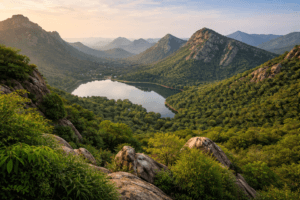
To understand the fury, one must first grasp what is at stake. The Aravalli Range is not merely a scenic backdrop; it is the geological spine and ecological lifeline of northwestern India. Stretching approximately 692 kilometers from Delhi through Haryana and Rajasthan into Gujarat, these are among the oldest fold mountains on Earth, with a history stretching back nearly two billion years.
Its functions are critical and multifaceted:
- The Great Green Wall: It acts as a vital barrier, arresting the eastward march of the Thar Desert into the fertile Indo-Gangetic plains of Haryana, Rajasthan, and western Uttar Pradesh.
- Water Recharge Engine: The range’s fractured and weathered rock acts as a giant sponge, allowing rainwater to percolate and recharge the aquifers that supply groundwater to a vast, water-stressed region. It is the source of rivers like the Chambal, Sabarmati, and Luni.
- Climate Regulator and Green Lung: The forests moderate local temperatures, guide monsoon winds, and act as “green lungs” for the Delhi-National Capital Region (NCR), absorbing pollutants and mitigating the capital’s infamous air pollution.
- Biodiversity Haven: Home to 22 wildlife sanctuaries, three tiger reserves, and species like leopards and the Great Indian Bustard, the range is a crucial wildlife corridor.
For decades, this fragile system has been under siege from legal and illegal mining for minerals like marble, granite, zinc, and sandstone. The resulting deforestation and land degradation have already opened gaps in this natural wall, allowing desert dust to fuel pollution in Delhi-NCR and disrupting local hydrology.
The Definition Dilemma: Clarity Versus Comprehensiveness
The Supreme Court’s intervention stems from a long-standing regulatory quagmire. For years, the four states and union territory spanning the Aravallis—Gujarat, Rajasthan, Haryana, and Delhi—lacked a uniform definition of the range. Haryana had no official definition at all. This inconsistency made regulating mining and enforcing protection orders nearly impossible, as what was protected in one state could be exploited just across the border.
To resolve this, the Court directed a committee led by the Ministry of Environment, Forest and Climate Change (MoEF&CC) to propose a single, objective definition. The committee settled on the 100-meter/500-meter formula, which was already in use in Rajasthan since 2006.
However, critics point to a stark alternative. In 2010, the Forest Survey of India (FSI), an expert body, had proposed a different, ecology-centric definition. It defined the Aravallis based on a slope greater than 3 degrees, a 100-meter foothill buffer, and valleys up to 500 meters wide, with no height threshold. This definition was designed to protect the entire landform system.
The implications of choosing one definition over the other are staggering. An FSI assessment from 2010 revealed that in Rajasthan alone, of 12,081 hills mapped, only 1,048 (about 8.7%) were above 100 meters. Activists argue this means over 90% of the Aravalli landscape—countless low hills, gentle slopes, and scrublands—could now fall outside the protected “Aravalli” zone.
The table below summarizes the key differences between the two competing visions for defining the Aravallis:
| Feature | Supreme Court / Government Definition (Adopted) | Forest Survey of India (FSI) / Activist Definition (Proposed) |
| Core Criteria | Height: 100 meters above local relief. | Slope: >3 degrees, with buffer zones. |
| Defining Philosophy | Objective, map-verifiable clarity for uniform regulation. | Ecological continuity and function of the entire landform system. |
| Scope of Protection | Focuses on distinct, taller hills and their immediate clusters. | Broadly protects hills, slopes, valleys, and connective tissue as one unit. |
| Estimated Coverage | Likely excludes a majority of the Aravalli system’s land area. | Designed to be comprehensive, including low-elevation but ecologically vital areas. |
| Primary Goal | Create a consistent legal standard to regulate mining across states. | Preserve the complete ecological integrity of the range to sustain its functions. |
A Clash of Perspectives: Government Assurance vs. Activist Alarm
The chasm between the government’s narrative and the protesters’ fears defines the current standoff.
The Government’s Stance: Regulation, Not Dilution Union Environment Minister Bhupender Yadav and the MoEF&CC have vigorously defended the new definition. Their argument rests on several key points:
- Strengthened Uniformity: They contend that a single, clear definition is a prerequisite for effective regulation, closing loopholes that varied state rules created.
- Comprehensive Protection Claims: Officials emphasize that the definition protects the entire landform within the lowest contour line of a qualifying hill, including its slopes and foothills. They also state that the “range” definition protects clusters and the land between them.
- Minimal Mining Impact: Minister Yadav stated that only about 0.19% to 2% of the Aravalli’s roughly 147,000 sq km area is even potentially eligible for mining, and only after rigorous studies and approval. He declared, “90 per cent of the Aravalli remain protected”.
- Core “Inviolate” Areas: The government highlights that mining remains absolutely banned in protected forests, wildlife sanctuaries, eco-sensitive zones, tiger corridors, and wetlands.
- Sustainable Management Plan: The Court has ordered a freeze on new mining leases until a “Management Plan for Sustainable Mining” (MPSM) is prepared, which will scientifically zone the landscape for conservation and limited, regulated activity.
The Protestors’ Case: An Existential Threat Environmentalists, resident groups, and opposition politicians view the government’s assurances as dangerously misleading. Their concerns are profound:
- Sacrificing the Functional Landscape: They argue that height is irrelevant to ecology. A 50-meter-high scrubland slope is just as crucial for preventing desertification, recharging groundwater, and providing wildlife habitat as a 150-meter-high rocky peak. By ignoring this, the definition severs the ecological connectivity of the range.
- Opening the Floodgates: The fear is that areas falling outside the new definition will be reclassified as “wasteland” or “barren hill,” making them immediately vulnerable to not just mining, but also real estate and commercial development, especially in high-pressure zones like Delhi-NCR.
- Data and Contradictions: Activists point to confusing and contradictory data from the government—varying estimates of the Aravalli’s total area, the number of districts it covers, and the percentage open to mining—which undermines trust in their claims.
- Historical Precedent: They cite the devastation already visible in parts of Haryana and Rajasthan, where legal and illegal mining has obliterated entire hills and created desert passages. A 2018 report found 31 of 128 hills in one Rajasthan study area had vanished in 50 years. The new definition, they warn, will accelerate this process exponentially.
The Road Ahead: Litigation, Landscapes, and Legacy
The battle has now moved on multiple fronts. Protests continue to swell, backed by opposition leaders who frame the Aravalli’s protection as “inseparable from Delhi’s survival”. Simultaneously, groups like the Aravalli Bachao Citizens’ Movement are preparing Public Interest Litigations (PILs) to challenge the definition in the Supreme Court itself, seeking a return to a more ecological standard like the FSI’s.
The immediate future hinges on the yet-to-be-prepared Management Plan for Sustainable Mining. If it is robust, scientifically rigorous, and treats the Aravallis as a continuous ecological entity rather than a collection of isolated tall hills, it could mitigate some risks. The parallel “Aravalli Green Wall” initiative, a massive afforestation project aimed at restoring 1.1 million hectares by 2027, also represents a positive, if separate, conservation effort.
Ultimately, the Aravalli conflict is a microcosm of a global dilemma: how to balance urgent developmental needs with long-term ecological security. The Indian Supreme Court, in opting for regulatory clarity, has ignited a firestorm over what kind of value we assign to nature. Is a hill only worth protecting if it reaches an arbitrary height, or is its true value measured in the groundwater it stores, the desert wind it blocks, and the clean air it provides to a choking metropolis?
The answer will determine whether one of the planet’s most ancient mountain ranges continues to sustain life for millions, or becomes a footnote in history, lost to the sands it once held at bay.
You must be logged in to post a comment.