
The Approval Race: How Indian Electronics Giants Are Gambling on China Before Getting the Green Light
In a bold and calculated move, leading Indian electronics manufacturers like Dixon Technologies and PG Electroplast have begun constructing factories and importing machinery for joint ventures with Chinese firms, despite not yet having secured the mandatory government clearance under India’s Press Note 3 (PN3) regulations, which are designed to scrutinize foreign investments from neighboring countries on national security grounds. This high-stakes strategy of building first and seeking approval later is driven by the urgent need to access critical Chinese technology for components like display modules and compressors, to avoid costly delays in a fast-growing market, and to capitalize on India’s Production Linked Incentive (PLI) schemes aiming for technological self-reliance. While company executives express confidence in eventual approval, they have prepared contingency plans to operate the facilities as wholly-owned subsidiaries if necessary, highlighting a pragmatic gamble where the pursuit of domestic manufacturing capacity and global competitiveness is currently outweighing the risks of regulatory denial.
The Approval Race: How Indian Electronics Giants Are Gambling on China Before Getting the Green Light
In the high-stakes arena of global electronics manufacturing, a remarkable gamble is unfolding on Indian soil. Leading manufacturers like Dixon Technologies and PG Electroplast are pouring millions into new factories, ordering specialized machinery, and breaking ground on ambitious projects—all while a crucial piece of the puzzle remains missing: the Indian government’s formal approval for their partnerships with Chinese firms.
This high-wire act represents more than corporate impatience. It is a calculated strategy, born of immense opportunity and frustrating delay, that speaks volumes about India’s urgent push for technological self-reliance, the enduring draw of Chinese expertise, and the complex geopolitics shaping the world’s supply chains.
Breaking Ground Before the Ink Dries
The stories of Dixon and PG Electroplast are case studies in corporate confidence and strategic risk-taking.
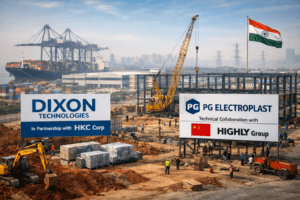
- Dixon’s Display Module Gambit: India’s largest home-grown electronics contract manufacturer has started constructing a factory for manufacturing display modules and has already received shipments of essential machinery at Indian ports. This facility is designed as a 74:26 joint venture with China’s HKC Corp. However, the government clearance required for this partnership under Press Note 3 (PN3) is still pending. Undeterred, Dixon’s Managing Director, Atul Lall, has publicly stated that production at the plant is not contingent on this approval. He has expressed confidence that the approval “will definitely come through,” but has a contingency plan: if it doesn’t, the plant will operate as a wholly-owned Dixon subsidiary.
- PG Electroplast’s Compressor Alliance: Similarly, a major contract manufacturer for air conditioners and appliances, has begun building an air conditioner compressor plant near Pune. This project is planned as a technical alliance with Shanghai Highly Group, a leading Chinese compressor producer. While this alliance doesn’t involve an equity stake, it still awaits crucial regulatory approval from Chinese authorities—a process that has dragged on for nearly a year. The company’s CFO remains “very, very hopeful” for a swift resolution.
For executives, the math is brutally simple. Delays in getting approvals—which can range from three to twelve months or more—directly hamper business plans, derail product roadmaps, and cause significant budget overruns. In a sector growing at 15-20% annually, propelled by massive government incentives, sitting idle is not an option.
The Gatekeeper: Understanding Press Note 3 (PN3)
To grasp the scale of this corporate gamble, one must understand the regulatory hurdle they are jumping. Press Note 3 (2020 Series) is not a routine formality. Instituted in April 2020, it was a strategic response to global economic uncertainty and national security concerns, designed to curb “opportunistic takeovers” of Indian companies.
The rule mandates that any entity from a country sharing a land border with India—which includes China, Pakistan, Bangladesh, Nepal, Myanmar, Bhutan, and Afghanistan—must obtain prior government approval before making an investment in an Indian company. This applies not just to new investments, but also to the transfer of ownership of existing investments that results in beneficial ownership falling to an entity from these countries.
The approval process is multi-departmental and rigorous, examining the proposal’s merits, the business sector involved, the background of the parties, and the proposed governance structure. The government has been particularly cautious in reviewing applications from China (including Hong Kong and Macau), treating each on a strict, case-by-case basis. For Indian companies, this has translated into a painfully slow and unpredictable timeline, creating what one industry executive called “significant operational friction”.
The Irresistible Pull: Why China, and Why Now?
In light of these hurdles, a fundamental question arises: why are India’s champion manufacturers so intent on partnering with Chinese firms? The answer lies in a convergence of technology, timing, and national ambition.
- The Technology Imperative: For all of India’s manufacturing growth, certain high-value components and sophisticated process technologies remain concentrated in China. In displays, precision mechanics, and advanced compressor technology, Chinese firms like HKC and Shanghai Highly possess the prowess, scale, and intellectual property that Indian companies need to move up the value chain. A technical alliance or joint venture is the fastest conduit for this know-how.
- The “Atmanirbhar Bharat” Deadline: India’s vision of a self-reliant economy is not abstract. It is backed by hard numbers and aggressive targets. The government aims to build a $500 billion domestic electronics manufacturing ecosystem by 2030–31. Electronics have already rocketed to become India’s third-largest export category. Production has increased six-fold in eleven years, and exports have jumped eight-fold. To maintain this trajectory and capture the next wave of growth in components and semiconductors, Indian companies cannot build everything from scratch. Strategic partnerships are essential to accelerate the learning curve.
- The Incentive Wave: The government is fueling this fire with unprecedented financial support. The Production Linked Incentive (PLI) scheme for 14 key sectors, with an outlay of ₹1.97 lakh crore (over $26 billion), is designed to make domestic manufacturing globally competitive. The newly boosted Electronics Components Manufacturing Scheme (ECMS), with an outlay now raised to ₹40,000 crore, specifically targets the component ecosystem Dixon and PG are entering. The 2026 budget further emphasized manufacturing, with significant allocations for semiconductors, electronics, and white goods. Companies are racing to align their projects with these incentive windows, making delays especially costly.
The Tightrope: Geopolitics and Calculated Risks
This corporate strategy does not exist in a political vacuum. It is a tightrope walk over the complex and often tense relationship between New Delhi and Beijing.
- The Contingency Plan: The most telling aspect of this strategy is the built-in escape clause. Both Dixon and PG Electroplast have explicitly stated they are prepared to go it alone if approvals fail. This is a critical risk-mitigation tool. It signals to the government that the primary goal is building domestic manufacturing capacity—a national objective—and that the Chinese partnership, while valuable, is a means to that end, not the end itself. It transforms the narrative from “dependent on China” to “leveraging global expertise for India’s gain.”
- The Investor Calculus: The market is watching closely. Companies like Dixon trade at high valuations (a P/E ratio around 70x) based on growth expectations fueled by these expansions. Proceeding without approval is a bold signal of management’s conviction, but it also raises execution risk. A denial could force a costly recalibration—divesting machinery, renegotiating contracts, or proceeding without the intended technological synergy. The confidence of leaders like Atul Lall could be seen as either visionary or overconfident.
- The Broader Context: It is crucial to note that India’s FDI policy is not monolithic in its restrictiveness. While PN3 creates a high bar for neighboring countries, the overall framework is liberal. For most sectors, 100% FDI is permitted under the automatic route. The government has progressively liberalized sectors like defense, insurance, and telecom to attract foreign capital. This highlights that the scrutiny on China is a targeted, security-driven exception within a generally open investment climate.
The Road Ahead: Integration or Isolation?
The moves by Dixon and PG Electroplast may be a harbinger of a new, more pragmatic phase in India’s industrial policy. It suggests a potential pathway where security scrutiny and economic pragmatism can co-exist.
For the government, approving these specific, capacity-building, job-creating technical alliances—while maintaining the right to block outright acquisitions or investments in sensitive sectors—could strike that balance. It would allow India to access critical technologies faster, deepen its manufacturing moat, and integrate more securely into global value chains.
For now, the cranes are swinging and the foundations are being laid. The confidence of India’s corporate champions is palpable. They are betting that by the time their factories are roof-ready, the regulatory approvals will be waiting at the door. Their gamble is not just on a government file moving faster; it is on India’s overarching ambition to become a global electronics powerhouse, an ambition that may ultimately demand a more nuanced approach to the very partners it views with strategic caution. The success or failure of this high-stakes bet will resonate far beyond factory walls, shaping the blueprint for how emerging technological giants navigate a fragmented world.
You must be logged in to post a comment.