
The AlphaFold Gambit: One Man, His Dying Dog, and the World’s First DIY mRNA Cancer Vaccine
Australian tech entrepreneur Paul Conyngham, after his dog Rosie’s cancer failed to respond to conventional chemotherapy, used AI tools like ChatGPT to devise a plan and Google DeepMind’s AlphaFold to analyze her genetic mutations, enabling him to collaborate with researchers to create a custom mRNA cancer vaccine. Following months of navigating ethics approvals, the treatment successfully shrank Rosie’s tumour, buying her significant time and quality of life, while his pioneering story highlights the transformative potential and profound ethical and regulatory challenges of democratized, AI-driven biotechnology.
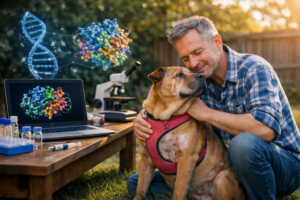
The AlphaFold Gambit: One Man, His Dying Dog, and the World’s First DIY mRNA Cancer Vaccine
The sterile, beige walls of the veterinary oncology ward had become a landscape of quiet despair. For months, Paul Conyngham had walked this path, the leash of his beloved Staffordshire Shar Pei cross, Rosie, held loosely in his hand. They had followed the established protocol: the consultations, the soul-crushing bills, the grueling rounds of chemotherapy. Each treatment was a small battle fought with the hope of winning a larger war. But the tumour on Rosie—a palpable, unwelcome presence that had invaded their lives—refused to retreat. It held its ground, a grim testament to the limits of modern veterinary medicine.
The oncologist’s final words were delivered with professional kindness, but they landed like a death sentence: there was nothing more they could do. For Conyngham, a 57-year-old Australian tech entrepreneur with 17 years of experience in machine learning, that sentence wasn’t an end. It was a prompt. It was the problem set.
In a story that reads like the script of a futuristic thriller but is grounded in the very real and rapidly evolving capabilities of artificial intelligence, Conyngham embarked on a desperate, ingenious, and ethically complex mission. Armed with ChatGPT, Google DeepMind’s revolutionary AlphaFold, and a father’s unrelenting love, he decided to build his dog a cure.
From Chemo to Code: A New Kind of Treatment Plan
Rosie, a rescue dog adopted from a shelter in 2019, was more than a pet; she was family. When the cancer diagnosis came in late 2024, the initial response was conventional. Conyngham, like any devoted owner, opted for the best care available, spending thousands of dollars on chemotherapy. But when that failed, his professional instincts kicked in. In the world of data science, if a standard model isn’t working, you build a custom one.
“I went to ChatGPT and came up with a plan on how to do this,” Conyngham later recounted. This wasn’t a casual query. It was the beginning of a collaboration between a human expert and a large language model, using the AI not as a simple search engine, but as a brainstorming partner, a research assistant, and a guide through the labyrinthine world of modern biotechnology.
The plan was audacious: create a personalized mRNA cancer vaccine for Rosie. The same technology that propelled Moderna and Pfizer’s COVID-19 vaccines to global prominence would be repurposed, not to fight a virus, but to teach Rosie’s own immune system to recognize and destroy her cancer.
The first step was data acquisition. Conyngham contacted the Ramaciotti Centre for Genomics at the University of New South Wales (UNSW). For a fee of $3,000 Australian dollars, they performed genomic sequencing on Rosie. This involved sequencing two sets of DNA: one from a healthy tissue sample, providing the blueprint of her normal cells, and one from a biopsy of the stubborn tumour. As Conyngham explained, it was like having the original factory specifications for a car’s engine and comparing them to the same engine after 300,000 kilometres of hard driving. The goal was to identify the specific “damage”—the genetic mutations—that were causing the cancer cells to run amok.
Decoding Life’s Language with AlphaFold
Identifying a list of mutations from genomic data is one thing. Understanding what those mutations do is another, far more complex challenge. A mutation is a typo in the genetic code, and that typo leads to a misshapen or malfunctioning protein. To design a vaccine, Conyngham needed to know which of these malfunctioning proteins—known as neoantigens—were present on the surface of the cancer cells. These neoantigens are the flags that an mRNA vaccine can train the immune system to attack.
This is where AlphaFold, the artificial intelligence program developed by Google DeepMind, became the game-changer. AlphaFold has effectively solved a 50-year-old grand challenge in biology: predicting a protein’s intricate three-dimensional structure from its amino acid sequence. Before AlphaFold, determining a protein’s structure was a painstaking, time-consuming, and expensive process often involving techniques like X-ray crystallography.
Conyngham fed the data on Rosie’s mutated genes into AlphaFold. The AI analysed the sequences and predicted the shape and function of the resulting abnormal proteins. It allowed him to visualize the enemy. By comparing these neoantigen structures to known databases, he could identify which ones were most likely to be immunogenic—that is, which ones would stick out like a sore thumb to Rosie’s immune cells and provoke a strong response. This process, which might have taken a professional lab team months or years of research, was compressed into a matter of weeks, powered by a publicly accessible AI tool.
“I’m under no illusion that this is a cure, but I do believe this treatment has bought Rosie significantly more time and quality of life.”
- Paul Conyngham
With a shortlist of viable neoantigen targets in hand, Conyngham collaborated with researchers at UNSW to design the corresponding messenger RNA sequence. This synthetic mRNA was a set of instructions, coded to tell Rosie’s cells to produce a harmless copy of that specific cancer neoantigen. Once injected, her cells would become miniature vaccine factories, churning out the neoantigen and displaying it to her immune system. Her immune cells, acting as vigilant scouts, would see this foreign flag and mount a full-scale response, learning to identify and destroy any cell—including the real tumour cells—that carried it.
The Paperwork is the Hardest Part
Building the vaccine was only half the battle. The next hurdle was a testament to the stark reality that exists between a brilliant idea and its execution. Before a single drop of the custom mRNA could be synthesized and injected, Conyngham had to navigate a formidable wall of regulation.
To conduct a drug trial on Rosie—even a trial of one, for a dog he owned—he needed ethics approval. This wasn’t a process designed for a tech-savvy owner with a plan. It was a bureaucratic labyrinth built for institutions and pharmaceutical companies.
For three months, Conyngham dedicated two hours every single night to typing up a 100-page document for the ethics committee. This wasn’t a task ChatGPT could do for him. It required meticulous detail: outlining the scientific rationale, the manufacturing process, the proposed dosage, the potential side effects, and the plan for monitoring and aftercare. It was a masterclass in perseverance, a love letter to his dog written in the dry, precise language of regulatory compliance.
Finally, in December 2025, the approval came through. Rosie received her first injection.
A New Frontier and its Unanswered Questions
The results, while not a fairytale ending, were nothing short of remarkable. The primary tumour, the one that had resisted all conventional treatment, began to shrink. It was proof of concept, a living, breathing testament to the power of democratized, AI-assisted biotechnology. Conyngham is realistic, acknowledging that Rosie’s cancer is advanced and that this is not a guaranteed cure. But it has bought her time—precious, high-quality time—and he is already working on a second vaccine to target a remaining tumour.
“There’s actually a chance that for some cancers, we can change it from being a terminal sentence to a manageable disease,” he said, articulating a hope that resonates far beyond his own backyard.
Paul Conyngham’s story is more than a heart-warming tale of a man and his dog. It is a profound case study for a future that is already arriving, raising a host of complex questions that society is only beginning to grapple with.
- The Democratization of Biotechnology: For the first time in history, tools like AlphaFold and large language models are putting immense power into the hands of individuals. What happens when a determined amateur can do what was once the sole purview of billion-dollar pharmaceutical companies? This could lead to incredible innovation, but also to chaos.
- The Ethics of DIY Medicine: Conyngham’s actions were driven by desperation and love, and he did it within the bounds of an ethics approval process. But his path illuminates a potential future of unregulated, “garage” biologics. What happens when someone with less expertise or noble intentions tries the same thing? The potential for harm—both to the subject and to public trust in science—is immense.
- The Regulatory Vacuum: Our current regulatory frameworks are built for a slow, centralized, industrial model of drug development. They are utterly unprepared for a world of N=1, personalized treatments designed by AI and manufactured on demand. How do we create a new framework that ensures safety without stifling the life-saving potential of this approach? The three months Conyngham spent on paperwork for his own dog is a clear signal that the system needs to evolve.
- The Role of AI in Discovery: Conyngham acted as a conductor, orchestrating a symphony of AI tools. ChatGPT helped him synthesize vast amounts of knowledge and formulate a plan. AlphaFold provided the critical structural insights. This partnership between human intuition and machine intelligence represents a new paradigm in scientific discovery. Demis Hassabis, the CEO of Google DeepMind, praised Conyngham’s efforts, recognizing that a tool his team built for the world was used to solve a deeply personal, life-or-death problem.
For now, in a home in Australia, a dog named Rosie is living a life she was told she wouldn’t have. Her story is a beacon of hope, a warning, and an invitation. It forces us to look at the AI tools on our desks and in the cloud not just as productivity aids, but as potential keys to unlocking the most profound secrets of biology. It asks us a difficult question: If we have the power to rewrite the code of life to save the ones we love, who gets to decide how, when, and for whom that power is used? Paul Conyngham has already given his answer. The rest of the world is just starting to write its own.
You must be logged in to post a comment.