
The AI Tipping Point: How Anthropic’s Cowork Plugins Sparked a Global Market Reassessment and What It Means for the Future of Work
Anthropic’s launch of specialized AI plugins for its Claude Cowork agent, designed to autonomously handle complex tasks in sales, legal, finance, and customer support, triggered a global market sell-off and profound investor anxiety, particularly for India’s IT services sector. The announcement signaled a shift from AI as a supportive tool to a direct, low-cost competitor capable of automating the very routine, labor-intensive processes that form the core of traditional outsourcing models. This has exposed the structural vulnerability of business models built on human labor arbitrage, forcing a critical reassessment where companies must rapidly adapt by moving up the value chain into strategic consulting and developing proprietary AI assets to avoid being disintermediated.
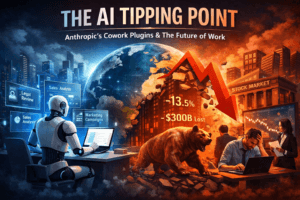
The AI Tipping Point: How Anthropic’s Cowork Plugins Sparked a Global Market Reassessment and What It Means for the Future of Work
A single product announcement from an AI startup has sent $300 billion in market value evaporating from software companies across three continents. In what analysts have grimly dubbed the “SaaSpocalypse,” Anthropic’s launch of specialized AI plugins has triggered a fundamental reassessment of how technology will reshape—or potentially replace—entire industries . The tremors were felt from Wall Street to Dalal Street, exposing the vulnerabilities of traditional business models in an AI-first world.
Beyond Chatbots: A Shift to Agentic Workflows
On January 30, 2026, Anthropic announced plugin support for its Claude Cowork agent, moving far beyond conversational chatbots. Claude Cowork, itself launched just weeks prior, is an “agentic” tool designed to plan, execute, and iterate through multi-step workflows autonomously . The new plugins transform this general assistant into a specialized co-worker for nearly every corporate department.
Table: Anthropic’s Initial Suite of Cowork Plugins
| Plugin | Core Function |
| Legal | Review documents, flag risks, track compliance, handle NDA triage . |
| Sales | Research prospects, prepare for deals, follow defined sales processes . |
| Marketing | Draft content, plan campaigns, manage product launches . |
| Enterprise Search | Unify search across company emails, chats, documents, and wikis . |
| Customer Support | Triage issues, draft responses, surface solutions, create knowledge base articles . |
| Finance | Analyze financials, build models, track key metrics . |
The key innovation is customization without coding. Using a “Plugin Create” tool, teams can instruct Claude on specific workflows, which tools and data to use, and create simple slash commands to trigger complex automations . Matt Piccolella from Anthropic’s product team explained the goal is “giving the maximum number of people” the ability to use this power . This moves AI from being a supportive tool to becoming an integrated owner of core workflows, capable of performing tasks that previously required interfaces from platforms like Salesforce or ServiceNow .
The Global Market Tremor: From “AI Helps” to “AI Replaces”
The financial market’s reaction was swift and severe, revealing a seismic shift in investor sentiment.
Table: Market Impact of Anthropic’s Announcement (Select Companies)
| Company | Sector | Reported Share Decline | Source |
| Thomson Reuters | Legal/Publishing | 18% (US), 16% (Toronto) | |
| RELX (owns LexisNexis) | Legal/Publishing | 14-15% | |
| Wolters Kluwer | Legal Analytics | 13% | |
| Sage | Software | 10% | |
| Infosys (ADR) | IT Services | ~6% | |
| Wipro (ADR) | IT Services | ~5% |
A Goldman Sachs basket of U.S. software stocks fell 6%, its worst drop since April, while two S&P indices tracking software and financial data lost a combined $300 billion . As Jeffrey Favuzza of Jefferies noted, the sentiment has pivoted from “AI helps these companies” to “AI replaces these companies” .
This panic stems from a fundamental competitive threat: Anthropic is moving from model supplier to application-layer competitor. Companies that built businesses by creating specialized software “wrappers” around third-party AI models now face the unsettling reality that the model builder itself can easily move into their space . As John Ruffolo of Maverix Private Equity observed, “You are building your business on top of another business that could compete against you” .
Indian IT at the Crossroads: An Existential Challenge to the Labor-Arbitrage Model
For India’s $283 billion IT services sector, the announcement struck a particular nerve . The industry’s foundational model—deploying large, skilled workforces to manage clients’ routine technical, analytical, and support processes—appears directly in the crosshairs of agentic automation.
The NIFTY IT index fell 6.6%, with bellwethers like Infosys dropping nearly 8% . Analysts immediately pinpointed the core vulnerability: “As Indian enterprises integrate Claude for critical coding workflows, dependency on large vendor teams may decline, squeezing billable hours and margins,” said Systematix Group’s Ambrish Shah . The threat extends to the entry-level talent pipeline, as AI automates routine development, testing, and maintenance tasks that have traditionally served as a training ground for new engineers .
The challenge is structural. Indian IT majors have been services-led rather than product-driven, with competition often based on scale and efficiency rather than proprietary technology . AI automation directly attacks this efficiency-based value proposition. The market is signaling that adaptation is no longer optional. As Stephen Yiu of the Blue Whale Growth Fund stated, “This year is the defining year whether companies are AI winners or victims” .
The Legal Industry: The First Domino to Fall
The legal sector served as the epicenter of the market quake, offering a clear case study of AI’s disruptive potential. Anthropic’s legal plugin promises to automate document review, compliance workflows, and legal briefing—high-volume, repetitive tasks that form the backbone of many legal service contracts .
This move pressures two groups simultaneously:
- Traditional legal information giants like Thomson Reuters and RELX, whose lucrative databases and research tools could be bypassed by an AI that synthesizes information directly.
- AI legal tech startups like Harvey AI and Spellbook, which themselves rely on foundation models from Anthropic or OpenAI to build their applications .
Scott Stevenson, co-founder of Spellbook, offers a nuanced perspective, arguing that specialized providers will persist because “Spellbook is like a toaster. We do one thing, and we do it well” . However, he acknowledges the brutal new reality: “The competition in AI is the most ruthless competition in the history of technology… The only moat right now is speed” .
The Path Forward: Adaptation in the Age of Agentic AI
The panic selling may reflect short-term fear, but it highlights a long-term imperative. Survival for incumbent companies—whether software providers, IT services firms, or professional service agencies—hinges on a strategic pivot.
For Indian IT and global service providers, the roadmap must include:
- Moving Up the Value Chain: Shifting from task-based outsourcing to owning business outcomes and consulting on AI-powered transformation.
- Building Proprietary AI Assets: Developing unique datasets, domain-specific models, and automated platforms that cannot be easily replicated by a general-purpose AI.
- Reskilling at Scale: Transitioning armies of engineers from performing automatable tasks to training, overseeing, and refining AI agents—becoming “AI supervisors” rather than task-doers.
For software companies, the strategy involves:
- Deepening Vertical Integration: Moving beyond being an “AI wrapper” to owning critical, specialized workflows that are difficult for a general model to replicate without deep industry context.
- Leveraging Existing Trust and Data: Utilizing entrenched client relationships and proprietary industry data to build moats that pure-play AI model providers lack.
Anthropic itself includes the disclaimer that its legal tool “does not provide legal advice” and that outputs “should be reviewed by licensed attorneys” . This underscores that human oversight, judgment, and accountability remain irreplaceable. The most resilient future belongs not to companies that resist AI, but to those that redefine their role around uniquely human skills—strategic thinking, complex problem-solving, ethical oversight, and client relationship management—while leveraging AI to handle scale and routine.
The “SaaSpocalypse” is not an endpoint, but a stark warning. It marks the moment the market internalized that AI’s primary impact may not be augmentation, but disintermediation. The race to adapt has officially begun.
You must be logged in to post a comment.