
The AI Arms Race Heats Up: Anthropic’s Strategic Gambit in India’s Booming Market
The AI Arms Race Heats Up: Anthropic’s Strategic Gambit in India’s Booming Market
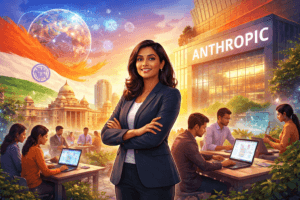
In a move that signals both the immense potential and fierce competitiveness of India’s artificial intelligence landscape, Silicon Valley AI safety pioneer Anthropic has made a decisive play. The appointment of Irina Ghose, a 24-year Microsoft veteran and former Managing Director of Microsoft India, as its new India head is far more than a routine executive shuffle. It is a calculated strategic masterstroke, a declaration of intent that places India at the epicenter of the global AI development race. This decision, culminating in the opening of Anthropic’s first Indian office in Bengaluru in early 2026, reveals a complex web of corporate ambition, local talent, and geopolitical tech dynamics.
Decoding the Ghose Appointment: More Than Just a Hire
Irina Ghose is not merely an executive; she is an institution within India’s technology sector. Her quarter-century at Microsoft equipped her with an unparalleled understanding of the Indian market’s unique contours—from navigating enterprise sales cycles with sprawling conglomerates to grasping the digital aspirations of a billion-strong consumer base. Her recent two-year tenure as India MD means she brings fresh, relevant relationships and on-the-ground insights that are pure gold for an incoming player.
For Anthropic, a company whose DNA is woven with threads of rigorous AI safety research and a methodical approach to deployment, Ghose provides the critical local catalyst. She bridges the gap between Anthropic’s foundational, safety-first ethos and the fast-paced, solution-oriented demands of the Indian market. Her hire sends a powerful message: Anthropic is serious about building not just a sales outpost, but a deeply integrated, culturally intelligent operation. It’s a move that prioritizes trust and relationships, essential currencies in a market skeptical of foreign tech solutions that fail to understand local nuances.
Why Bengaluru, and Why Now?
The choice of Bengaluru, India’s Silicon Valley, is predictable yet profound. The city is a vortex of engineering talent, home to the R&D centers of virtually every global tech giant and a thriving startup ecosystem hungry for cutting-edge AI tools. Anthropic’s establishment there is a direct talent acquisition pipeline. It allows them to tap into world-class computer scientists, linguists, and engineers who can help refine their flagship AI, Claude, for the linguistic and cultural diversity of India—a task of monumental complexity.
The timing is equally critical. India is experiencing an unprecedented AI inflection point. Enterprise adoption is moving beyond pilot projects into core operational transformation, while a vast young, tech-savvy population is rapidly embracing consumer AI applications. The government’s “AI for All” vision and push for digital public infrastructure create a fertile, if regulated, environment. By entering in early 2026, Anthropic positions itself at the genesis of this growth curve, aiming to shape habits and architectures before they become entrenched.
Claude’s Foothold: The Programming Niche and Beyond
A key insight from the Reuters report is that India is already Anthropic’s second-largest market for Claude, with usage “primarily focused on technical applications such as programming.” This is a crucial detail. It indicates that Claude has organically found product-market fit within India’s vast developer community, likely prized for its reasoning capabilities, large context window, and perceived reliability compared to more erratic alternatives.
This developer-led adoption is a classic and powerful market entry strategy. By becoming the indispensable tool for the architects of India’s digital future—its coders—Claude embeds itself into the very foundation of the country’s tech stack. These developers, building solutions for Indian businesses and consumers, will naturally propagate Claude’s capabilities upstream. Ghose’s challenge will be to leverage this strong technical beachhead to expand into adjacent verticals: financial services (for regulatory analysis and risk modeling), healthcare (for medical research and administrative automation), education (for personalized tutoring), and content creation across India’s dozens of major languages.
The Competitive Arena: A Clash of Titans on Indian Soil
Anthropic’s entry, particularly with Ghose at the helm, dramatically reshapes India’s AI competitive board.
- Microsoft (The Former Employer): This move sets up a fascinating direct confrontation. Microsoft, with its deep partnership with OpenAI (ChatGPT, GitHub Copilot), massive Azure cloud infrastructure, and entrenched enterprise presence, is a behemoth. Ghose’s intimate knowledge of Microsoft’s India strategy, strengths, and potential blind spots is Anthropic’s secret weapon. The battle for enterprise AI contracts will now be a high-stakes chess match.
- Google (The Investor & Competitor): The dynamic here is complex. Google, a major backer of Anthropic, also aggressively pushes its own Gemini AI and Vertex AI platform in India. While there may be alignment in challenging Microsoft, Google and Anthropic will inevitably compete for the same enterprise mindshare and developers. India could become a testing ground for this nuanced investor-competitor relationship.
- Domestic Champions: Companies like Reliance Jio (in partnership with NVIDIA), Tata Group, and Infosys are building formidable AI capabilities tailored for India. They combine global-scale tech with hyper-local understanding. Anthropic, through Ghose, must decide whether to see them as partners (licensing Claude) or competitors.
The Human Insight: What This Means for India’s Tech Ecosystem
Beyond corporate intrigue, Anthropic’s investment is a significant vote of confidence in India’s human capital. It affirms that India’s role is evolving from a backend services hub to a front-line innovation center for foundational AI technologies. The Bengaluru office will likely focus on applied AI research, model fine-tuning for Indian languages, and developing context-aware solutions for local challenges—from agriculture to bureaucratic governance.
For Indian developers and businesses, this intensifying competition is a boon. It means more choices, better-tailored models, competitive pricing, and accelerated innovation. It also raises critical questions about data sovereignty, model bias, and the ethical deployment of AI—areas where Anthropic’s safety-focused philosophy could set important standards.
Conclusion: A New Chapter in the Global AI Narrative
Anthropic’s appointment of Irina Ghose and its formal entry into India is a watershed moment. It transcends a simple market expansion announcement. It represents the globalization of the AI safety debate, the strategic poaching of institutional knowledge, and the recognition that the future of AI will be written not just in San Francisco and Beijing, but also in Bengaluru and Mumbai.
The coming years will see Ghose navigate regulatory frameworks, assemble local teams, and translate Anthropic’s principled approach into commercial success. Her success or failure will be a key indicator of whether Western AI labs can truly localize their offerings and compete in the intricate, high-growth, and fiercely contested arena that is India. One thing is clear: the global AI race has found a new, critical battleground, and the stakes for every player involved have just been raised.
You must be logged in to post a comment.