
The Adobe Effect: Why Giving Away Photoshop, Firefly, and Acrobat for Free to Millions of Indian Students Changes Everything
The Adobe Effect: Why Giving Away Photoshop, Firefly, and Acrobat for Free to Millions of Indian Students Changes Everything
There is a subtle but profound shift happening in the classrooms and hostel rooms of India. It’s the shift from being a passive consumer of technology to becoming an active creator powered by artificial intelligence. Yesterday, at the India AI Impact Summit in New Delhi, Adobe lit the fuse on this transformation with an announcement that could redefine the country’s creative and economic landscape.
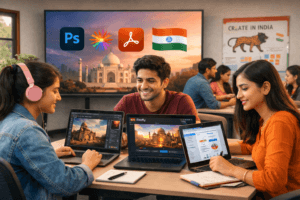
In a strategic move that bridges corporate ambition with national policy, Adobe announced it is making its flagship, AI-powered software—including Photoshop, Acrobat Pro, and the generative AI engine Firefly—available to students for free through accredited higher education institutions across India.
On the surface, this reads like a standard corporate social responsibility (CSR) initiative or a clever market-grabbing tactic. But to view it solely through that lens is to miss the magnitude of what is unfolding. This initiative, launched in partnership with the Government of India and NASSCOM FutureSkills Prime, is a multi-layered bet on the future of work, the sovereignty of creative skills, and the rise of what the press release calls the “Viksit Bharat” (Developed India).
Let’s move beyond the press release jargon and unpack what this actually means for a 20-year-old in Mumbai, a graphic design student in Lucknow, or a small business owner in Coimbatore.
The Perfect Storm: AI, Demographics, and Policy
To understand the “why” behind this announcement, you have to look at the convergence of three massive forces.
First, there is the demographic dividend. India has one of the youngest populations in the world, with hundreds of millions of people needing education and employment. Second, there is the AI revolution. Generative AI is not a futuristic concept; it is today’s workplace disruptor. It is automating mundane tasks but also creating a premium on human-led, AI-augmented creativity. Third, there is policy momentum. The Indian government’s focus on “Create in India” and the Union Budget 2026’s ambitious target to create two million jobs in the AVGC (Animation, Visual Effects, Gaming, and Comics) sector by 2030 has signaled a clear direction.
Adobe’s announcement is the fuel for this fire. By removing the financial barrier to entry for its premium tools, Adobe is effectively handing the keys to the kingdom to the very people the government wants to employ. Shantanu Narayen, Adobe’s Chair and CEO, framed it not as a donation, but as an enablement of the Prime Minister’s vision.
This isn’t just about software; it’s about infrastructure for the mind.
Beyond the Tool: The Pedagogy of AI-First Creativity
The headline-grabbing element is “free Photoshop.” But for the discerning student, the real value lies deeper. This is not merely a software dump; it is a structured learning ecosystem.
- The Power of the Suite: Students aren’t just getting a photo editor. They are getting a connected ecosystem. Imagine a student working on a history project. They can use Firefly to generate concept art of a historical event based on a text prompt, refine it in Photoshop, and then compile their research and visuals into a polished, interactive PDF report using Acrobat Pro. The workflow mirrors a real-world professional environment.
- Industry-Ready Credentials: In partnership with NASSCOM FutureSkills Prime—a digital skilling initiative backed by the Ministry of Electronics and Information Technology (MeitY)—this goes beyond a simple certificate of completion. Students will have access to industry-relevant courses and certifications. In a crowded job market, a credential co-signed by Adobe and a government-recognized body like NASSCOM acts as a powerful signal to recruiters. It tells them: “This candidate doesn’t just know the theory; they have hands-on experience with the tools that power the industry.”
- The Firefly Factor: AI Literacy with Guardrails: Perhaps the most crucial element is how Adobe is teaching AI literacy. There is a growing anxiety among students that “AI will take my job.” Adobe’s approach, showcased through Firefly, offers a counter-narrative: “AI will be your collaborator.”
- Commercial Safety: Adobe is heavily promoting that Firefly is trained on licensed and public domain content, making it “safe for commercial use.” For a student building a portfolio for a future job in advertising or media, this is critical. It means the work they create is not just a classroom exercise; it is a portfolio piece they can legally own and monetize.
- Model Agnosticism: Interestingly, Adobe is not locking students into its own model. Firefly is being positioned as an “all-in-one creative AI studio” that integrates models from partners like OpenAI and Google. This teaches students a vital lesson for the future: flexibility. The best creator isn’t the one who only knows one tool, but the one who knows how to orchestrate multiple AI models to achieve a unique vision.
A Human Story: What This Means for the Indian Creator
Let’s step away from the corporate strategy for a moment and imagine the human impact.
Consider Priya, a final-year visual arts student in a Tier-2 city. Until now, accessing Photoshop meant relying on outdated, pirated versions or expensive, short-term subscriptions that strained her family’s budget. She learned by watching YouTube tutorials that didn’t quite match her version of the software.
Under this new initiative, Priya’s college becomes an Adobe-accredited hub. She gets the latest, AI-infused Creative Cloud suite for free. She uses Firefly to generate textures and backgrounds for her paintings, something that used to take hours. She uses Generative Fill in Photoshop to expand the canvas of her photographs in ways she never thought possible. She takes the NASSCOM-certified course, adding a globally recognized badge to her LinkedIn profile.
By the time she graduates, she doesn’t just have a degree; she has a portfolio of work created with the same tools used by the Marvel studios and Ogilvy advertising agencies she aspires to join. She is not just “job-ready”; she is “future-ready.”
This is the “Adobe Effect.” It democratizes access not just to the tool, but to the language of modern creativity.
The Pedagogy Shift: The 15,000 Schools and 500 Colleges
The government’s plan to establish Content Creator Labs in 15,000 schools and 500 colleges is the physical manifestation of this digital push. A lab equipped with Adobe’s suite, staffed by trained educators, transforms a traditional computer science class into a multimedia storytelling hub.
- In Schools: It moves education from rote learning to project-based learning. A biology student doesn’t just write about the human heart; they create an interactive 3D model in Illustrator and animate its functions. A literature student creates a short AI-generated film based on a chapter from a novel.
- In Colleges: It blurs the lines between disciplines. An engineering student can use Acrobat Pro to draft and submit technical documents with embedded AR visualizations. A commerce student can use Photoshop and Firefly to build a brand identity for a mock startup, learning the essentials of marketing by doing.
This initiative turns every subject into a creative subject.
Addressing the Skeptics: It’s Not Just a Talent Grab
Of course, any major corporate initiative invites scrutiny. Is this simply a way for Adobe to hook an entire generation on its products, ensuring a lifetime of subscriptions once they enter the workforce?
There is truth to that. Brand loyalty in tech is incredibly sticky. If you learn on Adobe, you’re likely to advocate for Adobe in the workplace. But to call this purely self-serving ignores the context of the times. In an era where open-source tools and free, web-based AI generators are abundant, the barrier to entry for basic creation is already zero. Adobe’s challenge isn’t just about competing with piracy; it’s about competing with free alternatives by offering superior value.
The value they are offering is professional-grade depth. Canva is excellent for a social media post. An open-source tool like GIMP can edit a photo. But to build a career in high-end visual effects, animation, or professional publishing, you need the industry standard. By giving this away for free in an educational context, Adobe is ensuring that the next generation of Indian professionals doesn’t just tinker with creativity—they master it on the platform that defines the industry.
Furthermore, the investment in India is substantial. With over 8,000 employees and four campuses, India is Adobe’s second-largest workforce. This initiative is as much about cultivating a local ecosystem of innovation that can feed back into the company’s global R&D as it is about selling subscriptions. The “Kathāvatār” short films—a series of five Made-in-India AI films based on folklore, showcased at the Summit—are a perfect example of this symbiotic relationship. They prove what Indian talent can do with Adobe tools, telling Indian stories to a global audience.
The Road Ahead: Challenges and Opportunities
The announcement is a grand vision, but execution is everything. The success of this program will hinge on several factors:
- Infrastructure: Do the 15,000 schools and 500 colleges have the reliable internet and hardware required to run these sophisticated applications? The government and Adobe will need to work closely to ensure the digital infrastructure matches the software ambition.
- Teacher Training: A tool is only as good as the person teaching it. Massive upskilling of educators is required to move them from being syllabus-driven to being project-and-creativity-driven.
- Inclusivity: The program targets accredited institutions. A significant effort will be needed to ensure that students in rural, remote, or underfunded institutions that may not be on the “accredited” list are not left behind.
However, if these challenges are met, the opportunity is staggering. India has the chance to build the world’s largest talent pool of AI-augmented creatives.
Conclusion: The Canvas is India
Adobe’s announcement on February 19, 2026, is more than a product launch. It is a nation-building exercise in the digital age. By weaving its tools into the fabric of India’s educational policy and skilling infrastructure, Adobe is helping to draw the blueprint for a 21st-century economy.
It acknowledges a fundamental truth of our time: in an AI-powered world, creativity is the ultimate currency. And by putting the tools to mint that currency into the hands of millions of students, Adobe is betting big on India’s future. The question now is not whether India has the talent—that has never been in doubt. The question is what those millions of students will create now that they have the industry’s most powerful tools, an AI copilot, and a clear runway to a career.
You must be logged in to post a comment.