
The ACITI Partnership: A Democratic Tech Ecosystem Emerges from the G20
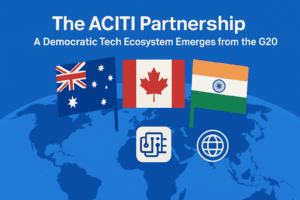
The ACITI Partnership: A Democratic Tech Ecosystem Emerges from the G20
- Why Now?: The unveiling of the ACITI Partnership at the G20 Summit isn’t a random diplomatic gesture but a direct response to acute global vulnerabilities. It targets the West’s overwhelming strategic dependence on a single nation for the processed minerals that power everything from electric cars to fighter jets, marking a pivotal shift towards supply chain sovereignty.
- A Coalition of Complementary Strengths: The alliance’s genius lies in its division of labor. Australia and Canada act as the resource bedrock, holding vast reserves of lithium, cobalt, and rare earths. India brings the indispensable industrial scale, with its massive manufacturing base, booming energy demand, and proven ability to deploy technology at a population level.
- Beyond Economics, A Value-Based Framework: ACITI seeks to build more than just efficient supply chains; it aims to establish a democratic tech standard. This involves aligning approaches to AI governance, data privacy, and ethical mining (ESG standards), positioning an open, rules-based model against more opaque, state-controlled alternatives.
The corridors of the G20 Summit in Johannesburg, already abuzz with talks of a shifting world order, became the stage for a significant realignment in November 2025. Against a backdrop where geopolitical friction and supply chain anxiety dominated discussions, the leaders of Australia, Canada, and India stepped aside to forge a pact aimed squarely at the future. The Australia-Canada-India Technology and Innovation (ACITI) Partnership is more than a memorandum of understanding; it is a strategic blueprint for like-minded democracies to reclaim agency in the defining domains of the 21st century: critical minerals, artificial intelligence, and the clean energy transition.
This partnership represents a pragmatic fusion of necessity and opportunity. It is born from the urgent need to diversify away from dangerously concentrated supply chains, particularly those dominated by China, and is empowered by the uniquely complementary strengths of three major democracies spanning three continents. As Australian Prime Minister Anthony Albanese stated, the goal is to “find new ways to cooperate on technology, and innovation in areas like clean energy, critical minerals and AI” for mutual benefit.
The Strategic Imperative: Why ACITI Was Born
The impetus for ACITI is rooted in hard economic and security realities. The global clean energy transition, accelerated by national net-zero commitments, is inherently mineral-intensive. According to a landmark report by the International Renewable Energy Agency (IRENA), the mining and processing of these essential materials are geographically concentrated to an extreme degree. China, for instance, currently accounts for 100% of the refined supply of natural graphite, about 70% of cobalt, and nearly 60% of lithium and manganese.
For nations like Australia and Canada, this creates a paradoxical bind. Australia is the world’s top lithium producer, yet approximately 70% of its raw lithium exports are shipped to China for processing. This leaves its economic future and strategic leverage at the mercy of a downstream bottleneck it does not control. The ACITI Partnership, therefore, is a direct mechanism to “drive further diversification of supply chains towards a secure, sustainable, and resilient future,” as outlined in the trilateral joint statement. It is an attempt to build a parallel, democratic ecosystem for the resources that will underpin national security and economic prosperity for decades to come.
A Triad of Complementary Strengths
The partnership’s potential lies not in the similarity of its members, but in their powerful differences. Each nation brings a critical, non-overlapping piece of the puzzle to the table, creating a synergy that would be difficult to achieve bilaterally.
Table 1: Complementary Strengths of the ACITI Partners
| Country | Primary Strength | Key Assets & Goals |
| Australia | Resource Powerhouse | World-leading reserves of lithium, cobalt, nickel, rare earths; seeks downstream processing and market diversification. |
| Canada | Resource & ESG Leader | Abundant critical minerals; strong regulatory and ESG (Environmental, Social, and Governance) frameworks; clean tech innovation. |
| India | Industrial & Digital Scale | Massive manufacturing base and domestic market (e.g., 500 GW non-fossil target by 2030); leadership in digital public infrastructure (DPI) and AI application. |
India’s role is particularly pivotal. It provides the commercial scale and ambition that Australia and Canada, as developed economies with smaller populations, cannot generate alone. Its target of 500 gigawatts of non-fossil fuel power capacity by 2030 creates a predictable, massive demand pull for clean technology and the minerals that enable it. Furthermore, India’s proven success in building **Digital Public Infrastructure (DPI)**—digital systems for identity, payments, and data sharing—offers a tangible model for how technology can be deployed at scale to benefit citizens, a principle central to ACITI’s aim of “mass adoption of AI to improve the lives of our citizens”.
Navigating the Chasm: Challenges on the Road to Integration
Declaring a partnership is one thing; making it work is another. ACITI’s members must bridge significant divergences in their economic models, regulatory philosophies, and immediate priorities. The path to integration is fraught with challenges that will test the coalition’s resolve.
Table 2: Key Challenges Facing the ACITI Partnership
| Challenge Area | Nature of the Divergence | Potential Impact |
| Regulatory & Priority Alignment | AU/CA: High-regulation, ESG-focused, longer development cycles. IN: Rapid scaling, cost-competitiveness, job creation focus. | Could slow project approval, increase costs, and create friction over standards for mineral traceability and mining practices. |
| Financing & Political Cycles | Large-scale processing and tech projects require billions in capital. Political cycles in Canada and India could disrupt funding continuity and policy momentum. | Risk of stalled “moon-shot” projects if aligned political will falters or private sector investment is insufficient. |
| External Market Pressures | China can leverage its dominant market position to manipulate prices, restrict exports, or subsidize production to undermine ACITI-aligned projects. | Could make new, ethically sourced projects economically uncompetitive in the short term. |
The most fundamental tension lies in reconciling high-regulation ideals with development speed. Australia and Canada operate within stringent ESG and environmental frameworks that are non-negotiable for their publics and investors. India, while increasingly focused on sustainability, must prioritize affordable energy, domestic job creation, and rapid industrial expansion to meet the needs of its growing economy. Finding a common operational language that upholds shared values without stifling the partnership’s momentum will be a delicate balancing act.
From Declaration to Reality: The Path Forward and Broader Implications
The first concrete step is already scheduled: officials from the three countries are to convene in the first quarter of 2026 to begin translating the vision into a workable program. Success will depend on pursuing “early, visible outcomes” to build credibility and political capital. Achievable pilot projects could include:
- Joint feasibility studies for building shared critical mineral processing facilities.
- Coordinated regulatory sandboxes for AI applications in public-sector domains like healthcare, agriculture, and climate modeling.
- Research partnerships focused on next-generation battery materials or recycling technologies.
Geopolitically, while ACITI is not explicitly framed as an anti-China bloc, its success would inevitably create a powerful counterbalance. It represents the crystallization of a “middle-power coalition,” where democracies without the singular heft of the U.S. or China pool their specialized strengths to shape global norms. For Australia, it smartly nests within its broader Indo-Pacific strategy, complementing the Quad, the Minerals Security Partnership, and its compact with the United States. It allows Canberra to punch above its weight by influencing technology and sustainability standards across multiple overlapping alliances simultaneously.
The Foundation of a New Tech Order
The ACITI Partnership arrives at an inflection point. It is a bold experiment in whether democracies can organize themselves efficiently enough to secure the building blocks of their future without compromising the open, rules-based, and ethical standards they champion. Its promise is a world where the energy transition is powered by transparent and resilient supply chains, and where AI is governed by frameworks that prioritize public benefit over unchecked control.
The challenges are substantial, bridging the gap between regulatory idealism and industrial pragmatism will require unprecedented diplomacy and compromise. However, the alternative—ceding the terrain of advanced technology and critical resources to systems that do not share democratic values—is a risk these three nations have calculated is too great to accept. As they move from the announcement in Johannesburg to the hard work of implementation in 2026, the world will be watching to see if this triad can truly forge a new, durable model for technological sovereignty in the democratic world.
You must be logged in to post a comment.