
The Accidental Empire: How a 1924 Pune Seedling Became India’s Mighty Sardar Guava
In 1924, a chance guava seedling identified by horticulturist Dr. Gurdev Singh Cheema at a research institute in Pune evolved into India’s legendary Sardar (L-49) guava, a variety that now anchors a 3.71 lakh-hectare industry with yields reaching 56 kg per tree. Selected from the Allahabad Safeda for its exceptional size, sweetness, and reliability, the Sardar proved scientifically superior in yield and shelf life, transforming the livelihoods of farmers like Vilas Kale in Maharashtra, who achieved 20-tonne-per-hectare harvests through innovative water management. From the nurseries of Malihabad to orchards across Uttar Pradesh, Andhra Pradesh, and even farms in Africa and the Middle East, this resilient “accidental empire” became a cornerstone of Indian agriculture. Nearly a century later, it faces modern climate challenges with adaptive research, yet remains a enduring symbol of how one keen observation can grow into a national treasure.
The Accidental Empire: How a 1924 Pune Seedling Became India’s Mighty Sardar Guava
In the quiet of a pre-dawn Pune orchard in 1924, a horticulturist’s discerning eye fell upon a guava seedling that looked a little different from the others. It was a moment of serendipity, a genetic roll of the dice that could have easily been overlooked. Instead, it marked the beginning of a quiet agricultural revolution. A century later, that single, chance plant has multiplied into millions, its progeny forming the backbone of a 3.71 lakh-hectare industry and answering to a name that resonates with strength and reliability: the Sardar guava.
To understand the Sardar’s legacy is to understand modern Indian horticulture itself. It’s a story not just of a fruit, but of scientific foresight, farmer resilience, and a variety so robust it has crossed oceans to take root in foreign soils.
The Genesis: More Than Just Luck(now)
The official records state it plainly: in 1924, Dr. Gurdev Singh Cheema and his colleagues at the Imperial Fruit Research Institute in Ganeshkhind, Pune, identified a promising chance seedling among a crop of Allahabad Safeda guavas. By 1927, it was christened L-49, a clinical designation for a plant with extraordinary potential.
But to leave the story there is to miss its soul. Dr. Cheema, later revered as Udyan Mahirshi (Great Sage of Horticulture), wasn’t just cataloging plants; he was curating India’s fruit future. His work on the Alphonso mango, including the legendary dispatch of a parcel to King George V, was about proving that Indian fruit could command a global stage. The selection of the L-49 guava was driven by the same ambition. He saw in that sturdy Pune seedling a candidate for national prominence—a fruit that could be both a farmer’s reliable ally and a consumer’s delight.
This was no accident. It was the careful selection of a champion. The seedling, later commercially popularized as the ‘Sardar’ guava, possessed a suite of traits that made it exceptional: a high yield, a large, appealing fruit, and a sweetness that could compete with the best. It was, in essence, the perfect candidate to democratize guava cultivation across India’s diverse landscapes.
The Anatomy of a Wonder: More Than Meets the Eye
What makes the Sardar guava tick? On a 68-year-old farmer like Vilas Tattyaba Kale’s land in Sonori village, Pune, the answer is written in the harvest. Standing among his nearly 500 Sardar trees, he’ll tell you it’s about dependability.
The numbers back him up. Scientific studies, like the one conducted by Dr. S.G. Bhalekar in western Maharashtra, have quantified the Sardar’s dominance. In a head-to-head trial with seven other varieties, the Sardar (L-49) was the undisputed champion, averaging a staggering 56.39 kg of fruit per plant annually. It produced more fruits (around 334 per plant), each one heavier (about 168 grams), and boasted a peak sweetness (12.9° Brix) and a longer shelf life (around 80 hours) than most competitors.
This isn’t just data; it’s the language of a farmer’s livelihood. More kilos per tree means more income. Longer shelf life means less waste and better prices. Sweetness means repeat customers. The Sardar delivers on all fronts.
The Farmer’s Equation: Vilas Kale’s Orchard of Innovation
To witness the Sardar’s potential, one must walk the red soil of Vilas Kale’s seven-acre farm in Sonori. The village, once solely known for its figs, is now a mosaic of fruit orchards, and Kale is a central figure in its transformation.
His journey began with figs, then custard apples, but the real turning point came when he dedicated 3.25 acres to guavas, planting the Sardar, Coconut Behat, and Ratnadeep varieties. The Sardar, however, quickly became the star of his operation.
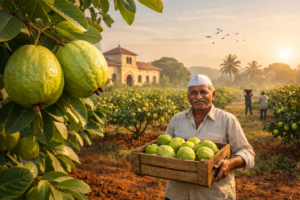
“With Sardar guavas, I consistently achieve yields of 20 tonnes per hectare,” Kale says, his hands gently cupping a fruit that has grown to an impressive size—sometimes reaching 500 grams, a testament to his skill and the variety’s genetic potential. This isn’t luck; it’s the result of relentless problem-solving. Water scarcity was his first great adversary. In a region prone to drought, Kale invested in deepening a traditional well, digging a borewell, and constructing two farm ponds. Today, a meticulously planned drip irrigation system delivers life to each tree, ensuring they thrive even through the harshest summers.
The result is an orchard that attracts traders directly to his farm gate. They come for the sheer quality and size of the fruit, knowing that a crate of Kale’s Sardar guavas will command top prices in markets from Pune to Lonavala. His success has become a blueprint for neighbors, proving that with the right variety and smart water management, even a smallholding can be a powerhouse of productivity.
The National Tapestry: From Malihabad to the World
Kale’s story is a microcosm of a much larger national picture. The Sardar guava has proven its mettle from the gangetic plains of Uttar Pradesh to the drylands of Gujarat and the southern belts of Andhra Pradesh. It thrives because it’s adaptable. Dr. Santosh Marbhal from the divisional agricultural research center in Pune explains the science behind its success: “Guava thrives best in subtropical climates of 23–28°C. It tolerates drought and prefers well-drained loamy soils.” The Sardar, with its robust genetics, fits this bill perfectly across a wide range of microclimates.
Its journey, however, hasn’t been confined to India. For that, we must travel to Malihabad in Uttar Pradesh, the home of the legendary Nafees Nursery. Founded in 1932 by Nafees Hasan Khan, this third-generation enterprise has been a living bank of the region’s fruit diversity. Here, a one-year-old Sardar sapling can be bought for as little as Rs 25.
Shabihul Hasan Khan of Nafees Nursery recalls the variety’s global voyage. “For years, we have supplied lakhs of Sardar saplings to Middle Eastern and African countries such as Tanzania, Sudan, Ethiopia, Kenya, Oman, and Somaliland.” In 1995, they supplied hundreds to Maharashtra’s then-Director of Horticulture, A.K. Mule, a transaction that helped thicken the state’s orchards. The Sardar, born from a Pune seedling, had become an agricultural export commodity, helping to establish orchards across continents. It’s a powerful reminder that India’s contribution to global agriculture extends far beyond spices and grains.
A Fruit for All Seasons and Markets
The Sardar’s appeal is its versatility. In the markets, a 20-kg crate typically trades between Rs 250 and Rs 500, a price point that makes it accessible to the masses while remaining profitable for the farmer. Its firm flesh makes it ideal for transport, and its flavor profile lends itself to everything from a simple slice of fresh fruit to a complex guava jelly or the beloved North Indian gooey amrood ki chutney.
Farmers also value its cropping pattern. Through techniques like controlled water stress and pruning, they can induce flowering in different flushes—the Mrig flush (June), the Hasta flush (October), or the Ambe flush (January)—allowing them to time their harvest for the best market prices. In Maharashtra, the Mrig flush is most favored, aligning with the post-monsoon season when demand begins to peak.
The Future Under a Hotter Sun
The story, however, is not without its modern challenges. Rising temperatures are accelerating ripening and causing sunburn in orchards across the country. The very climate that nurtured the Sardar is becoming more unpredictable. Dr. Marbhal advises adaptive strategies like mulching to conserve soil moisture and mist irrigation to cool the microclimate.
The future of the Sardar lies in resilience. Breeding programs are now focusing on developing pink-fleshed varieties, low-seed fruits, and rootstocks that are dwarf (for ultra-high-density planting) and resistant to diseases and fruit flies. The goal is to build upon the Sardar’s robust foundation, creating new varieties that can withstand the pressures of a changing climate and a growing population.
Nearly a century after a chance seedling was marked for greatness, the Sardar guava stands as a towering figure in Indian agriculture. It is a legacy etched not in stone, but in the sweet, firm flesh of a golden fruit. From the historic nurseries of Malihabad to the sun-baked fields of a farmer like Vilas Kale, the story of the Sardar guava is a testament to the enduring power of observation, innovation, and the simple, profound act of planting a tree. And every year, when the branches bend heavy with fruit, that story is told once more, in a language understood by all.
You must be logged in to post a comment.