
The Accidental Diplomat: How Varsen Aghabekian Shahin Is Redefining Palestine’s Voice on the World Stage
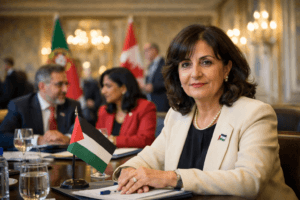
The Accidental Diplomat: How Varsen Aghabekian Shahin Is Redefining Palestine’s Voice on the World Stage
In the gilded halls of the Hotel Bayerischer Hof in Munich, where the world’s diplomatic and security elite gather each year to diagnose global ills, the fate of millions often feels like an abstraction—a topic for panel discussions and press releases. But for Dr. Varsen Aghabekian Shahin, the Palestinian Minister of Foreign Affairs and Expatriates, the Munich Security Conference is not just a forum for debate; it is a vital lifeline to the international community. On February 13, 2026, on the sidelines of this high-stakes gathering, Shahin sat down with her counterparts from two nations that have recently made historic shifts in their Middle East policy: Portuguese Foreign Minister Paulo Rangel and Canadian Foreign Minister Anita Anand [citation:original source].
These were not merely procedural bilaterals. They were working meetings designed to translate symbolic political recognition into tangible diplomatic and economic reality, set against the backdrop of a precarious Gaza peace plan and a stalled two-state solution .
The Face of Palestinian Diplomacy
To understand the weight of these meetings, one must understand the diplomat sitting across the table. Dr. Varsen Aghabekian Shahin is not a traditional career politician. She is an academic and a policy architect who has navigated the intersections of health, human rights, and institution-building for decades. Holding a Ph.D. in Administrative and Policy Studies from the University of Pittsburgh, Shahin’s career has spanned from serving as a dean at Al-Quds University in Jerusalem to directing human resource development for the Palestinian health councils and managing strategic plans for East Jerusalem .
Her expertise lies in the granular details of governance—the very foundation a future state requires. During a lecture at Ateneo de Manila University in late 2025, she meticulously laid out the history of the territorial erosion since the 1947 UN partition plan, emphasizing that the conflict is fundamentally territorial and humanitarian, not religious . This technocratic, rights-based approach defines her tenure. When she thanks Portugal and Canada for their recognition of the State of Palestine, she is not just accepting a compliment; she is holding them to the legal and moral obligations that such recognition entails .
Lisbon’s “Courageous Step” and Bilateral Promise
The meeting with Portuguese Foreign Minister Paulo Rangel was imbued with a specific warmth. Just months prior, in September 2025, Portugal had officially recognized the State of Palestine, a move the Palestinian Ministry of Foreign Affairs lauded as a “courageous step consistent with international law and United Nations resolutions” .
Shahin’s gratitude toward Portugal was rooted in the consistency of its message. This was not a fleeting political gesture. In November 2025, Shahin received the credentials of José Guedes de Sousa, the new Head of Portugal’s Representative Office to the State of Palestine. During that ceremony, she explicitly encouraged Portugal to play an active role in rebuilding the Gaza Strip and emphasized the need to deepen ties in diplomacy, tourism, and culture . The meeting in Munich served as a follow-up to that momentum. It was an opportunity to brief Rangel on the rapidly evolving situation on the ground—the slow trickle of reconstruction aid, the security challenges, and the need for European technical expertise to bolster Palestinian institutions. For Portugal, engagement with Palestine offers a pathway to increased relevance in Mediterranean and Middle Eastern affairs, positioning Lisbon as a key interlocutor between Europe and the Arab world.
Ottawa’s Conditional Recognition: A Partnership Forged in Reform
The discussion with Canadian Minister Anita Anand carried a different, yet equally significant, texture. Canada’s recognition of the State of Palestine, announced by Prime Minister Mark Carney in September 2025, was framed by Ottawa as part of a “coordinated international effort to preserve the possibility of a two-state solution” .
However, the Canadian decision was notably conditional. It came with explicit benchmarks tied to the Palestinian Authority’s (PA) commitment to “fundamental reforms,” including the demilitarization of the future state and a pledge to hold general elections in 2026—from which Hamas would be excluded . This creates a partnership dynamic that is both supportive and demanding.
For Shahin, the conversation with Anand was likely a delicate balancing act. On one hand, she needed to express deep appreciation for Canada joining the majority of UN states in recognizing Palestine, a move that strengthens the international legality of Palestinian statehood . On the other, she had to demonstrate tangible progress on the reform agenda that Canada values so highly. The 2026 elections loom large as a test of the PA’s legitimacy and governance capacity. Shahin, with her background in institutional capacity building, is uniquely positioned to bridge this gap. She can speak the language of policy reform fluently, assuring Canada that the path to sovereignty runs through transparent governance. Furthermore, with Canada holding the levers of trade agreements—Palestinian exports already benefit from the Canada-Israel Free Trade Agreement (CIFTA)—the discussion likely touched on economic cooperation as a pillar of stability .
The Munich Moment: Beyond Symbolism
The timing of these meetings is critical. The 2026 Munich Security Conference occurs at a moment the Munich Security Council itself describes as a fragile opening. A report released by the conference’s Middle East Consultation Group (MECG) just a day before these meetings, titled Building on Momentum: From Promise to Progress?, suggests that while the region faces immense structural risks, a narrow window for diplomatic progress exists .
Shahin’s discussions with Rangel and Anand are part of a wider effort to capitalize on this window. The MECG report highlights that the two-state solution remains the preferred outcome among Palestinians, according to Arab Barometer surveys, but that implementation gaps and mutual mistrust threaten to derail the 2025 Gaza Peace Plan (UNSCR 2803) .
In this context, Shahin’s briefings to her counterparts serve multiple purposes. First, they provide ground-truth updates on the situation in the occupied territories, moving beyond the sanitized language of official reports. Second, they seek to coordinate strategies on how to counter the serious escalation of violence and settlement expansion. Third, they aim to transform the “symbolic” recognition of Palestine into active diplomatic capital—whether through Portugal’s influence in the EU or Canada’s voice in the G7 and the Commonwealth.
As Wolfgang Ischinger, the conference chief, noted ahead of the gathering, the Middle East was a top priority, with expectations that the implementation of the Gaza plan would be a central subject . The presence of high-level delegations from Israel, Palestine, and key Arab states created an ecosystem where these bilateral meetings could have immediate, practical outcomes.
Conclusion: The Long Road from Recognition to Reality
When Foreign Minister Shahin thanked her Portuguese and Canadian counterparts, she was acknowledging more than a diplomatic formality. She was recognizing that in a world order increasingly strained by geopolitical rivalries, the decision to stand by international law and the right to self-determination is a political choice that requires courage .
For Portugal, the path forward involves leveraging its EU membership to push for tangible reconstruction projects in Gaza and cultural exchanges that humanize the Palestinian experience. For Canada, it means walking the tightrope of supporting a reformed Palestinian Authority while maintaining its complex relationship with Israel, all while ensuring that its recognition translates into “diplomatic action,” as activists in Winnipeg have demanded .
Shahin left the Munich meetings with agreements on joint coordination and strengthened bilateral relations. But the true measure of these high-level talks will not be found in the press releases issued in Munich. It will be found in the weeks and months that follow: in the opening of new trade lines, in the delivery of aid to Gaza, and in the quiet, persistent work of building a state that, in the eyes of the law and an overwhelming majority of the world’s nations, already exists . The meetings in Munich were not the destination; they were a crucial refueling stop on a very long road.
You must be logged in to post a comment.