
The $500 Billion Question: How a Supreme Court Blunder Forced a Reset in U.S.-India Trade Talks
Following the U.S. Supreme Court’s decision to strike down President Trump’s global tariffs, Commerce Secretary Howard Lutnick made a critical trip to New Delhi to salvage a massive trade deal with India, which had paused negotiations to reassess its position. The ruling created a strategic “trilemma” for India: the new 10% baseline U.S. tariff is now lower than the 18% rate it had just negotiated, undermining the value of its concessions, including a pledge to buy $500 billion in U.S. goods. While Lutnick’s visit signaled a renewed commitment to the partnership, the path forward is fraught with complexity, as India must now decide whether to renegotiate a less advantageous deal under the shadow of unresolved issues like its purchases of Russian oil and the U.S.’s simultaneous imposition of a 126% tariff on Indian solar imports.
The $500 Billion Question: How a Supreme Court Blunder Forced a Reset in U.S.-India Trade Talks
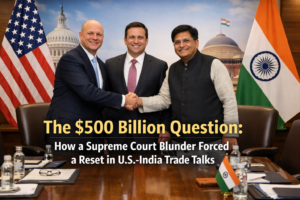
The photograph emerging from New Delhi was one of practiced diplomacy: three men in business attire, smiles fixed for the camera, shaking hands across a polished table. On one side stood U.S. Secretary of Commerce Howard Lutnick and the newly confirmed U.S. Ambassador to India, Sergio Gor. On the other, India’s Minister of Commerce and Industry, Piyush Goyal.
The official readout from the meeting on Thursday was predictably cordial. Minister Goyal described the talks as “very fruitful,” a diplomatic nicety that usually signals little more than the successful avoidance of an open argument.
But behind the smiles and the blandishments lies a tectonic shift in the global trade landscape. Lutnick’s quiet arrival in the Indian capital wasn’t part of a pre-planned roadshow. It was a damage-control mission. Just days earlier, the entire foundation of a historic U.S.-India trade deal—one that had been painstakingly negotiated and was set to redefine the economic relationship between the world’s two largest democracies—had been swept away by a single ruling from the U.S. Supreme Court.
The story of Lutnick’s trip is not just a story about tariffs. It is a masterclass in real-time geopolitical strategy, a case study in how domestic legal battles create international chaos, and a high-stakes poker game involving $500 billion in goods, the flow of Russian oil, and the future of American manufacturing.
The ‘Trilemma’ in New Delhi
To understand the pressure-cooker environment Lutnick walked into, one must rewind to the previous week. The Supreme Court’s 6-3 decision to strike down President Donald Trump’s sweeping global tariffs was a thunderclap heard from Washington to Warsaw to Wellington. For the White House, it was an unprecedented judicial overreach. For U.S. trading partners, it was a sudden, chaotic reprieve.
Among the first to react was New Delhi. Indian officials, who had just signed off on a complex trade framework with the U.S., immediately pulled the plug on talks aimed at finalizing the deal. They needed time to recalibrate.
“They are studying all these developments for their implications,” was the careful, non-committal statement from India’s Ministry of Commerce and Industry. Behind that careful language was a state of high alert.
Ajay Srivastava, founder of the New Delhi-based Global Trade Research Initiative, put it bluntly: “The Supreme Court verdict has created a trilemma for U.S. trade partners, including India. Everyone is waiting for more clarity.”
What is this “trilemma”? It’s the three-pronged puzzle now facing Indian negotiators:
- The Better Deal Paradox: The original agreement had U.S. tariffs on Indian goods falling to 18%. Now, in the wake of the court ruling, the Trump administration slapped a temporary 10% baseline tariff on all comers. Why would India lock itself into a bilateral deal that guarantees a higher tariff (18%) than the new, universal baseline (10%)?
- The Concession Dilemma: In the original framework, India had made massive concessions. The crown jewel was a pledge to purchase a staggering $500 billion in U.S. goods over five years—a move designed to slash the $45.8 billion goods trade deficit that so vexes President Trump. These concessions were made in exchange for preferential access to the U.S. market. If that preferential access is now nullified by a universal tariff, what is the rationale for following through on those pledges?
- The Uncertainty Factor: The U.S. legal and political landscape is now more volatile. President Trump has vowed a new legal fight and warned countries not to “play games.” India must now negotiate with an administration that is operating with one hand tied behind its back, but which has promised to be twice as aggressive in retaliation. How do you strike a long-term deal with a partner whose primary trade tool has just been declared unconstitutional?
This was the puzzle Lutnick and Ambassador Gor flew 8,000 miles to solve.
The Russian Shadow
Adding a combustible layer of complexity to the trade talks is the ghost of Russian crude. India, the world’s third-largest oil importer, has emerged as a key buyer of discounted Russian oil since the invasion of Ukraine, a move that has consistently irked Washington.
During the original trade discussions, President Trump made a sweeping claim: that New Delhi had “committed to stop directly or indirectly importing Russian Federation oil.” This was met with stony silence by Indian officials, who have long defended their oil purchases as a matter of national energy security, driven by price, not politics.
While Indian imports of Russian crude are projected to fall to a two-year low this month—a dip analysts attribute more to fluctuating market prices and refinery maintenance than political pressure—the underlying tension remains. The U.S. sees any financial flow to Moscow as a lifeline for its adversary. India sees it as a pragmatic economic decision.
In the context of the renegotiated trade deal, this issue becomes a potent bargaining chip. The U.S. could demand a concrete, verifiable plan to phase out Russian oil purchases as a non-negotiable condition for any future trade benefits. India, in turn, could use its newfound leverage from the lower baseline tariff to resist such demands, arguing that the U.S. needs them more than they need a preferential deal that is now less preferential.
The 126% Warning Shot
If Lutnick’s visit was the olive branch, the stick arrived in the form of a new 126% solar import duty.
In a move that surprised few trade watchers, the administration simultaneously levied this massive tariff on solar cells and modules from India. The official reason is a familiar one: allegations that Indian manufacturers benefited from unfair government subsidies, allowing them to undercut American competitors and flood the U.S. market. The numbers are stark: according to U.S. Census Bureau data, solar imports from India skyrocketed to nearly $793 million in 2024, a roughly ninefold jump from 2022.
The message is unmistakable. While the White House is willing to talk trade frameworks and billion-dollar purchasing pacts, it will not tolerate what it sees as predatory practices in strategic sectors. The “America First” policy isn’t on hold just because of a court ruling.
This creates a schizophrenic dynamic for Indian industry. On one hand, they are being invited to be partners in a massive, long-term trade relationship. On the other, they are being hit with punitive duties that can cripple a booming export sector overnight. For Indian solar manufacturers, Lutnick’s “fruitful” talks in Delhi offer little comfort as they stare down a 126% price hike that will likely price them out of the U.S. market entirely.
The Path Forward: A Game of Leverage
So, where does this leave the $500 billion question?
Secretary Lutnick’s job in Delhi was to convince his Indian counterparts that the U.S. is still a reliable partner, despite the legal chaos. He likely argued that the 10% baseline tariff is temporary, a stopgap measure, and that a bilateral deal remains the only path to true, predictable market access. He may have hinted at using other executive tools—new national security investigations under Section 232, or aggressive use of trade remedy laws—to show that the administration is far from powerless.
For India, the calculus is complex. Walking away from the deal would mean forgoing the deeper strategic partnership with the U.S. that the deal represents—a partnership seen in New Delhi as a crucial hedge against a rising China. It would also risk the full force of President Trump’s wrath, a scenario he explicitly warned about in his fiery Truth Social post: “Any Country that wants to ‘play games’… will be met with a much higher Tariff, and worse.”
But simply signing the original deal as-is would be political suicide for the Indian government, which would face sharp criticism for locking the country into higher tariffs and delivering billions in procurement commitments for no tangible gain.
The most likely outcome is a complete renegotiation. The old framework is dead. The new talks will start from a different baseline: the 10% universal tariff. India will seek to negotiate a rate below that baseline, restoring the preference they were originally promised. In exchange, they will likely have to offer even more—perhaps deeper cuts in agricultural tariffs that protect millions of Indian farmers, or more stringent intellectual property rules that concern its powerful generic drug industry. The $500 billion purchasing pledge may be revised, but it will almost certainly remain on the table, as it addresses the U.S.’s core goal of reducing the trade deficit.
Howard Lutnick’s quiet trip to New Delhi was not about finalizing a deal. It was about preventing a total collapse of trust. It was about looking Minister Goyal in the eye and assuring him that despite the noise and the legal setbacks, the United States remains committed to building a new economic architecture with India. Whether that architecture can be built on the shifting sands of U.S. trade law and the hard realities of Indian realpolitik is the story that will unfold in the months ahead. The smiles in the photograph may have been genuine, but the negotiating table they leaned on is now more precarious than ever.
You must be logged in to post a comment.