
The $300 Billion Question: Can India’s IT Crown Jewel Survive the AI Revolution?
India’s $300 billion IT outsourcing industry faces an existential test from AI, which threatens to automate the core labour-intensive services—like maintaining legacy systems—that powered its decades-long growth, triggering a sharp stock market rout and fears of up to 50% of entry-level jobs disappearing. However, analysts argue that while the business model will fundamentally shift from steady maintenance fees to high-value consulting and AI integration, the industry is not doomed; it will instead evolve, as AI tools are currently incapable of managing the complex, error-proof enterprise systems that Indian firms specialise in, potentially creating new roles even as it eliminates old ones, though this transition will cause significant short-term pain and squeeze the middle-class dream for millions of junior engineers.
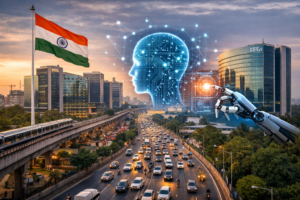
The $300 Billion Question: Can India’s IT Crown Jewel Survive the AI Revolution?
The city of Bengaluru, often called the Silicon Valley of India, runs on a specific kind of rhythm. It’s the clatter of keyboards in 24/7 cafes, the honking traffic jam of young professionals in hatchback cars heading to sprawling office parks, and the quiet confidence of a million dreams built on code. For three decades, this rhythm has been the heartbeat of the Indian economy, powered by a simple equation: highly skilled, English-speaking graduates + lower wages = the world’s back office.
But today, a new, more ominous sound is creeping into the mix: the low hum of servers running artificial intelligence. And it’s causing a tremor that has sent shockwaves through the country’s $300 billion IT industry.
In recent weeks, Indian technology stocks have experienced a rout not seen in years. The Nifty IT index has tumbled, wiping out tens of billions of dollars in investor wealth. The trigger wasn’t a recession or a geopolitical crisis, but a software update. When Anthropic’s Claude AI demonstrated a tool that could automate complex legal and compliance tasks, it felt like a knife had been pointed at the very heart of the labour-intensive Indian outsourcing model.
The question on everyone’s mind, from the tech CEO in a Gurugram high-rise to the fresh engineering graduate in a small town, is stark: Can India’s IT crown jewel survive artificial intelligence?
The “Claude Moment” and the Fear of Obsolescence
To understand the panic, you have to understand the business model. For decades, giants like Tata Consultancy Services (TCS), Infosys, and Wipro have acted as the “plumbers of the tech world,” as JPMorgan Chase aptly puts it. They have maintained the creaking legacy systems of Fortune 500 companies—the databases, the HR software, the customer service platforms. This “application managed services” business, which can account for nearly half of some firms’ revenue, involved armies of engineers doing repetitive but essential tasks: fixing bugs, running updates, and ensuring systems didn’t crash.
It was a wonderful, labour-heavy monopoly on grunt work.
The “Claude moment” in early February signalled that the grunt work might soon have a cheaper, faster, and tireless alternative. If AI can autonomously navigate complex systems to patch code or ensure regulatory compliance, why pay a team of 50 engineers in Hyderabad to do it? This existential fear is why founders are predicting the disappearance of traditional IT services by 2030, and CEOs are warning that half of all entry-level white-collar jobs could be vaporized.
The Architecture Argument: Why AI Isn’t a Silver Bullet
However, to write off India’s IT industry as a dinosaur watching the asteroid is to misunderstand both the technology and the industry’s evolution. A growing chorus of analysts and industry leaders argue that the doomsday scenario is not just simplistic, but fundamentally flawed.
The counter-argument hinges on the word “enterprise.”
As a recent HSBC report titled “Software Will Eat AI” points out, large-scale AI systems are “inherently flawed” when it comes to the high-stakes world of enterprise software. An AI model trained on the public internet can generate a witty poem or create a convincing image of a cat in a spacesuit. But it cannot be trusted to “lift and replace” the core banking platform that handles millions of transactions a day, or the flight control software of an airline.
Enterprise software is the result of decades of meticulous engineering. It is designed to be near-error-proof, with high throughput and ironclad reliability. The proprietary intellectual property embedded within these systems is not something a generic AI model can simply be trained on. As HSBC notes, AI is “decades behind” in designing the most complex and critical software architecture—precisely the domain where Indian IT firms have built deep expertise.
Think of it this way: AI is a brilliant, incredibly fast intern who can read every manual in the library. An Indian IT firm is the seasoned architect who knows that the library’s foundation has a crack that isn’t in any manual, that the plumbing makes a weird noise when it rains, and that the city is planning to dig a tunnel right underneath it. The intern can summarize the manuals, but the architect knows how to keep the building standing.
This is the “plumbing” analogy taken to its logical conclusion. JPMorgan argues that it’s naive to assume AI can offer the same level of customization, integration, and holistic understanding as a dedicated IT services firm. Instead of replacement, they foresee a future of partnership. AI tool firms will build the hammers and saws; Indian IT services firms will be the carpenters who use them to build, renovate, and repair the unique houses that are global corporations.
The New Frontier: From Maintenance to Transformation
Salil Parekh, CEO of Infosys, has been beating this drum, suggesting that AI expands the opportunity for his firm. The real value, he posits, lies not in resisting AI, but in being the guide that helps clients navigate it. The future isn’t about maintaining legacy systems; it’s about transforming them using intelligent tools.
This represents a fundamental shift in the client engagement model. Instead of being paid a steady stream of fees for “keeping the lights on,” Indian IT firms will increasingly be hired for high-value, project-based work: consulting, strategy, and implementation. They will be the systems integrators for the AI age, stitching together off-the-shelf AI tools with a company’s unique data and workflows.
This pivot is already visible. According to India’s software lobby group Nasscom, 2025 marked a decisive move from AI experimentation to actual deployment. The revenue from AI projects, while currently a small fraction of the total, is a growing beachhead.
The Human Cost: The Squeeze on the Middle Class Dream
While the corporate narrative is one of evolution and opportunity, the human story is more complicated and, in the short term, far more painful. The headline numbers—that AI might displace 92 million jobs but create 170 million new ones—offer cold comfort to the 22-year-old whose job application is now being screened by an algorithm that deems his skills redundant.
The immediate impact will be felt at the entry level. For decades, the Indian IT industry functioned as a massive, if imperfect, social equalizer. It took thousands of graduates from Tier-2 and Tier-3 colleges, with moderate technical skills but a hunger to succeed, and put them to work. They were the front-end developers, the testers, the first-rung support staff. They were paid enough to rent a small apartment, buy a motorcycle, and send money home. They were the foot soldiers of the middle-class dream.
These are precisely the roles most vulnerable to automation. Why hire a team of ten junior testers when an AI agent can run millions of test cases overnight? This is the “50% elimination” that CEOs are warning about. Hiring is already projected to be subdued, with net employee strength growing by just over 2% in 2026—a far cry from the double-digit growth of the past.
The new jobs being created—AI engineers, data annotators, prompt specialists—require a different, more specialized skill set. They will likely be filled by graduates from India’s elite institutes, leaving the vast majority of the engineering pool scrambling. This risks creating a two-tiered workforce, exacerbating inequality and potentially derailing the dreams of millions of families who invested everything in an engineering degree, believing it was a ticket to a secure future.
The Road Ahead: Pain, Pivot, and Potential
The road ahead for India’s $300 billion industry is not one of extinction, but of profound and painful transformation.
In the short run, the pain is undeniable. Revenues will face deflationary pressure as the old billing model—based on hours worked and bodies deployed—gives way to an “outcome-driven” approach. Analyst firm Nuvama Institutional Equities predicts that the benefits of AI will only be visible in the medium term, suggesting a period of stagnation or even decline first.
Adding to the headwinds are external factors. The United States remains the largest market for Indian IT, and while recent tariff scares have eased, visa restrictions have tightened. New, higher visa fees could cost top Indian IT firms up to $250 million annually—a direct hit to their operating margins.
The industry is now at a crossroads. It can either fight the last war, trying to protect its legacy business, or it can double down on the future. The winners will be those who successfully navigate the transition from labour arbitrage to value arbitrage. They will invest heavily in reskilling their millions of employees, not just in coding, but in the soft skills of consulting, creative problem-solving, and strategic thinking that AI cannot replicate.
The skyscrapers of Bengaluru and Hyderabad aren’t going to crumble. The stock tickers of Infosys and TCS aren’t going to zero. But the rhythm of the city is changing. The quiet hum of AI in the server rooms is growing louder, and it is demanding a new kind of dance. For the Indian IT industry, the age of easy money is over. The age of intelligent evolution has just begun. The question is whether it can move fast enough to keep the music playing for the millions whose dreams depend on it.
You must be logged in to post a comment.