
The $250 Billion Shockwave: How a Single Strike on Qatar Sent Global Energy Markets Into a Tailspin
The recent coordinated strikes on Qatar’s Ras Laffan complex—the world’s premier LNG hub—and Iran’s South Pars field have triggered a seismic shift in global energy dynamics, sending UK and European gas prices soaring over 25% as markets price in a new reality where critical infrastructure is a primary target of war. Beyond the immediate supply disruption and the tragic human cost, the attacks have shattered the long-standing immunity of energy facilities, forcing Europe to confront the fragility of its LNG-dependent strategy just as it needs to restock for winter, while Gulf states grapple with the realization that their economic diversification and neutrality no longer shield them from regional conflict.
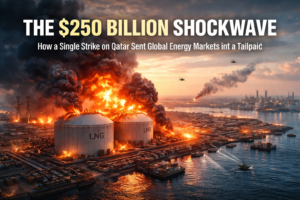
The $250 Billion Shockwave: How a Single Strike on Qatar Sent Global Energy Markets Into a Tailspin
On the morning of March 19, 2026, the global energy landscape shifted. It didn’t shift because of a policy announcement from OPEC, a new pipeline deal, or a gradual decline in reserves. It shifted because of fire and metal. In the span of 48 hours, two of the most critical energy nodes on the planet—Qatar’s Ras Laffan Industrial City and Iran’s South Pars field—were transformed from symbols of economic might into warzones.
For consumers in the UK and Europe, the immediate aftermath was visible on trading screens: a 25% spike in wholesale gas prices, the largest single-day jump since the early days of the Ukraine invasion. But to view this merely as a market fluctuation is to miss the forest for the trees. This is the opening salvo of a new kind of conflict—one where energy infrastructure isn’t just a strategic asset, but the primary target.
This is the story of how a complex web of geopolitical vengeance, fragile infrastructure, and global dependency converged to create a perfect storm, and why the price you pay to heat your home is now inextricably linked to the flight path of a drone over the Persian Gulf.
The Bullseye: Why Ras Laffan Changed the Game
To understand the sheer panic that rippled through trading floors from London to Singapore, you have to look at a satellite image of Ras Laffan Industrial City. Located on Qatar’s northeastern coast, it is not just another facility; it is the Fort Knox of natural gas. Stretching over 295 square kilometers, it is a sprawling metropolis of mega-trains, liquefaction plants, and storage tanks that collectively handle more than 75% of the world’s liquefied natural gas (LNG) trade.
When news broke that Iran’s retaliatory strikes had caused “extensive damage” here, the market didn’t just see a fire; it saw a threat to the very mechanism of global energy supply.
Shell’s Pearl GTL (Gas-to-Liquids) facility, confirmed damaged in the attack, is a marvel of modern engineering. It takes the natural gas bubbling up from the North Field (the Qatari side of the world’s largest non-associated gas field) and converts it into high-performance fuels and base oils for detergents and plastics. But its true value lies in its complexity. A facility like this cannot be turned off and on like a light switch. Shutting it down safely is a delicate process; restarting it is a logistical nightmare that can take weeks or even months. Every day it remains offline is a permanent loss of supply that cannot be reclaimed.
But the psychological damage was worse. For decades, the energy industry has operated under an unspoken rule: energy infrastructure is generally off-limits in conflict. Pipelines might get caught in crossfire, but the deliberate targeting of a sovereign nation’s primary economic asset—a facility that powers not just Qatar but millions of homes in Asia and Europe—was a red line that had not been crossed since the Iran-Iraq War of the 1980s. By striking Ras Laffan, Iran signaled that the old rules are dead.
The Symbiosis of Conflict: The South Pars Connection
Just a day earlier, satellite imagery and social media footage showed flames billowing from Iran’s own South Pars facilities. This is the tragic irony of the geography. The North Field, which Qatar sits on, is a geological extension of Iran’s South Pars. The two nations are effectively sharing a bathtub of gas that holds an estimated 1,800 trillion cubic feet of natural gas.
For years, despite deep political and sectarian divides, Qatar and Iran managed a tense but functional coexistence over this asset. Iran, hampered by sanctions and technical inefficiency, flared much of its associated gas while struggling to develop its side. Qatar, with the help of Western majors like Shell, ExxonMobil, and Total, turned its side into a goldmine.
Israel’s reported strike on the Iranian side of the field—an operation the US claims it knew “nothing” about—was a masterclass in strategic arson. By hitting Iran’s facilities, Tel Aviv effectively dared Tehran to retaliate against the “other half” of the field. And Iran took the bait.
The strikes have now created a mutually assured destruction scenario for the world’s energy supply. Iran’s facilities, already hobbled by years of underinvestment, will take years to fully repair. Meanwhile, the damage to Ras Laffan introduces a massive risk premium into every LNG contract signed with Qatar. Insurers are now scrambling to re-evaluate policies for tankers docking in Doha, and shipping companies are questioning whether the risk is worth the reward.
A Market on the Edge: Beyond the 25% Spike
Theo Leggett and Katie Hope of the BBC reported early price surges of over 20%, with prices settling at 171p per therm. To put that in perspective, just three years ago, before the Ukraine war, prices hovered around 50p to 60p. The market is now permanently resetting to a “conflict premium.”
But Matthieu Favas, commodity editor at the Economist, hit on the most crucial point in his interview with the BBC: timing. “Demand will pick up as we enter summer… Europe will need to restock.”
Europe learned a brutal lesson in 2022 when it realized its dependence on Russian pipeline gas was a geopolitical weapon. It pivoted hard to LNG, building floating storage units and import terminals at breakneck speed. But that pivot merely shifted the dependency from Russia to Qatar and the United States. Now, that strategy is being tested.
If Europe cannot restock its reserves this summer because Qatari cargoes are delayed or cancelled, the winter of 2026 will make the energy crisis of 2022 look like a mild chill. Factories in Germany, which form the backbone of the European economy, will face impossible decisions: pay ten times the normal rate for power or shut down entirely.
The Diplomatic Fallout: Trump, Israel, and the “Betrayal” of the Gulf
Perhaps the most startling revelation in the news feed is the pointed post from Donald Trump. By explicitly warning Iran against further attacks and simultaneously distancing the US from Israel’s initial strike, Trump is attempting to walk an impossible tightrope.
For the Gulf states, this is a nightmare scenario. As Azadeh Moshiri reported from Dubai, “Gulf leaders [are] taken aback by the scale of the attacks.” These nations—the UAE, Saudi Arabia, Kuwait, and Qatar—have spent the last decade trying to diversify their economies away from oil and gas, building glittering metropolises designed to attract tourists, financiers, and tech giants. They want to be seen as safe havens, neutral Switzerland of the Middle East.
The drone strike on Kuwait’s Mina Al-Ahmadi refinery, one of the largest in the region, shatters that illusion. If a refinery in Kuwait can be hit, so can the Burj Khalifa’s power supply, or the desalination plants that provide drinking water to Dubai.
The officials in the region feel betrayed. They played mediating roles between the US and Iran. They maintained backchannel communications with Tehran even as they hosted American troops. They believed their economic utility would grant them immunity. Iran’s willingness to target these facilities suggests that in the current calculus of war, utility is no longer a shield.
The Human Cost Beyond the Trading Floor
Amid the talk of therms, barrels, and supply chains, the BBC report reminds us of the human toll. The tragic death of three women in the occupied West Bank, killed by shrapnel from an intercepted missile falling on a beauty salon, is a microcosm of this new war.
In the past, conflict was often contained to borders and battlefields. Today, a missile fired from Iran toward Israel, intercepted by defense systems, can rain death on a civilian location miles from any military target. The shrapnel doesn’t discriminate between a soldier and a stylist.
In Qatar, the immediate concern is for the expatriate workforce. Ras Laffan employs tens of thousands of people from South Asia, Europe, and the Americas. They are the engineers, the safety officers, and the crane operators who keep the global energy machine running. They now find themselves living and working in a high-value target zone.
Looking Ahead: The New Normal
As we move through March 19, 2026, we are not witnessing a temporary spike. We are witnessing a structural shift. The attack on Ras Laffan has introduced a geopolitical velocity to the energy transition that policymakers had hoped to avoid.
What happens next?
- The “Energy War” Doctrine: Nations will now view their energy independence not just in terms of supply, but in terms of physical security. Expect a massive uptick in spending on air defense systems for critical infrastructure. The days of unprotected LNG terminals are over.
- The Decoupling Dilemma: Europe will have to decide if it can afford to be reliant on a region so prone to conflict. This will accelerate the push for internal renewables, not for “green” reasons, but for security reasons.
- The Iran Calculus: The regime in Tehran has shown it can project power and pain far beyond its borders. Whether this strength or overreach depends on the response. If the US and Israel feel compelled to retaliate against the Iranian mainland, the entire region could be plunged into a war that makes the last six months look like a prelude.
For the average person in the UK filling up their car or looking at their energy bill, the world just got more expensive and less certain. The strike on Ras Laffan was a reminder that in a globalized world, the flames of a fire in Qatar can burn a hole in the pocket of a pensioner in Manchester. And until the world finds a way to decouple its prosperity from the stability of the Persian Gulf, we will all remain hostages to the next launch.
You must be logged in to post a comment.