
The $25 Million Question: Policing Melbourne’s Protests and the True Cost of Civic Discord
The $25 Million Question: Policing Melbourne’s Protests and the True Cost of Civic Discord
Title: Melbourne’s Protest Price Tag: How the Israel-Gaza War Strains Victoria’s Police Budget and Social Fabric
Meta Description: A $25 million policing bill for Melbourne’s protests reveals more than just a financial strain. We delve into the operational challenges, community tensions, and the complex debate over the right to protest in a modern democracy.
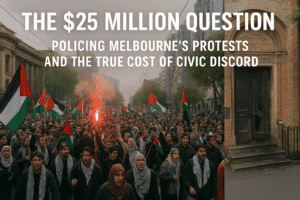
The scene has become a weekly ritual in Melbourne’s central business district. The air fills with the scent of smoke from flares, the rhythmic beat of drums, and a chorus of chants calling for a ceasefire and Palestinian liberation. Thousands gather, a sea of keffiyehs and Palestinian flags, flowing from the State Library Victoria down Swanston Street, a major arterial road brought to a standstill. It is a powerful, visceral display of democratic expression.
But a few blocks away, in the quiet, tree-lined streets of East Melbourne, the door of a synagogue stands charred and damaged, a stark and silent testament to a different, more sinister outcome of global conflict hitting home. These two images—the mass public protest and the targeted act of hate—are the dual fronts of a single reality for Victoria Police, and a new report has now put a staggering price tag on managing it: $25 million and counting.
A recent analysis by Victoria’s independent Parliamentary Budget Office (PBO), requested by the opposition, has quantified the direct cost of Operation Park. Established after the October 7th Hamas attacks, this police operation was tasked with a Herculean mission: to keep the peace in a city emotionally charged by a distant but deeply felt war. The figure, covering costs until mid-August, has ignited a fierce debate not just about money, but about the very nature of protest, public safety, and social cohesion in Australia’s most culturally diverse city.
Beyond the Headline: Deconstructing the $25 Million
At first glance, $25 million is an astronomical sum. To the average Victorian, it translates to hundreds of new police recruits, upgraded station facilities, or countless community policing programs that now may be underfunded. However, the PBO report adds crucial nuance that is often lost in political soundbites.
Nearly 60% of this cost is attributed to officer wages. As the report notes, these are wages that would have been paid regardless. Officers were on duty; they were simply deployed to protest management instead of other duties. This doesn’t negate the cost, but it reframes it. The primary financial impact is not on the police payroll, but on opportunity cost. Where were these officers not because they were managing protests?
This is the hidden, indirect expenditure the PBO couldn’t quantify. Police stations in suburban Melbourne, regional Victoria, and even other parts of the city are routinely stripped of their officers to backfill the massive operation in the CBD. This means slower response times to domestic incidents, burglaries, and local emergencies. It means community policing—the proactive work that builds trust and prevents crime—grinds to a halt. The true cost is a stretched-thin police force operating in a constant state of reactive triage.
The $25 million also exclusively covers the visible policing of rallies. It does not include the immense, and arguably more important, work of Operation Park that happens away from the cameras: intelligence gathering, investigating over 429 reports of antisemitism and 30 of Islamophobia, and the constant patrols of Jewish schools, synagogues, and community hubs to provide a sense of security in a time of fear.
The Human Element: Community Fear and Fracture
The financial cost is a proxy for a deeper social cost. For parts of Melbourne’s Jewish community, the weekly protests are not seen as a legitimate expression of political dissent but as a menacing display of aggression that makes them feel unsafe in their own city. The chants, sometimes crossing into antisemitic tropes, and the sight of flags associated with militant groups, create an environment of intimidation. The alleged arson attack on the East Melbourne Hebrew Congregation is the terrifying extreme of this atmosphere, a line crossed from protest into violent hate crime.
Conversely, for many in the pro-Palestinian movement, which includes a broad coalition of Muslims, students, activists, and trade unionists, these protests are a moral imperative. They see a humanitarian catastrophe unfolding in Gaza and believe they have a duty to amplify the voices of the voiceless through the only means they have: peaceful assembly. To them, any attempt to stifle these protests through permits or heavier restrictions is an attempt to silence criticism of the Israeli government and ignore the plight of Palestinians.
This is the impossible tightrope Victoria Police must walk. Their mission is not to take a side but to protect the right to protest safely while preventing violence, protecting all communities from hate, and keeping the city functioning. It is a mission that satisfies no one completely. Protesters often feel over-policed and antagonized, while affected communities feel under-protected and ignored.
The Permit System Debate: A Solution or a Slippery Slope?
In response to the report, Shadow Police Minister David Southwick declared Victoria the “protest state” and renewed calls for a protest permit system, similar to those in New South Wales and other jurisdictions. His argument is one of efficiency and order: a permit system would allow police to plan, resource events appropriately, and minimize disruption to the public and commerce.
“Police get pulled from police stations across Victoria to deal with protests in Melbourne and that compromises safety for all of us,” Southwick stated. This is a practical concern that resonates with many frustrated commuters and businesses.
However, the proposed solution is fraught with democratic peril. The state government, and notably Victoria Police Chief Commissioner Shane Patton himself, have rejected a permit system. Their reasoning is fundamental: in a free society, the right to protest should not be contingent on government approval.
A permit system inherently gives the state the power to decide which causes are worthy of public assembly and which are not. It can be used to sideline dissent and silence unpopular viewpoints. History shows that the movements we now celebrate—from suffragettes to civil rights activists—often engaged in “unlawful” protests that would likely have been denied a permit. The very nature of protest is to disrupt, to be heard when those in power would prefer not to listen.
Chief Commissioner Patton’s opposition is telling. It suggests that the head of the police force, the person ultimately responsible for managing the chaos, believes the tools of communication and negotiation with organizers are preferable to the blunt instrument of state control. The goal, as a Victoria Police spokesperson said, is “proper engagement,” not permission.
The Path Forward: A City in Search of Balance
There are no easy answers. The $25 million figure is a symptom of a world where international conflicts are instantly localised through our interconnected lives and social media. The war in Gaza has ignited passions in Melbourne in a way few other international events have, revealing deep community fractures.
Moving forward requires a multi-faceted approach:
- Enhanced Communication: Police must continue to build robust lines of communication with protest organizers from all sides to ensure events are as safe and minimally disruptive as possible. This is hard, ongoing work, but it is the bedrock of managing protests in a free society.
- Zero Tolerance for Hate: A clear and unwavering distinction must be maintained between peaceful protest and hate speech or incitement to violence. The full force of the law must come down on those who cross that line, whether from within a protest crowd or in acts of targeted bigotry.
- Community Reassurance: Visible, consistent patrols and engagement with both Jewish and Muslim communities are essential to rebuild a sense of safety. The cost of this must be seen as a non-negotiable investment in social harmony.
- Informed Public Discourse: The debate must move beyond simplistic headlines about cost. It needs to grapple with the complex trade-offs between absolute freedom of assembly, public order, and the resource constraints of a police force.
The $25 million is more than a line item in a budget report. It is the cost of democracy operating under extreme stress. It is the price of keeping a city from fracturing along the fault lines of a war thousands of kilometers away. While the protests may eventually dwindle, the conversations they have sparked about the limits of free speech, the duty of protection, and the meaning of community in a globalized world will—and must—continue long after the last banner is folded and the last flare fizzles out. The true measure of Melbourne’s character will not be found in the price of policing, but in how it navigates this profound challenge to its social fabric.
You must be logged in to post a comment.