
The 244th Stone: Why the Unending Demolition of al-Arakib Reveals a Deeper Conflict
The 244th Stone: Why the Unending Demolition of al-Arakib Reveals a Deeper Conflict
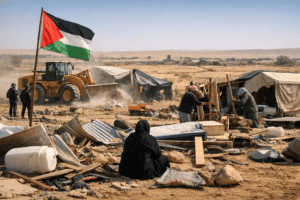
On a cool December morning, just a day after Christmas, the familiar roar of bulldozers returned to al-Arakib. For the 244th time since 2010, Israeli forces dismantled the tents and makeshift structures that constitute this Palestinian village in the Negev desert. The arithmetic of this conflict is staggering: a community has been erased, on average, every 23 days for over fifteen years. This latest demolition is not an anomaly; it is a ritual of displacement, a brutal cycle that pits the state’s machinery against a community’s ancestral claim to home. The story of al-Arakib, however, transcends a simple tally of destruction. It is a stark window into the struggle over land, recognition, and identity in Israel’s southern desert, exposing a systemic campaign often overshadowed by other flashpoints in the region.
A Cycle of Resilience and Erasure
The imagery is both tragic and profound: following each demolition, the residents of al-Arakib—22 families totaling some 86 people—rebuild. Using wood, scrap metal, and nylon sheets, they construct barriers against the desert’s searing summer heat and its bitter winter cold. This act of rebuilding is not merely about shelter; it is a political statement, a physical manifesto of sumud, or steadfastness. The recent abduction of community elder Sheikh Sayyah al-Turi during the raid underscores a tactic beyond property destruction: the targeting of social and moral anchors to fracture communal resolve.
This persistence exists despite a documented legal victory. In the 1970s, al-Arakib’s residents successfully navigated Israeli courts to prove ownership of 1,250 dunams (approximately 309 acres) of their ancestral land. Yet, this legal recognition has proven meaningless against the state’s use of urban planning and building code enforcement. The charge of “unlicensed construction” is the blunt instrument used to justify the demolitions, a pretext rights groups label as discriminatory, given the systemic refusal to grant building permits or recognize development plans for dozens of Arab villages in the Naqab.
The Negev Development Plan: Progress for Whom?
To understand the pressure on al-Arakib, one must examine the larger framework governing the Negev. The “Negev Development Plan,” initiated in 2006 and periodically reinvigorated with billion-shekel investments, is publicly touted as a national project for revitalizing Israel’s south. It promises innovation hubs, agritech, and modern infrastructure. However, its geography reveals its exclusivity. Funding flows to Jewish-majority towns like Netivot and Ofakim, while unrecognized Bedouin villages like al-Arakib are cartographically and bureaucratically excluded.
As analysts like Hussein Al-Rafai’a and Atiyya Al-A’sam have argued, this “development” has historically begun with demolition. The plan’s implementation has coincided with the relocation of major Israeli military bases to the region, fostering a military-industrial-academic complex that further marginalizes the indigenous Bedouin population. The pattern suggests a strategy: clear land not for generic “development,” but for specifically Jewish settlement, military expansion, and state control. The humanitarian cost is severe: villages like al-Arakib are denied basic water, electricity, and sewage services, creating conditions of engineered hardship intended, as residents assert, to exhaust them into leaving.
The Core Contradiction: Pre-existing Communities vs. The Unrecognized Map
A critical facet often missing from the discourse is the historical footprint of these communities. Al-Arakib, as noted, predates the state of Israel, established during Ottoman rule. It is one of at least 51 such villages in the Negev that exist in a legal and administrative limbo. Their very presence challenges the state’s narrative of “making the desert bloom” on empty land. The continued existence of al-Arakib, a community with pre-1948 land deeds, represents an inconvenient truth that repeated bulldozing seeks to physically negate.
This brings into sharp focus Article 17 of the Universal Declaration of Human Rights, which guarantees the right to own property and protects against its arbitrary deprivation. For the residents, their proven ownership and continuous habitation—interrupted only by forced displacement—make the state’s actions a clear violation of this principle. The conflict thus becomes a clash between two forms of legitimacy: documented, generational belonging versus state zoning and planning authority wielded disproportionately against one community.
A Microcosm of a Broader Struggle
The relentless focus on al-Arakib’s 244th demolition risks reducing it to a macabre record. In truth, it is a symbol for the plight of roughly 240,000 Palestinian Arabs in the Negev, half of whom live in similar unrecognized villages and encampments. Their struggle is for fundamental recognition—the right to exist on their land with dignity and access to services. Each demolition in al-Arakib sends a chilling message to these other communities.
Yet, the unwavering commitment to rebuild also tells another story. It speaks of a deep, non-violent civil resistance that refuses to be erased from the landscape or history. It challenges the international community to look beyond the more covered conflicts in the West Bank and Gaza and witness this slow-motion displacement happening within Israel’s own borders.
The tenth demolition of 2025 in al-Arakib is not the end of a story. It is merely the latest, brutal chapter in a long battle over geography and memory. As long as the nylon sheets go back up against the desert sky, the community’s claim stands—a fragile, defiant answer to the bulldozer’s roar. The real question is how many more cycles of destruction and resilience the world will witness before the fundamental rights to home, property, and recognition are addressed. The number, already at 244, is a damning indictment of a status quo built on inequality and erasure.
You must be logged in to post a comment.