
The $100 Oil Dilemma: Why India’s Corporate Earnings Are Headed for a Reality Check
Despite easing geopolitical tensions, brokerages including Goldman Sachs and HSBC anticipate significant cuts to India’s consensus earnings forecasts over the next two to three quarters as crude oil prices are expected to remain elevated in the $80–$100 per barrel range. Goldman Sachs now projects MSCI India earnings growth at just 8% and 13% for CY26 and CY27—roughly 11 percentage points below consensus—while HSBC warns that sustained high prices could materially dent FY27 growth expectations. Historical trends suggest that every $20 increase in crude can compress earnings by 1.5–3%, with the impact varying sharply across sectors: export-oriented firms may benefit from a weaker rupee, while airlines, auto OEMs, and consumer-facing businesses face margin pressure. Near-term March quarter earnings are expected to see limited impact due to inventory buffers, but the full effect will likely emerge in subsequent quarters. With valuations already reflecting some stress, Goldman Sachs has downgraded Indian equities to marketweight and lowered its Nifty target, signaling a less attractive risk-reward profile in the face of this oil-driven earnings headwind.
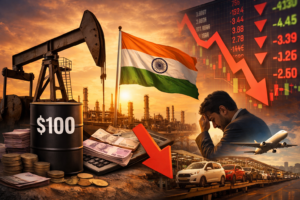
The $100 Oil Dilemma: Why India’s Corporate Earnings Are Headed for a Reality Check
For months, Indian investors have watched crude oil prices with the kind of anxious attention usually reserved for election results or central bank policy announcements. And for good reason. Even as diplomatic efforts gain traction and the immediate threat of a wider Gulf conflict appears to be receding, the arithmetic of oil economics is delivering an uncomfortable truth: India Inc. is about to face a sustained period of margin compression that consensus earnings estimates have largely failed to account for.
Global brokerages, including Goldman Sachs and HSBC, are now signaling what many market veterans have been quietly warning about—significant downward revisions to India’s earnings forecasts over the next two to three quarters. This isn’t merely about headline risk or geopolitical posturing. It’s about the stubborn reality of $80–100 per barrel oil, a level that fundamentally alters the profitability landscape for a country that imports roughly 85 percent of its crude requirements.
The Numbers Behind the Warning
Let’s start with what the brokerages are actually projecting, because the gap between consensus expectations and ground reality is striking. Goldman Sachs now expects MSCI India earnings growth at 8 percent and 13 percent for calendar years 2026 and 2027 respectively. On paper, those aren’t terrible numbers. But they represent a staggering 11 percentage point reduction from consensus estimates, which had been sitting at 16 percent growth for both years.
To put that in perspective, we’re talking about a downgrade that effectively wipes out nearly two-thirds of expected growth for 2026. This isn’t a minor adjustment around the edges—it’s a fundamental reassessment of corporate India’s near-term earnings trajectory.
HSBC, meanwhile, has flagged what it calls the “key risk” of a prolonged conflict, warning that sustained tensions could materially dent the current 16 percent year-on-year growth expectations for fiscal 2027. Even in a more benign scenario where the conflict doesn’t escalate, the brokerage expects oil to remain stubbornly above pre-crisis levels, averaging $80–100 per barrel through April and May before potentially easing to around $80 by June and July.
What History Tells Us About Oil’s Impact
The relationship between crude prices and corporate earnings isn’t linear, and that’s what makes this moment particularly concerning for analysts. Historical analysis suggests that a 20 percent increase in crude prices typically leads to a 1.5 percentage point compression in earnings for FTSE India companies. But here’s the critical detail—the impact intensifies disproportionately as prices rise further.
If crude averages around $100 per barrel, historical trends point to roughly a 3 percent reduction in full-year earnings. Push that to $120 per barrel, and the downside expands to more than 5 percentage points against FY27 earnings estimates. These aren’t catastrophic numbers in isolation, but they come at a time when India’s broader macroeconomic picture is already showing signs of strain.
Goldman Sachs has already factored in a 1.1 percentage point reduction in India’s 2026 GDP growth forecast, bringing it down to 5.9 percent. The brokerage has also raised its CPI forecast by 70 basis points, widened the current account deficit projection to 2 percent of GDP, and factored in 50 basis points of rate hikes for 2026. This is the interconnected reality of high oil prices—they don’t just hit corporate margins; they ripple through inflation, consumption, interest rates, and currency markets simultaneously.
The Sectoral Story: Winners, Losers, and the In-Between
What makes this earnings downgrade cycle different from previous ones is the uneven nature of its impact. This isn’t a uniform headwind that will depress all sectors equally. The divergence between companies and sectors is likely to be significant, and understanding these nuances is where real investment insight lies.
Export-oriented sectors present the most interesting paradox. A weaker rupee—which typically accompanies higher oil prices—can actually provide a partial hedge for companies earning in dollars. Information technology services, pharmaceuticals, and specialty chemicals with significant export exposure may see currency benefits that offset some of the input cost pressures. But this isn’t a simple equation. Many export-oriented companies also consume energy or use petroleum-derived raw materials, creating a complex web of offsetting factors.
The auto sector finds itself in a particularly challenging position. Original equipment manufacturers (OEMs) face the classic dilemma of whether to pass on higher input costs to consumers at a time when discretionary spending is already showing signs of fatigue. HSBC notes that persistently elevated prices could prompt OEMs to implement gradual price hikes, potentially adding to inflationary pressures at a sensitive time. The sector’s premium-focused players may fare better, as their customer base typically has greater capacity to absorb price increases.
Airlines represent perhaps the most directly exposed sector, with fuel costs constituting a substantial portion of operating expenses. For these companies, the inventory buffer that protects most sectors in the near term is less relevant—every flight that takes off burns fuel purchased at current market prices.
Coal-powered generators occupy an interesting middle ground. Unlike many other sectors, they may actually have the ability to pass on higher costs through regulated mechanisms or power purchase agreements. Similarly, companies that have invested in alternative energy sources or have long-term supply contracts at fixed prices may find themselves with a competitive advantage over peers.
The Valuation Question: How Much Is Priced In?
For equity investors, the critical question isn’t just how much earnings will fall—it’s whether current market prices already reflect that reality. On this front, HSBC offers some historical perspective that merits attention.
The brokerage argues that Indian market valuations have historically compressed to around one standard deviation below their five-year average during periods of stress—whether that was the 2011 Libyan Civil War, the 2013 taper tantrum, the 2018 NBFC crisis, or the 2022 Russia-Ukraine conflict. The only instance of a deeper de-rating occurred during the COVID-19 lockdowns, when economic activity effectively came to a halt.
HSBC’s conclusion is that even a prolonged conflict is unlikely to justify a valuation reset of that pandemic-era magnitude. In other words, while earnings expectations may come down, the market may not need to de-rate dramatically from current levels to reflect that reality.
This assessment has practical implications for investors. Goldman Sachs has already downgraded Indian equities to marketweight from overweight in its regional allocation, citing a less attractive risk-reward profile compared with North Asian markets. The brokerage also reduced its 12-month Nifty target to 25,900 from 29,300, reflecting both lower earnings expectations and a slightly lower fair-value multiple.
The Near-Term Reprieve
For investors worried about the immediate future, there is some comfort in the near-term outlook. Brokerages expect the impact on March 2026 quarter earnings to remain limited across most sectors. Companies typically hold several weeks of inventory, including key inputs and finished goods, which should support near-term revenues and cash flows.
This inventory buffer means that downside risks to consensus estimates for the March quarter are seen as limited, except in directly exposed sectors such as airlines. OEMs have also only selectively passed on price increases to date, helping contain near-term inflationary pressures. The full impact of elevated oil prices is more likely to manifest in the June and September quarters, when inventory buffers are exhausted and the cumulative effect of higher costs works its way through corporate profit and loss statements.
Strategic Implications for Investors
So what should investors do with this information? The answer depends on investment horizon and risk tolerance, but several themes emerge from the brokerage commentary.
First, the case for selective exposure becomes stronger. The days of broad-based sectoral tailwinds may be behind us for now. Instead, investors need to focus on companies with demonstrated pricing power, strong balance sheets, and the ability to pass through input costs without destroying demand. Premium-focused businesses within consumer sectors, companies with captive power sources, and exporters with natural currency hedges may warrant closer attention.
Second, the importance of the inventory cycle shouldn’t be underestimated. Companies that built up raw material inventories before the price surge will have a significant competitive advantage over peers that operated on just-in-time inventory models. This is one of those situations where balance sheet analysis—specifically looking at inventory levels and composition—can yield genuine investment insights.
Third, the currency dimension adds a layer of complexity that many investors overlook. A weaker rupee isn’t uniformly negative—it’s a transfer mechanism from importers to exporters. Understanding which companies have natural hedges in place, and which ones are exposed to unhedged foreign currency liabilities, becomes critical in this environment.
Beyond the Headlines
What makes this moment noteworthy is how it challenges the prevailing narrative about India’s economic resilience. Over the past several years, India has been positioned as a structural growth story—demographic dividend, digital transformation, formalization of the economy, and manufacturing push under the production-linked incentive schemes. All of that remains true over the long term. But in the short to medium term, India remains vulnerable to external shocks in ways that more diversified economies are not.
The country’s dependence on imported oil is a structural vulnerability that no amount of domestic economic reform can fully eliminate. Every $10 increase in the price of crude oil adds roughly $15 billion to India’s import bill, widens the current account deficit, puts pressure on the rupee, and ultimately filters through to corporate profitability and household consumption.
This isn’t to suggest that India’s growth story is derailed. But it is to argue that the path to that growth will be more uneven than consensus estimates have assumed. The earnings downgrades that Goldman Sachs and HSBC are flagging aren’t a sign of fundamental weakness in Indian enterprise—they’re a reflection of the mathematical reality that oil prices matter more for India than for most other major economies.
The Bottom Line
For investors accustomed to India’s consistent premium valuations and steady earnings growth, the next two to three quarters may feel unsettling. Earnings estimates will come down. Growth expectations will be reset. The gap between India’s headline GDP numbers and underlying corporate profitability may widen.
But this is also the kind of environment that separates disciplined long-term investors from those chasing momentum. The companies that emerge from this period with market share intact, margins protected, and balance sheets strengthened will be the ones that compound value over the next cycle. The challenge—and the opportunity—lies in identifying which companies have the pricing power, cost structures, and strategic positioning to navigate $100 oil without sacrificing long-term value creation.
As the brokerages have made clear, the easy money from India’s post-pandemic recovery may be behind us. What lies ahead is a more demanding environment where fundamental analysis, sectoral insight, and a clear-eyed view of oil’s impact will matter more than broad-based optimism about India’s structural story. For investors willing to do that work, the next few quarters may offer opportunities to build positions in quality companies at more reasonable valuations. For everyone else, the brokerage warnings serve as a useful reminder that even the strongest structural growth stories remain subject to the arithmetic of commodity prices.
You must be logged in to post a comment.