
‘Tech Sovereignty Must Be Maintained’: Lithuania’s Delicate Dance with India Amid the Russia Shadow
Lithuanian Vice-Minister Edvinas Grikšas, during his first official visit to India for the Impact AI Summit, emphasized that future bilateral cooperation must be grounded in a shared commitment to “technological sovereignty,” a stance that subtly addresses concerns over India’s deepening ties with Russia. While acknowledging security discussions will be central, Grikšas positioned Lithuania as an agile EU gateway for India’s booming tech sector, offering niche expertise in cybersecurity, fintech, and AI-driven manufacturing (Industry 5.0) to co-create products. This pitch aims to build a parallel track of trust and collaboration, inviting India to leverage Lithuania’s digital prowess and EU access as a strategic alternative to its historical partnerships, thereby framing technological independence as the foundation for a resilient 21st-century alliance.
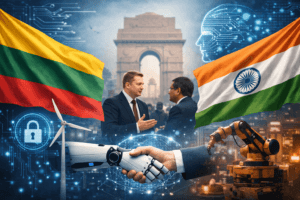
‘Tech Sovereignty Must Be Maintained’: Lithuania’s Delicate Dance with India Amid the Russia Shadow
The air in New Delhi is thick with the future. At the Impact AI Summit, a congregation of global tech leaders, policymakers, and visionaries, the conversations are less about ones and zeros and more about power, ethics, and independence. It is here that Edvinas Grikšas, Lithuania’s Vice-Minister for Economy and Innovation, navigates a complex diplomatic landscape. For a nation of just 2.9 million people, Vilnius punches far above its weight in the technology world. But for Grikšas, his first official visit to India is about more than just promoting Lithuanian fintech or AI capabilities; it is a delicate foray into a strategic partnership shadowed by the long-standing and deeply entrenched relationship between New Delhi and Moscow.
In an exclusive interview with ThePrint, Grikšas’s message was consistent and pointed: technology is the new theater of geopolitical independence, and for any partnership to thrive, there must be a shared vision of “technological sovereignty.”
The Sovereignty Dilemma in a Hyper-Connected World
“When I speak about cooperation, bilateral cooperation between Lithuania and India, it’s important to have the same priorities, to have the same approach to technological sovereignty,” Grikšas stated. “It is a part of security and is important, because AI can be used in every type of technology. It is important we create [technologies] bilaterally, that is how it should be.”
This is not merely diplomatic jargon. “Technological sovereignty” has become the defining mantra of the 21st century for mid-sized powers. For Lithuania, a nation that has stared down the barrel of hybrid warfare and disinformation campaigns from its eastern neighborhood, sovereignty means building systems that are resilient, secure, and free from malign external influence. It means ensuring that the code running critical infrastructure—from power grids to defense mechanisms—is trustworthy.
Grikšas’s comments subtly underscore a concern that permeates Central and Eastern European capitals: India’s continued strategic embrace of Russia. As Moscow’s war in Ukraine grinds past the three-year mark, India has not only maintained but deepened its energy ties with Russia, importing over $56 billion worth of oil last fiscal year. While New Delhi frames this as a matter of national energy security, nations like Lithuania, which share a border with Russian ally Belarus and have historic memories of Soviet occupation, view the flow of petrodollars as a direct enabler of Russian aggression.
However, Grikšas’s approach in New Delhi is not one of confrontation but of proposition. He is not in India to lecture but to offer an alternative path for collaboration. By emphasizing the need to build technologies bilaterally, he is subtly advocating for a partnership model that inherently excludes third-party meddling—a direct contrast to the concerns surrounding technology transfers involving Russia.
The Gateway to Europe: Lithuania’s Value Proposition
Beyond the geopolitical chess game lies a concrete opportunity. Lithuania is not just asking for trust; it is offering capability. The nation has successfully transformed itself from a post-Soviet state into a digital powerhouse. Today, the ICT sector accounts for roughly 7% of its GDP. It is home to a thriving ecosystem of “unicorns”—startups valued at over $1 billion—particularly in the niche of cybersecurity.
“We see ourselves as a hub because we are part of the European Union and we are quite a small country, but this gives us this agile approach,” Grikšas explained. “Lithuania is very dynamic, we are quite a digitalised country, so we have a mission to be a hub for AI, not only in Europe, but we see ourselves as a gateway to Europe.”
For Indian IT and tech giants looking to scale into the European market, this proposition is compelling. The EU is a notoriously complex regulatory environment. By partnering with a Lithuanian firm or establishing a presence in Vilnius, Indian companies can leverage the country’s deep understanding of EU regulations—from the General Data Protection Regulation (GDPR) to the upcoming AI Act. Lithuania’s recent securing of €130 million from the European Commission to build an AI factory further cements its role as a nucleus for innovation.
Grikšas sees a perfect symmetry here. “India’s ICT sector is growing very fast, and you have wonderful solutions in AI,” he noted. “Sharing good practices, maybe bringing our business-to-business cooperation… to build some products.” This is the language of co-creation, not just outsourcing. He envisions a future where a cybersecurity protocol designed in Vilnius is integrated into a massive Indian digital public infrastructure project, or where an Indian AI algorithm is optimized by Lithuanian fintech experts for the European banking sector.
Beyond Fintech: The Frontier of Cyber and Industry 5.0
While Lithuania is renowned in Europe as a fintech hub—thanks to a progressive regulatory sandbox and a high concentration of licensed electronic money institutions—Grikšas is keen to broaden the conversation. The future, he argues, lies at the intersection of physical and digital: Industry 5.0.
“Cyber security is one of the other parts, you know, advanced manufacturing,” he said. “When we speak about productivity, industry revolution 5.0 is already here, actually. It’s not only about digitalisation, it’s about robotics, it’s about using AI to be more productive.”
This is where the partnership potential becomes truly transformative. India is on a massive push to become a global manufacturing hub. Lithuania offers expertise in securing the “smart factory”—the interconnected web of robots, sensors, and AI that defines modern manufacturing. A cyberattack on a manufacturing plant can now halt physical production, destroy machinery, or compromise the integrity of the goods being produced. Protecting this requires a level of technological sophistication that Lithuania, with its two cybersecurity unicorns, can provide.
“The best possible way to be productive and competent,” Grikšas describes it, is to have “connected humans, for example, hand manufacturing, together with AI, with robotics.” This vision of human-machine collaboration is at the heart of Industry 5.0. By partnering with India, Lithuania is not just looking for a market; it is looking for a laboratory. India’s sheer scale and diversity provide a testing ground for technologies that can then be refined and exported back to Europe.
The Unspoken Question: Trust and Track Records
Sources within the Indian strategic community point out that New Delhi is not naive to these concerns. India has successfully navigated complex defense and technology partnerships with nations like France and Germany for decades. The track record with Paris on defense deals, such as the Rafale aircraft, has built a foundation of trust regarding the secure transfer of sensitive technology and the strict adherence to end-user agreements.
For Lithuania, still a relatively new player in the Indo-Pacific, the challenge is to build a similar track record. The recently signed India-EU Security and Defence Partnership provides a macro-level framework, but the micro-level relationships are built through summits like the one in New Delhi.
Grikšas acknowledges that security will be a recurring theme in his discussions. “Yeah, I guess we will have a lot of discussions, and this part of security, will be one of the topics, one of the main topics, maybe,” he conceded. But he frames this not as an obstacle, but as a common ground. In a world where AI is a dual-use technology—equally applicable to curing diseases and developing autonomous weapons—the dialogue on its safe and sovereign use is essential.
Conclusion: A Partnership of Agility and Scale
As the Impact AI Summit concludes, the takeaway from the Lithuanian delegation is clear: Vilnius is betting that its agility, its digital-first culture, and its position as a trusted EU member can outweigh the gravitational pull of India’s historical ties with Russia. It is a long-term play. Grikšas is not expecting an overnight shift in Indian foreign policy, but he is laying the groundwork for a parallel track of cooperation.
The relationship between India and Lithuania will likely not be defined by grand geopolitical statements, but by the quiet, steady work of engineers, coders, and entrepreneurs building products together. It will be defined by whether a Lithuanian cybersecurity startup can solve a problem for an Indian manufacturer, or whether an Indian AI firm can help a Vilnius bank detect fraud more effectively.
In the end, Grikšas’s message of technological sovereignty resonates not as a critique of India’s past choices, but as an invitation to design its future. In a world increasingly fragmented by tech blocs, the partnership between a digital hub and a scaling giant—built on a foundation of shared sovereignty—may just be the template for 21st-century diplomacy. It is a dance of delicacy and determination, and for now, Lithuania is leading with an open hand, hoping India chooses to grasp it.
You must be logged in to post a comment.