
Tarmeem: India’s Genetic Milestone Turns One and Sparks Debate on Food’s Future
India’s first gene-edited sheep, named Tarmeem, is thriving at one year old, showing normal health and a significant 10% increase in muscle mass compared to its non-edited twin after researchers at Sher-e-Kashmir Agricultural University successfully used CRISPR technology to “knock out” the myostatin gene that limits muscle growth. This scientific milestone, achieved after seven years of research, aims to address the Kashmir Valley’s mutton production deficit by creating more efficient livestock, though its future application in farming depends on government approval amidst ongoing global debates about the ethics and regulation of gene-edited animals versus genetically modified organisms.
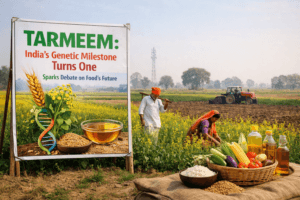
Tarmeem: India’s Genetic Milestone Turns One and Sparks Debate on Food’s Future
A Scientific Breakthrough in the Kashmir Valley
In a secure enclosure at the Sher-e-Kashmir Agricultural University in Srinagar, a remarkable sheep named Tarmeem recently celebrated its first birthday. Born on December 16 last year alongside a non-edited twin sister, Tarmeem represents far more than just another animal—it embodies India’s first successful venture into gene-edited livestock. The Arabic word for “modification” or “editing,” Tarmeem’s name reflects the scientific precision that brought her into existence through CRISPR technology, a biological system that allows scientists to edit DNA with unprecedented accuracy.
The researchers behind this achievement have spent seven years pursuing this milestone. “We started from zero,” admits Prof. Riaz Shah, dean of faculty of veterinary sciences and principal investigator on the project. “There were a few false starts. We tried multiple strategies, and the breakthrough finally came in December 2024.” The team conducted seven IVF procedures resulting in five live births and two abortions, with successful gene-editing achieved in only one—Tarmeem herself.
The Science Behind the Sheep
The researchers targeted a specific gene known as myostatin, which functions as a natural limiter of muscle growth in mammals. By using CRISPR-Cas9 technology—often described as “molecular scissors”—they successfully “knocked out” this gene in sheep embryos. Dr. Suhail Magray, a researcher on the project, explains the process: “We extracted a number of embryos from pregnant sheep and edited the myostatin gene. The embryos were kept in controlled laboratory conditions for two-three days after which they were transferred to a female sheep—the foster recipient.”
The results have been promising. According to Prof. Shah, Tarmeem is “growing well, showing normal physiological, biochemical and physical parameters.” Most significantly, her muscle growth has shown an approximately 10% increase compared to her non-edited twin, with researchers expecting this difference to potentially widen as she matures. This targeted genetic alteration demonstrates how precise gene-editing differs dramatically from earlier genetic modification techniques that introduced foreign DNA from completely different species.
Global Context and Applications
Globally, gene-editing in livestock is advancing rapidly, though with varying regulatory approaches:
- Medical applications: Research sheep have been genetically modified since the 1990s, like the UK’s “Tracy” who produced therapeutic proteins in her milk
- Food production: Countries including Argentina, Australia, Brazil, Colombia, and Japan already treat certain gene-edited animals as equivalent to conventional ones for consumption
- Disease resistance: The US and China are developing disease-resistant crops and animals through gene-editing, with the US FDA recently approving a genetically enhanced pig
- Human medicine: CRISPR technology, which earned its discoverers a Nobel Prize in 2020, is already being used to treat blood disorders like sickle cell anemia and thalassemia in humans
The Kashmir Valley’s Meat Deficit Challenge
The motivation behind Tarmeem’s creation extends beyond scientific curiosity to address practical food security concerns. The Kashmir Valley presents a stark imbalance between meat production and consumption—while the region consumes approximately 60,000 tonnes of mutton annually, local production meets only half this demand. Prof. Nazir Ahmad Ganai, the university’s vice-chancellor, frames this challenge within broader resource constraints: “Land is getting squeezed, water is getting depleted, population is growing but space available for growing food is shrinking.”
Gene-editing offers a potential solution to this deficit. By increasing a sheep’s body weight by up to 30% through myostatin gene editing, farmers could theoretically produce more meat with fewer animals, reducing the environmental footprint of livestock production. This efficiency gain mirrors the Green Revolution of the 1960s that transformed India’s agricultural productivity through high-yield crop varieties. Prof. Ganai envisions a similar transformation for the meat industry: “India became food-surplus through science. With gene-edited sheep and other animals, India can do the same for the meat industry.”
Ethical Considerations and Regulatory Landscape
Despite the scientific promise, gene-edited animals remain controversial, particularly regarding their distinction from genetically modified organisms (GMOs). Scientists emphasize that gene editing involves tweaking existing genes within an organism, while genetic modification typically introduces foreign genes from different species. This distinction has prompted varied regulatory responses worldwide:
- The European Union maintains strict restrictions, though it recently voted to reduce oversight for gene-edited crops
- The United Kingdom plans to allow gene-edited foods starting next year
- India’s agriculture ministry has already approved two gene-edited rice varieties aimed at boosting yields
The regulatory fate of Tarmeem and potential future gene-edited livestock in India remains uncertain. Prof. Shah notes that while experimentation continues to evaluate health and survival parameters, the team has “submitted a research project to the government for funding support.” Any broader application would require explicit government approval for farming or consumption—a process that will likely involve careful consideration of ethical, safety, and environmental concerns.
Broader Implications for Indian Agriculture
Tarmeem’s successful development represents more than an isolated achievement—it signals India’s growing capacity in advanced agricultural biotechnology. The country has numerous institutions working on gene-editing applications across different species, including pigs, goats, and poultry. This research aligns with global trends toward using biotechnology to address food security challenges in the face of climate change and population growth.
The potential benefits extend beyond meat production to include:
- Developing disease-resistant livestock that require fewer antibiotics
- Creating animals better adapted to changing climatic conditions
- Reducing the environmental impact of livestock through improved feed efficiency
- Enhancing animal welfare by reducing susceptibility to certain diseases
However, these potential benefits must be weighed against legitimate concerns about unintended consequences, corporate control of genetic resources, and impacts on traditional farming communities. The future of gene-editing in Indian agriculture will likely be shaped by how these complex considerations are balanced.
Looking Ahead: From Laboratory to Landscape
As Tarmeem approaches adulthood under close scientific observation, her development continues to provide valuable data about the long-term effects of myostatin gene editing in sheep. The research team has established standardized protocols through this pioneering work, potentially increasing success rates for future gene-editing attempts. Prof. Shah expresses optimism about the technology’s trajectory: “We have now standardized the practice and I think the success rate would be high in future.”
The journey from laboratory breakthrough to practical application remains uncertain, but Tarmeem has undoubtedly opened a new chapter in India’s agricultural biotechnology narrative. Her first year of life represents both a scientific achievement and a conversation starter about how emerging technologies might reshape our food systems. As climate pressures intensify and global populations grow, such innovations will likely play an increasingly prominent role in discussions about sustainable food production.
In the protected enclosure in Srinagar, Tarmeem and her twin sister continue their parallel lives—one representing the future of biotechnology, the other representing traditional genetics. Together, they embody the choices and challenges facing societies worldwide as we determine what role gene-editing should play in feeding humanity while respecting biological integrity and ethical boundaries.
You must be logged in to post a comment.