
Targeted for Speaking Out: The Foiled Plot Against Palestinian American Activist Nerdeen Kiswani
US law enforcement foiled a plot to assassinate Palestinian American activist Nerdeen Kiswani, arresting 26-year-old Alexander Heifler on charges of unlawfully possessing and making firearms after a weeks-long NYPD undercover sting. According to a criminal complaint, Heifler assembled about eight Molotov cocktails while an undercover officer was present and had allegedly obtained Kiswani’s address, planning to flee to Israel after the attack. The NYPD commissioner confirmed the undercover officer worked for the department’s racially and ethnically motivated extremism unit, and Mayor Zohran Mamdani noted Heifler was linked to an offshoot of the Jewish Defense League, an FBI-designated violent extremist group. Kiswani, founder of the pro-Palestine group Within Our Lifetime, has faced prior harassment from far-right pro-Israel organizations like Betar, which she recently sued for stalking and offering bounties. Following the foiled plot, Kiswani vowed to continue speaking out for Palestinians, while supporters condemned the attempted political violence.
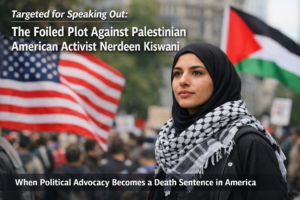
Targeted for Speaking Out: The Foiled Plot Against Palestinian American Activist Nerdeen Kiswani
When political advocacy becomes a death sentence in America
The call came late Thursday night. Nerdeen Kiswani, a 30-something Palestinian American activist known for organizing some of New York City’s largest pro-Palestine protests, picked up her phone to receive news that would shatter any remaining illusion of safety for vocal critics of Israeli policy on American soil.
The FBI’s Joint Terrorism Task Force had a message: someone was planning to kill her. And they were about to act.
By the time Kiswani processed those words, federal agents had already arrested 26-year-old Alexander Heifler in Hoboken, New Jersey. The criminal complaint, unsealed Friday, paints a chilling picture of a weeks-long undercover operation that intercepted what authorities describe as a nascent act of political violence—one that allegedly involved Molotov cocktails, a targeted address, and plans to flee to Israel afterward.
The Anatomy of a Sting Operation
The details emerging from the complaint reveal how close this plot came to realization—and how law enforcement managed to intercept it at the eleventh hour.
According to court documents, an undercover NYPD officer first encountered Heifler in a group video call where he openly solicited assistance with “molotovs.” What followed was a carefully choreographed dance of surveillance and engagement. The undercover officer met with Heifler multiple times, gradually building the trust necessary to monitor his intentions in real-time.
At one critical juncture, Heifler mentioned having an address for the intended “victim”—a term the complaint deliberately leaves unnamed, though all evidence points to Kiswani. The tipping point came Thursday night, when the undercover officer was present at Heifler’s residence as he assembled approximately eight Molotov cocktails.
That was when law enforcement moved in.
“He had planned to leave the country shortly after the foiled attack,” the complaint states, suggesting Heifler envisioned a clean escape. Instead, he now faces federal charges of unlawfully possessing and making firearms—charges that may expand as investigators dig deeper into his networks and intentions.
The Activist at the Center of the Storm
For those who follow Palestinian activism in the United States, Kiswani’s name is anything but obscure. As the founder of Within Our Lifetime (WOL), she has been a leading organizational force behind many of the New York City protests that erupted following Israel’s war on Gaza.
Her activism has made her a lightning rod. Pro-Israel groups, particularly Betar—a far-right organization the FBI has designated as a “known violent extremist organization”—have relentlessly targeted her. In February, Kiswani filed a federal lawsuit against Betar USA, alleging years of stalking, harassment, and what she described as social media “bounties.”
“For years, Betar USA stalked & harassed me even offering $1,800 for someone to hand me a beeper while I was pregnant,” Kiswani wrote on X at the time. The reference to a beeper—a device that in other contexts has been used in explosive attacks against Hezbollah members—carried particularly sinister implications.
The group recently ceased its New York operations as part of a settlement with New York Attorney General Letitia James, whose office investigated Betar for “bias-motivated assaults, threats and harassment targeting Muslim, Arab, Palestinian and Jewish New Yorkers.” Yet even after the foiled plot became public, Betar’s response was anything but conciliatory.
“Violent terrorist Nerdeen Kiswani wants to globalize the intifada not surprising if other terrorists targeted her,” the group wrote in a social media post commenting on the arrest.
The Political Ecosystem of Threats
Kiswani has been explicit about whom she holds responsible for creating the climate that nearly cost her life. In her initial post about the foiled plot, she named two specific targets: Betar and Florida Republican Representative Randy Fine.
Fine, who has made repeated Islamophobic remarks throughout his political career, has previously singled out Kiswani for public criticism. The congressman did not immediately respond to requests for comment following the arrest.
New York City Mayor Zohran Mamdani, in a statement released Friday, went further than merely condemning the plot. He explicitly linked Heifler to “an offshoot of the Jewish Defense League”—a group with a long and violent history in the United States. The Jewish Defense League, founded by Meir Kahane in the late 1960s, has been tied to numerous bombing plots, assassination attempts, and acts of political violence over five decades.
“The defendant reportedly planned to flee to Israel following the attack,” Mamdani added, noting a pattern that has appeared in other cases of political violence by American extremists seeking safe harbor abroad.
The Complicated Figure of Nerdeen Kiswani
Any honest examination of this case must acknowledge that Kiswani is not a universally beloved figure even within pro-Palestine circles. Her rhetoric has drawn criticism from some fellow activists, and she has publicly feuded with Mayor Mamdani himself over positions she views as insufficiently supportive of the Palestinian cause.
Within Our Lifetime’s stated positions have included support for armed resistance and the claim that Palestine must be liberated “by any means necessary.” The group has called for Zionists to be banned from public life—language that critics argue crosses into discriminatory territory.
Kiswani has consistently rejected accusations of antisemitism, maintaining that her activism targets the state of Israel and its ideology of Zionism, not Jewish people as a whole. It’s a distinction she has made repeatedly, even as opponents have labeled her a “terrorist” or “terror supporter.”
None of that complexity, however, justifies a plot to kill her with Molotov cocktails at her home—presumably while her family, including her child, might have been present.
The Broader Context of Targeting Palestinian Voices
The foiled plot against Kiswani does not exist in isolation. It unfolds against a backdrop of increasing state and non-state pressure on Palestinian activists in the United States, particularly since October 7, 2023.
Mahmoud Khalil, the Columbia University student activist whose three-month detention by ICE became a national cause célèbre, responded to news of the plot with visible anger. “Another attempt to intimidate and silence Palestinians speaking out against Israel’s genocide and for Palestinian freedom,” he wrote.
Khalil’s case—he was detained despite being a legal permanent resident—represented the state’s own apparatus being deployed against a student activist. The Kiswani plot represents something arguably more terrifying: the specter of vigilante violence, enabled by a political climate in which certain forms of anti-Palestinian animus have been normalized, if not outright encouraged.
Brooklyn Borough President Antonio Reynoso connected the dots explicitly. “This is horrifying but not surprising in a political climate where our own president constantly sows division and pushes extremist rhetoric,” Reynoso said.
The Role of Undercover Policing
The NYPD’s involvement raises its own set of questions. The undercover officer who infiltrated Heifler’s planning process worked for the department’s “racially and ethnically motivated extremism unit”—a specialized team created to track threats from white supremacists, anti-government extremists, and other ideologically driven actors.
Police Commissioner Jessica Tisch praised the unit’s work. “Our undercover officer identified and tracked the threat—first online and then in person—allowing us to disrupt the planned attack, take Heifler into custody, and ensure that no one was harmed,” she wrote.
But civil liberties advocates have long raised concerns about undercover operations, particularly when they involve officers who may participate in planning activities or provide material support to suspects. The line between “tracking a threat” and “enabling an attack” can blur in real-time, and courts have occasionally suppressed evidence from stings deemed to constitute entrapment.
No such claims have emerged in this case yet. But the involvement of an undercover officer who was physically present while Heifler assembled Molotov cocktails will almost certainly become a focus of any potential defense.
A Pattern of Political Violence
The Kiswani plot joins a growing list of foiled or actualized political violence targeting Americans based on their views about Israel and Palestine.
In March 2026—just weeks before this plot—two teenagers were charged over what authorities described as an “Islamic State-inspired” attack outside Mayor Mamdani’s own home. In 2025, a Palestinian American teenager was shot dead by an Israeli settler, according to officials. The Department of Homeland Security has repeatedly warned of heightened threats targeting Jewish, Muslim, Arab, and Palestinian communities since the Gaza war began.
What distinguishes the Kiswani case is the alleged perpetrator’s reported plan to flee to Israel. That detail suggests a transnational dimension to the threat—one that implicates not just American extremists but potentially networks that view violence against Palestinian activists as not merely permissible but laudable.
What Comes Next
Heifler currently faces only firearms-related charges, but the investigation is almost certainly ongoing. Federal prosecutors in New Jersey will likely present evidence to a grand jury seeking additional counts, which could include stalking, hate crimes, or even attempted murder charges if the evidence supports them.
Kiswani, for her part, has vowed to continue her activism. “I will not stop speaking up for the people of Palestine,” she wrote, even as she acknowledged the gravity of what authorities had prevented.
Whether that resolve holds as the full details of the plot emerge—and as Kiswani processes the knowledge that someone had her address, assembled bombs, and planned to use them—remains to be seen.
For now, what’s clear is that a specific threat has been neutralized. What’s less clear is whether the political climate that enabled it will change, or whether the next activist to speak out will find their own undercover officer watching—or something far worse.
You must be logged in to post a comment.