
Supreme Court’s Busy Tuesday: Three Key Verdicts That Reshape India’s Legal Landscape
The Supreme Court delivered three significant rulings this week, addressing political vendettas, investigative failures in terror cases, and foundational questions of religious freedom: it dismissed a plea against Telangana CM Revanth Reddy, warning that political battles should not be fought in courts; it agreed to examine the Uttar Pradesh government’s challenge to the acquittal of four death row convicts in the 2007 CRPF camp terror attack, where the High Court had cited severe investigative lapses; and it scheduled a nine-judge bench hearing from April 7, 2026, to determine the constitutional scope of religious freedom across faiths, including the Sabarimala temple entry dispute, Dawoodi Bohra excommunication, and Parsi women’s entry into fire temples—a ruling that will reshape India’s secular framework.
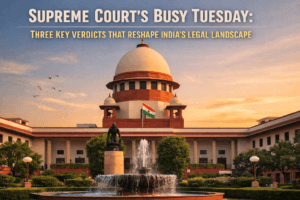
Supreme Court’s Busy Tuesday: Three Key Verdicts That Reshape India’s Legal Landscape
The Supreme Court of India delivered three significant rulings on a single day this week, each touching different aspects of the nation’s complex legal fabric. From protecting elected representatives from political vendettas to revisiting the constitutional framework of religious freedom, the bench led by Chief Justice Surya Kant addressed matters that will have far-reaching implications for Indian democracy and secularism.
Part I: Political Battles Don’t Belong in Courts — SC Upholds Clean Chit to Telangana CM
In a ruling that reaffirms the boundary between political rivalry and criminal prosecution, the Supreme Court on Monday dismissed a plea challenging the Telangana High Court’s decision to quash criminal proceedings against Chief Minister A Revanth Reddy under the SC/ST (Prevention of Atrocities) Act .
The Case That Never Should Have Been
The matter traced back to a 2016 FIR registered at Gachibowli police station, where the complainant—associated with the SC Mutually Aided Cooperative Housing Society Limited—alleged that at Reddy’s instigation, his brother and others had trespassed on society land and demolished two rooms. The complainant further claimed that “casteist remarks” were made against him .
What made this case particularly troubling was the sheer lack of evidence tying Reddy to the incident. The high court had already quashed the proceedings in July 2025, finding no factual or legal basis for the allegations. Reddy wasn’t present at the spot, no witness placed him there, and the prosecution couldn’t produce any material linking the Congress leader to the alleged offense .
Yet the complainant persisted, bringing the matter to the Supreme Court.
“Adventurous Litigation” and Judicial Wisdom
The bench comprising Chief Justice Surya Kant, Justice Joymalya Bagchi, and Justice Vipul M Pancholi delivered a masterclass in judicial restraint. Senior advocate Siddharth Luthra, appearing for the Chief Minister, didn’t mince words—he called the petitioner an “adventurous litigant” who had previously made scurrilous allegations against the high court judge handling the matter .
The court’s observations cut to the heart of what distinguishes genuine grievances from political vendettas.
“We read in between lines, how these political battles take place,” the bench observed, noting that the high court’s view was both “possible and plausible” given that the allegations were “inferential in nature with no material to establish the role of the present CM” .
The court went further, explaining why mere inference cannot sustain criminal prosecution: “Nobody saw him at the spot or had seen him confer with anyone. Even if in a situation, a person is not there and a miscreant states that what is being done is at the instance of this person, we can understand. But here it is only inferential. And you also have an earlier dispute with him” .
A Warning Against Weaponizing Courts
Perhaps the most significant aspect of the ruling came in the form of a broader observation about the role of courts in democratic societies. The Chief Justice explicitly stated that “political battles should not be fought in courts” .
This statement carries profound implications for India’s increasingly litigious political landscape. When every electoral rivalry transforms into criminal litigation, courts become battlegrounds rather than arbiters of justice. The Supreme Court’s refusal to entertain such manufactured disputes sends a clear signal: the judiciary will not be a tool for political harassment.
The bench made clear that while it wasn’t issuing Reddy a “clean chit,” the high court’s thorough examination of the facts revealed no prima facie case. The high court had “minutely considered the facts of the case and found that no prima facie case is made out” .
The contempt angle added another layer. In earlier proceedings, the Supreme Court had taken strong note of the “scandalous and scurrilous allegations” made against the high court judge. While contempt proceedings were closed after the litigant and his lawyers apologized, the court cautioned that such conduct “undermines the integrity of the judicial system and must be strongly deprecated” .
Why This Matters
For the average citizen, this ruling reinforces that criminal law cannot be invoked casually against public figures. The protection extends both ways—legitimate grievances deserve hearing, but manufactured complaints waste judicial time and weaponize legal processes.
For political figures across party lines, the message is equally clear: if you can’t win at the ballot box, don’t seek victory through litigation.
Part II: Justice Delayed but Not Denied — The CRPF Camp Attack Case Returns to Supreme Court
In a separate development, the Supreme Court agreed to examine the Uttar Pradesh government’s appeal against the Allahabad High Court’s acquittal of four death row convicts in the 2007 Rampur CRPF camp terror attack .
A Night of Horror, Years of Litigation
The facts of the case are chilling. On the night of December 31, 2007, as the nation prepared to welcome the New Year, gunfire erupted near the CRPF Group Centre Gate in Rampur. When the firing ceased, eight CRPF personnel lay dead, with five others wounded .
The trial court convicted four men—Mohd Sharif, Sabauddin, Imran Shahjad, and Mohd Farooq—under Section 302 IPC and Section 149, sentencing them to death. A fifth accused, Jang Bahadur Khan, received life imprisonment. All were also convicted under the Unlawful Activities (Prevention) Act .
The High Court’s Stinging Rebuke
But in October 2025, the Allahabad High Court delivered a verdict that exposed serious flaws in the investigation and prosecution. The high court didn’t just acquit the accused—it delivered a scathing critique of how the entire case was handled.
The court observed that “this case would have met a different result had the investigation and the prosecution been conducted by more trained police” .
The problems were fundamental and numerous:
Eyewitness identification failures: The eyewitnesses didn’t know the accused beforehand, and the incident occurred at night. Yet the investigating agency failed to conduct Test Identification Parades—a basic requirement when witnesses are identifying strangers .
Compromised evidence: Fingerprints allegedly lifted from glass panes at the CRPF camp weren’t kept in safe custody. Empty cartridges and firearms recovered from the scene weren’t properly stored in the police malkhana .
Forensic mismatches: The bullets recovered from the camp didn’t match test bullets, raising the possibility of tampering .
UAPA charges not established: The high court found that the offense under the Unlawful Activities (Prevention) Act wasn’t made out.
The result? Complete acquittal on murder charges and UAPA offenses. The accused were, however, convicted under Section 25(1-A) of the Arms Act for possessing prohibited articles without authorization, receiving ten years of rigorous imprisonment .
The State’s Challenge
The Uttar Pradesh government now approaches the Supreme Court, seeking to restore the death sentences. A bench of Justices Vikram Nath and Sandeep Mehta issued notice to the accused and posted the matter for hearing .
The state’s challenge raises profound questions about the balance between investigative failures and the gravity of the offense. Eight CRPF personnel lost their lives. Their families have waited nearly two decades for justice. Yet the high court found that the prosecution “miserably failed to prove the case against the accused for the principal offence beyond reasonable doubt” .
The Deeper Implications
This case exposes a troubling pattern in terrorism-related prosecutions: the urge to secure convictions sometimes overshadows the need for proper procedure. When investigations are sloppy, evidence is compromised, and basic safeguards are ignored, even genuine cases can collapse.
The Supreme Court now faces a difficult task. It must weigh the horrific nature of the crime against the constitutional requirement that guilt be proven beyond reasonable doubt. If the investigation was indeed as flawed as the high court found, can the death sentences be restored? Or does the remedy lie elsewhere—perhaps in fixing the systemic failures that allowed such a case to falter?
For the families of the slain CRPF personnel, this represents another painful chapter in an already agonizing wait. For the accused, it means continued uncertainty about their fate. And for the criminal justice system, it’s yet another reminder that proper investigation isn’t a technicality—it’s the foundation of justice itself.
Part III: Sabarimala and Beyond — The Nine-Judge Bench That Will Redefine Religious Freedom
The most consequential legal development this week concerns not a single case but a cluster of matters that together will reshape how India understands religious freedom. The Supreme Court announced that a nine-judge bench will commence hearing the Sabarimala reference from April 7, 2026 .
From Temple Entry to Constitutional Transformation
What began as a dispute over women’s entry into the Sabarimala temple has evolved into something far more significant. The September 2018 verdict by a five-judge bench—which lifted the ban on women aged 10-50 entering the Ayyappa shrine—sparked massive protests and review petitions .
In November 2019, a different five-judge bench took the rare step of referring the matter to a larger bench, recognizing that the issues involved extended far beyond Sabarimala . The court framed seven questions that touch the very foundation of India’s constitutional scheme regarding religion.
The Seven Questions That Will Define India’s Secularism
The questions the nine-judge bench will address are remarkably broad and profound :
First, what is the scope and ambit of the right to freedom of religion under Article 25? This seems straightforward until one realizes that Article 25 guarantees freedom “subject to public order, morality and health” and to other fundamental rights. How far can the state interfere with religious practices?
Second, how do individual rights under Article 25 interact with the rights of religious denominations under Article 26? This question captures the tension between an individual’s claim to equality and a community’s claim to autonomy.
Third, are denominational rights under Article 26 subject to other fundamental rights besides public order, morality, and health? The wording of Article 26 doesn’t explicitly include the “other fundamental rights” limitation that Article 25 contains. Is that omission significant?
Fourth, what does “morality” mean under Articles 25 and 26? Specifically, should “morality” be understood as constitutional morality rather than majoritarian social morality? This question could fundamentally alter how courts approach religious practices that discriminate.
Fifth, how far can courts inquire into religious practices? Can judges determine what is “essential” to a religion, or should that determination be left to religious communities?
Sixth, what does “sections of Hindus” mean in Article 25(2)(b)? This matters because it determines which groups can claim the protections available to Hindu denominations.
Seventh, can someone who doesn’t belong to a religious denomination challenge its practices through public interest litigation? This question addresses who has standing to bring such challenges.
Beyond Sabarimala: The Other Faiths in the Dock
The Sabarimala review won’t be heard in isolation. The nine-judge bench will also examine other longstanding religious disputes :
The Dawoodi Bohra community’s practice of excommunication has been pending for 39 years—making it the oldest constitution bench case. When a member is excommunicated, they face social boycott and denial of entry to places of worship. Does this violate fundamental rights?
Parsi women’s entry to fire temples after marrying outside the community raises similar questions about religious identity and gender discrimination. Does a Parsi woman lose her religious identity by marrying a non-Parsi under the Special Marriage Act?
Muslim women’s entry into mosques and dargahs will also be examined, though the specific questions remain to be framed.
The Political Temperature Rises
The timing of the hearing—mid-campaign in Kerala, which heads to elections—has amplified political stakes .
The Centre, through Solicitor General Tushar Mehta, has made its position clear: it supports the review petitions, meaning it opposes women’s entry into Sabarimala . This places the Union government in alignment with traditionalist voices.
In Kerala, the political battle lines are sharply drawn. The CPI(M)-led Left government has adopted a cautious tone. Law Minister P Rajeev emphasized that the matter cannot be reduced to a binary choice and that the state will clarify its stand after detailed examination .
The opposition Congress demands that the government immediately file a revised affidavit. Leader of Opposition V D Satheesan accused the administration of political duplicity, questioning why discussion is needed to change a position .
The BJP, too, has flagged concerns about potential government flip-flops with elections approaching .
Hindu organizations like the Nair Service Society and Sree Narayana Dharma Paripalana Yogam have reaffirmed their opposition to allowing women of menstruating age into the shrine, recalling the massive protests that followed the 2018 verdict .
What’s at Stake
The seven questions before the nine-judge bench go to the heart of India’s identity as a secular republic. The answers will determine:
- Whether religious communities have autonomy to determine their own practices, free from judicial scrutiny
- Whether individual rights—particularly of women and marginalized groups—can override denominational claims
- What “morality” means in constitutional adjudication
- Who gets to challenge religious practices in court
The bench will also need to grapple with how its ruling affects different faiths differently. Hinduism, with its decentralized structure and diverse practices, may be affected differently than Islam, with its more unified theological framework, or the Parsi community, with its small numbers and tight-knit organization.
The Path Forward
The court has set an ambitious schedule: written submissions by March 14, hearings from April 7 to April 22, with specific days allocated to review petitioners, opponents, and rejoinder arguments . The bench has appointed senior advocate K Parameshwar as amicus curiae, with counsel Krishna Kumar Singh representing review supporters and Shashwati Pari representing opponents .
Chief Justice Surya Kant will separately notify the composition of the nine-judge bench through an administrative order .
Conclusion: A Week That Captures India’s Judicial Moment
Taken together, these three developments capture the remarkable range of the Supreme Court’s work.
In the Telangana CM case, we see the court protecting the democratic process from being hijacked by litigation—insisting that political battles belong at the ballot box, not in courtrooms.
In the CRPF camp attack case, we see the tension between the demand for justice in terror cases and the constitutional requirement of proof beyond reasonable doubt. The court must navigate between honoring the memory of slain personnel and ensuring that convictions rest on solid evidence, not investigative shortcuts.
And in the Sabarimala reference, we see the court preparing to answer questions that have lingered since the Constitution was adopted. How does a modern republic reconcile individual equality with religious freedom? How much autonomy do religious communities retain in a constitutional order that guarantees fundamental rights? What does secularism mean in a society as deeply religious as India?
The nine-judge bench that assembles on April 7 won’t just decide about temple entry. It will articulate a vision of how religion and constitutionalism can coexist in the world’s most diverse democracy. That vision will affect every faith, every community, and every citizen who cares about both their religious identity and their constitutional rights.
As these matters unfold, one thing is clear: the Supreme Court remains the arena where India’s most fundamental disagreements are ultimately resolved. Whether the question is political vendettas, terrorist prosecutions, or religious freedom, the court’s word is final. The burden on the nine judges who will hear the Sabarimala reference is immense—but so is the opportunity to bring clarity to questions that have divided the nation for decades.
You must be logged in to post a comment.