
Suffocating in Silence: How Delhi’s Toxic Air Became a Battle for Democracy and Breath
Suffocating in Silence: How Delhi’s Toxic Air Became a Battle for Democracy and Breath
Introduction: The Annual Siege
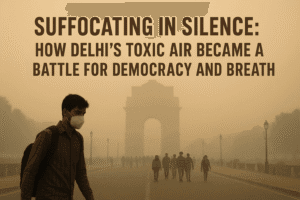
Every autumn, a familiar enemy descends upon India’s capital. It’s not an invading force, but a creeping, insidious blanket of grey-yellow haze that smothers the city of New Delhi. The air takes on an acrid, metallic taste that lingers in the back of the throat. Landmarks like India Gate and the Red Fort vanish into the gloom, their grandeur erased by a slurry of pollutants. Flights are grounded, schools oscillate between closure and uneasy operation, and hospitals brace for an annual influx of patients—children, the elderly, and the otherwise healthy—gasping for air.
This is not merely “bad air.” At its peak, the pollution reaches levels 30 times the World Health Organization’s (WHO) safe limit. The oft-repeated comparison to smoking dozens of cigarettes a day falls short; the reality is a complex cocktail of particulate matter (PM2.5), sulphur dioxide, nitrogen oxides, and other carcinogens, trapped under a meteorological lid known as a temperature inversion. The result is a sustained, public health emergency that, according to The Lancet, accounted for 1.67 million deaths in India in 2019.
But beneath the well-documented health crisis lies a deeper, more insidious malady: a crisis of democracy. The government’s cyclical inaction, the suppression of dissent, and the preference for political optics over systemic solutions are creating a capital where the very right to protest for clean air is being suffocated.
The Illusion of Action: Band-Aids on a Hemorrhaging Artery
The Indian government is not entirely idle. It has a “Graded Response Action Plan” (GRAP), a policy designed to trigger specific measures as air quality deteriorates. In theory, it’s a sensible, phased approach. In practice, critics argue it’s a case of too little, too late, activated only after the city is already choking.
The measures themselves often seem more theatrical than transformative. Anti-smog guns—water cannons mounted on trucks—patrol the streets, spraying a fine mist in a futile attempt to weigh down the microscopic particles poisoning the air. A massive, expensive smog tower stands as a monument to misguided ambition, its impact on the city’s atmosphere negligible at best.
This year, the desperation reached new heights with an attempt at cloud seeding. The plan was to inject silver iodide into the atmosphere to artificially induce rain, hoping the falling droplets would wash the pollutants from the sky. However, Delhi’s dry winter air lacked the necessary moisture, rendering the multi-crore experiment largely ineffective.
“These are band-aid methods,” says Saurav Das, a journalist and environmental activist who was recently diagnosed with bronchitis despite a healthy lifestyle. “They’re more focussed on perception management because these are not long-term solutions. The government is focused on crisis management, not prevention.”
This preference for technical quick-fixes avoids confronting the complex, politically challenging root causes of the pollution: industrial emissions, vehicle exhaust, construction dust, and most contentiously, the agricultural practice of stubble burning by farmers in neighboring states.
The Democratic Deficit: When Protest Becomes a Crime
Frustration boiled over in November 2025, leading to a rare citizen-led protest. Organized largely through WhatsApp and social media, it was a grassroots cry for a fundamental right: the right to breathe. Yet, in a stark demonstration of the shrinking space for civil dissent, the protest was quelled within an hour. Over 80 demonstrators, including women, children, and the elderly, were arrested.
Saurav Das, who helped amplify the protest call, has faced repeated police harassment since. “They compromised the integrity of the data, destroyed civic spaces, used unnecessary force,” he says. “Our democratic spaces are shrinking, our voices are not being heard, and we cannot breathe.”
The protest and its suppression highlight a critical failing of accountability. For years, political infighting between the central government and Delhi’s local government was blamed for the paralysis. However, the current ruling party, the Bharatiya Janata Party (BJP), now controls both. The betrayal felt by voters who expected change is palpable.
“The pollution issue cuts across party and ideological lines,” Das notes. “Everyone deserves clean air, regardless of who you voted for.”
Further eroding public trust were accusations of data manipulation. During Diwali, the government’s real-time air quality monitoring websites mysteriously went offline for hours. A viral video appeared to show officials spraying water directly around an air quality sensor, a blatant attempt to locally and temporarily lower the readings. The BJP denied the allegations, but the damage to institutional credibility was done.
The Chasm of Inequality: Who Gets to Breathe?
The burden of Delhi’s pollution is not borne equally. For the city’s middle and upper classes, escape is a luxury they can afford. They retreat into homes fortified with air purifiers, commute in cars with sealed windows and internal air filtration, and work in climate-controlled offices. The pollution, for them, is an inconvenience, a topic of dinner-table conversation, a reason to keep the children indoors.
For the millions living in poverty—the street vendors, rickshaw pullers, construction workers, and homeless families—there is no escape. They are on the front lines of this silent war, their lungs the primary filters for the city’s toxic air. They have no purifiers, no sealed vehicles, and no option to stay home. Their exposure is constant, and the long-term health consequences—cognitive impairment in children, increased cancer risk, chronic respiratory and cardiovascular disease—are a sentence they did not choose.
This inequality transforms the pollution from an environmental problem into a profound social justice issue. It is a daily reminder that the most basic elements of life, clean air and water, have become commodities, accessible only to those who can pay.
The Global Stage vs. The Home Front: A Hypocrisy on Display
The irony is piercing. As New Delhi choked, Indian delegates were in Belém, Brazil, leading talks on climate justice and emissions reduction for the Global South at the COP30 summit. India rightly argues that developed nations, historically responsible for the bulk of global emissions, must provide the financial resources to help developing nations adapt and transition to greener economies.
This position, articulated under Article 9.1 of the Paris Agreement, is valid and crucial. Avantika Goswami, a researcher at the Center for Science and Environment who attended COP30, defends India’s role. “It can’t be an either-or situation,” she argues. “Delhi’s pollution has to be tackled… At the same time, India needs to be at COP30 to fight for climate justice. Both things are important.”
However, from the ground in Delhi, this duality feels like hypocrisy. How can a nation credibly lead a charge for global environmental action when it cannot—or will not—ensure the basic respiratory health of its own capital’s citizens? The government’s actions at home—revoking firecracker bans, failing to implement GRAP proactively, and suppressing protests—directly contradict its rhetoric on the world stage.
“This hypocrisy will not go unnoticed,” Das states bluntly. It undermines India’s moral authority and signals that environmental action, whether local or global, is secondary to political expediency.
Beyond the Smog: A Path Forward Requires Political Will
The solution to Delhi’s airpocalypse is not a mystery. It requires a sustained, multi-pronged, and regionally coordinated strategy that moves beyond emergency responses to address the core issues:
- Agricultural Transition: Providing farmers with financial and technological support to transition away from stubble burning, perhaps by creating a market for crop residue.
- Industrial Regulation: Enforcing stricter emissions standards for industries and transitioning to cleaner fuels.
- Transport Revolution: Accelerating the shift to electric public transport and investing in robust pedestrian and cycling infrastructure.
- Data Transparency and Accountability: Ensuring real-time, unmanipulated air quality data is publicly available and holding agencies accountable for their targets.
- Empowering Civic Engagement: Protecting, not stifling, the right of citizens to protest and demand action from their government.
Delhi’s crisis is a cautionary tale for the world. It demonstrates that environmental degradation and democratic backsliding are two sides of the same coin. When a government ceases to listen to its people, it ceases to protect their most fundamental needs. The fight for clean air in Delhi is, ultimately, a fight for the soul of Indian democracy—a struggle to prove that in the world’s largest democracy, the voices of its citizens are stronger than the smog that seeks to silence them. The world is watching, and Delhi is struggling to breathe.
You must be logged in to post a comment.