
Strategic Leadership in a Power-Hungry Nation: What Binod Muni’s Ascension at Eaton Signals for India’s Electrical Future
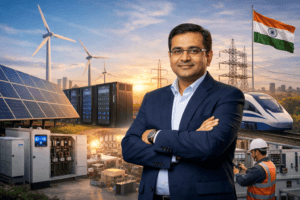
Strategic Leadership in a Power-Hungry Nation: What Binod Muni’s Ascension at Eaton Signals for India’s Electrical Future
In a move that blends continuity with strategic evolution, intelligent power management giant Eaton has announced the appointment of Binod Muni as the Managing Director of its Electrical business in India, effective January 1, 2026. This leadership transition, set against the backdrop of India’s monumental infrastructure and energy transition goals, is more than a routine corporate reshuffle. It represents a calculated play by a global industrial leader to navigate one of the world’s most complex and high-growth electrical markets.
Succeeding the retiring Syed Sajjadh Ali, whose 17-year tenure solidified Eaton’s foundations in the region, Muni steps into a role of immense opportunity and equally significant challenge. His appointment offers a lens through which to examine not just Eaton’s corporate strategy, but the broader currents shaping India’s quest for reliable, intelligent, and sustainable power.
A Foundation Forged in Growth
To understand the weight of this role, one must first appreciate the landscape Eaton has helped shape over two decades in India. With over 6,300 employees spread across innovation centers, manufacturing plants, and commercial hubs, Eaton is deeply embedded in the country’s industrial fabric. The company’s commitment to the ‘Make in India’ vision is not mere rhetoric; it’s a operational reality seen in its local manufacturing and R&D investments. This established presence provides Muni with a robust platform—a “strong foundation,” as he notes—comprising trusted customer relationships, local talent, and a comprehensive portfolio that serves sectors from data centers and utilities to aerospace and mobility.
Syed Sajjadh Ali’s legacy is one of market cultivation. He steered the business through a period of rapid urbanization and initial forays into renewable integration. The task now evolves from building a strong player to orchestrating a market leader capable of dictating tempo in an era defined by urgency.
The Binod Muni Profile: A Blend of Finance and Field
What does Binod Muni bring to the table? His 27-year career is a study in strategic diversity. Unlike a pure-play engineer or sales leader, Muni’s path spans sales, business development, and crucially, finance. His stints at Schneider Electric, Saint-Gobain, and Carrefour represent a mosaic of experiences across different facets of industrial and consumer business. This hybrid background is arguably his greatest asset.
In a market like India, where price sensitivity competes with an urgent need for cutting-edge technology, a leader who can simultaneously appreciate margin structures, supply chain economics, and customer-facing strategy is invaluable. His prior role as Eaton’s Country Head – Sales and Marketing since August 2024 provided a crucial runway, allowing him to diagnose the market’s pulse before taking the helm. His stated priorities reflect this balanced approach: differentiated go-to-market strategies, accelerated product localization, value engineering, and supply chain resilience. These are not siloed goals but interconnected pillars of a sustainable growth model.
The Indian Context: A Nation at an Electrical Crossroads
Muni’s leadership will be tested against India’s staggering electrical ambitions. The nation is engaged in a multi-front war: to universalize reliable grid power, to massively integrate renewable energy, to modernize a sprawling but often strained transmission network, and to electrify its mobility sector. Each of these represents a multi-billion dollar opportunity fraught with complexity.
For a company like Eaton, this translates into demand for everything from circuit breakers and switchgear in new data centers, to advanced power quality solutions for semiconductor fabs, to grid-edge technologies that can manage the volatility of solar and wind power. The challenge isn’t just selling products; it’s providing integrated systems that enhance efficiency, safety, and sustainability. Muni’s focus on “technology localization” is key here—adapting global innovations to withstand India’s unique environmental conditions, voltage fluctuations, and usage patterns is a critical success factor often overlooked by multinationals.
Strategic Imperatives: Where Theory Meets Reality
Diving deeper into Muni’s announced priorities reveals a clear roadmap:
- Market Share Expansion via Differentiation: In a crowded market with entrenched domestic and international players, Eaton cannot compete on volume alone. Differentiation will come through intelligence—offering digital, connected products that provide data and control, moving from being a component supplier to a solutions partner. This aligns perfectly with Eaton’s global narrative of intelligent power management.
- Innovation and Localization Speed: The “accelerated new product introductions” he mentions are vital. The global energy transition is moving at breakneck speed, and India will not wait. Speeding up the cycle from global R&D to locally relevant, manufacturable products will be a critical competitive edge. This ties directly to supporting India’s self-reliance goals.
- Value Engineering: This is the bridge between world-class technology and Indian market affordability. It involves re-engineering designs to optimize cost without compromising core performance or safety—a nuanced task requiring deep engineering and customer insight.
- Operational and Supply Chain Resilience: The lessons of global disruptions are fresh. Building a resilient, possibly regionalized, supply chain for critical components will ensure business continuity and instill customer confidence.
- Talent and Culture: Ultimately, executing this vision requires “a highly engaged, high-performing team.” Fostering a culture of innovation, agility, and customer-centricity within the Indian organization will be his most profound internal task.
The Road Ahead: Challenges and Opportunities
The path is not without obstacles. Muni will have to navigate intense competition, regulatory evolution, and the constant pressure of cost. However, the macro trends are powerfully in Eaton’s favor. The government’s push for manufacturing (PLI schemes), green hydrogen, data localization, and railway electrification creates vast, tailwind-driven segments.
His closing remark hits the right note: “support India’s evolving electrical and energy needs.” This positions Eaton not as a foreign vendor, but as a stakeholder in national development. It’s a compelling narrative that resonates with government and private sector partners alike.
Conclusion: A Leadership Appointment with National Resonance
Binod Muni’s appointment as Managing Director of Eaton’s Electrical business in India is a significant event in the country’s industrial corridor. It reflects a mature corporate strategy that values nuanced, financially-savvy leadership to harness hyper-growth. His success will not be measured by revenue alone, but by how effectively Eaton’s technology becomes woven into the infrastructure of a rising India—powering its data centers, stabilizing its green grid, and securing its factories.
For observers of India’s industrial and energy landscape, Muni’s tenure will be a case study in how global giants can localize intellect, operations, and strategy to win in this demanding yet rewarding market. The baton has been passed at a pivotal moment. The race to power India’s future is on, and Eaton, under its new pilot, has positioned itself on the starting grid with a finely tuned machine.
You must be logged in to post a comment.