
Strategic Compassion: Singapore’s Calculated Diplomacy in a Post-Ceasefire Middle East
In the wake of a fragile ceasefire, Singapore’s Foreign Minister Vivian Balakrishnan’s visit to the Palestinian Territories and Israel is a strategic demonstration of the city-state’s nuanced foreign policy, leveraging its uniquely trusted position with both sides to reaffirm its steadfast commitment to a negotiated two-state solution, while transitioning its support from immediate humanitarian aid—exemplified by a US$500,000 donation to the World Food Programme—toward a longer-term role in the future reconstruction and capacity-building essential for a just and lasting peace.
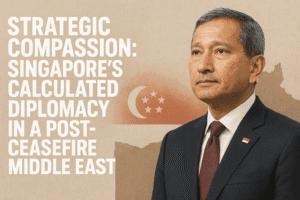
Strategic Compassion: Singapore’s Calculated Diplomacy in a Post-Ceasefire Middle East
In the fragile calm that follows conflict, the world’s diplomatic machinery whirs to life. The recent ceasefire between Israel and Hamas, a tentative pause in a war that has ravaged Gaza and horrified the globe, presents not just a humanitarian reprieve but a critical geopolitical window. It is into this complex and charged landscape that Singapore’s Foreign Minister, Dr. Vivian Balakrishnan, is stepping, leading a delegation to both the Palestinian Territories and Israel. This is more than a routine diplomatic mission; it is a masterclass in the nuanced, principled, and strategically vital foreign policy of a small state determined to punch above its weight.
While headlines will understandably focus on the US$500,000 cheque for the World Food Programme, the true significance of this visit lies in its timing, its symbolism, and its unwavering consistency with Singapore’s long-held national interests and moral convictions.
The Delicate Dance of a Small State
For a nation like Singapore, with no natural resources and a existence predicated on global trade and the stability of international law, a volatile world is an existential threat. Its foreign policy, therefore, cannot be built on whims or fleeting alliances. It is a doctrine of principle and pragmatism, a balance that Dr. Balakrishnan’s visit perfectly encapsulates.
- The Pragmatism of Access and Trust:A striking statement from the Foreign Minister underscores Singapore’s unique position: “I’m glad that Singapore has access and deep reservoirs of trust on both sides of this tragic conflict.” In a conflict defined by intractable positions and deep-seated animosity, this is a rare and valuable diplomatic commodity. This trust is not accidental. It has been painstakingly built over decades.
Singapore maintains good relations with Israel, from whom it learned critical lessons in national defense during its early years. Simultaneously, it has consistently supported the Palestinian right to self-determination and has long provided technical assistance and capacity-building programs for the Palestinian Authority. By not being seen as irrevocably tied to one side, Singapore positions itself as a credible, honest interlocutor. This allows it to “better understand the situation on the ground,” as Dr. Balakrishnan noted, gathering unfiltered intelligence and assessing the prospects for peace from a privileged vantage point.
- The Principle of the Two-State Solution:The visit “reaffirms Singapore’s commitment… to our support for the two-state solution.” This is not a new talking point trotted out for convenience. It is the bedrock of Singapore’s position, consistently reiterated even when it was politically inconvenient. During his visit in March 2024, Dr. Balakrishnan did not mince words in Jerusalem, telling Israeli leaders that their military actions in Gaza had “gone too far,” while in Ramallah, he expressed deep concern for the humanitarian crisis.
This balanced criticism demonstrates that Singapore’s support for a two-state solution is a principled stand for a just and lasting peace, not a partisan endorsement. It is a commitment to the only outcome that aligns with Singapore’s core belief in the inviolability of international borders and the right of all peoples to secure statehood.
Beyond the Headlines: The Layers of a Multifaceted Mission
Dr. Balakrishnan’s itinerary is a carefully constructed tapestry of humanitarian aid, political reinforcement, and future-looking reconstruction.
The Immediate: Humanitarian Lifelines The US$500,000 donation to the World Food Programme is a direct, tangible response to the catastrophic hunger in Gaza. However, Singapore’s humanitarian push extends beyond this. The commitment to support Egyptian hospitals and provide prosthetic supplies for approximately 100 Palestinian amputees in Jordan and Gaza is a profound example of targeted, compassionate aid. It addresses the horrific, long-term consequences of war—the shattered bodies and lives that will need support long after the immediate food crisis abates. This moves Singapore’s contribution from a financial transaction to a deeply human-centric recovery effort.
The Strategic: Reaffirming the Path to Peace The delegation’s presence so soon after the ceasefire is a powerful symbolic act. It signals to both Israeli and Palestinian leaders that the international community, including steadfast partners like Singapore, is watching and expects the truce to be a bridge to further negotiations. By meeting with leaders on both sides, Dr. Balakrishnan reinforces Singapore’s role as a consistent advocate for dialogue. His meetings are likely to involve frank discussions on preventing a return to full-scale conflict and the difficult compromises needed to make the next phase of the US-backed peace plan viable.
The Future: A Stake in Reconstruction Prime Minister Lawrence Wong’s statement that “Singapore is ready to do its part to rebuild Gaza” is a forward-looking commitment. For a nation renowned for its excellence in urban planning, port management, water security, and public housing, this is not an empty promise. Singaporean expertise could be invaluable in the future reconstruction of Gaza, from infrastructure development to public administration training. This visit allows Singapore to position itself at the table early, ensuring its capabilities are recognized and its companies considered when the time for large-scale rebuilding comes.
The Messengers Matter: A Delegation of Significance
The composition of the delegation is itself a message. Including Members of Parliament Yip Hon Weng and Hazlina Abdul Halim from the Government Parliamentary Committee for Defence and Foreign Affairs serves multiple purposes:
- Bipartisan Buy-in: It demonstrates that Singapore’s foreign policy enjoys support across its political establishment.
- Direct Accountability: It allows elected officials to witness the situation firsthand, making them more informed advocates and scrutineers of government policy upon their return.
- Grassroots Connection: The MPs can translate the complex realities of the conflict to their constituents, helping to ground Singapore’s international stance in domestic understanding.
Conclusion: The Singaporean Playbook on the World Stage
Dr. Vivian Balakrishnan’s working visit to the Palestinian Territories and Israel is a case study in how a small, globally integrated nation can exert meaningful influence. It refuses the binary choices that often define the conflict, opting instead for a path of principled engagement.
By coupling immediate humanitarian compassion with unwavering support for a long-term political solution, and by backing its words with tangible aid and technical promise, Singapore reinforces its identity as a responsible and consistent international actor. In a world increasingly fractured by great power rivalry and regional strife, this mission reaffirms a simple but powerful truth: that the size of a nation’s voice is not determined by its land mass, but by the clarity of its principles, the consistency of its actions, and the strategic depth of its compassion.
As the fragile ceasefire is tested, Singapore’s quiet, confident diplomacy offers a glimmer of what a more stable future could look like, built not on the triumph of one side over the other, but on the hard, unglamorous work of building trust, one difficult conversation at a time.
You must be logged in to post a comment.