
Strategic Autonomy Under Pressure: Decoding the Geopolitics of Putin’s India Visit
Russian President Vladimir Putin’s upcoming visit to India marks a pivotal moment in shifting global geopolitics, as both nations work to build a sanctions-resistant economic and defense partnership insulated from Western pressure. Despite a record $68.7 billion in bilateral trade—heavily skewed in Russia’s favor—India sees strategic value in deepening ties through rupee–ruble trade, independent banking channels, a potential FTA with the Eurasian Economic Union, and new cooperation in defense, logistics, nuclear energy, and skilled-worker mobility.
The U.S. has escalated pressure with steep tariffs linked to India’s import of Russian oil, even as some American strategists view a stronger India-Russia partnership as a potential wedge in the Russia-China axis—a “reverse Nixon” play. For India, the summit is a test of its strategic autonomy, balancing Western partnerships with long-term Russian cooperation in energy, defense, and critical resources. Ultimately, the meeting aims to future-proof a relationship central to India’s multipolar foreign policy while navigating the risks of great-power rivalry.
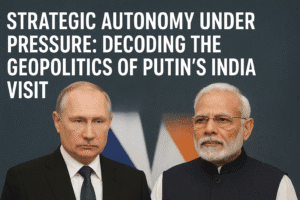
Strategic Autonomy Under Pressure: Decoding the Geopolitics of Putin’s India Visit
The Kremlin’s spokesperson framed India’s challenge with U.S. tariffs as a bilateral issue, but Russia’s actions reveal a deliberate strategy: to build an economic and defense partnership so insulated from Western pressure that it becomes untouchable.
Russian President Vladimir Putin’s upcoming visit to India—his first since the war in Ukraine began—is more than a routine diplomatic exchange. It is a strategic maneuver in a high-stakes geopolitical chess game where international sanctions, soaring U.S. tariffs, and India’s delicate balancing act between East and West are the pieces in play. The tone was set by Kremlin spokesperson Dmitry Peskov, who publicly acknowledged the “pressure” Washington exerts on New Delhi but insisted Russia would not interfere in that bilateral dispute.
The significance of the summit lies not in the platitudes about friendship, but in the concrete architecture both nations are rushing to construct—a sanctions-resistant framework for trade, energy, and defense. This partnership, aimed at reaching $100 billion in bilateral trade, is being built with national currencies and independent banking channels, explicitly designed to be “free of any influence coming from any third country”.
The Core Challenge: A Lopsided Partnership and External Pressure
The India-Russia relationship is navigating a paradox of success. Bilateral trade reached a record $68.7 billion in the last fiscal year, a figure that would be cause for celebration if not for its stark composition. Indian imports from Russia—primarily discounted oil and fertilizers—accounted for a staggering $63.8 billion, while Indian exports to Russia were a mere $4.9 billion. This severe imbalance is a point of concern for Indian officials and a vulnerability that the U.S. seeks to exploit.
The external pressure is direct and punitive. The Trump administration has imposed steep tariffs of 50% on a wide range of Indian goods, a move explicitly linked to India’s continued import of Russian crude oil. As noted by Shashi Tharoor, this has made half of India’s exports to its largest trading partner “prohibitively expensive,” exposing the fragility of an export model reliant on a few markets.
Peskov’s response to this pressure is a masterclass in diplomatic framing. He labels the U.S. sanctions “illegal” from the standpoint of international law, noting that only UN Security Council-approved sanctions are legitimate. More importantly, he reframes the challenge as a shared problem, stating that “some countries” are putting obstacles in the way and that both sides must “stick to [their] own interests”.
Building the Sanctions-Resistant Architecture
The upcoming summit is a workshop for constructing an alternative system. The key deliverables and strategic goals on the table reveal a methodical plan to deepen and, crucially, insulate the partnership.
Table: Key Summit Deliverables and Strategic Goals
| Area of Cooperation | Key Initiative / Proposal | Strategic Goal |
| Trade & Finance | Expansion of trade in national currencies (₹ and ₽); Linking of banking channels. | To de-dollarize bilateral trade, rendering U.S. financial sanctions powerless against transactions. |
| Trade Balance | An importers’ forum to identify specific Indian goods for Russia to purchase. | To address the massive trade deficit and make the relationship more mutually sustainable. |
| Long-Term Economic Integration | Negotiation of a Free Trade Agreement (FTA) with the Eurasian Economic Union. | To lock in long-term market access and supply chains across a wider economic bloc. |
| Defense & Logistics | Ratification of the Reciprocal Exchange of Logistic Support (RELOS) pact. | To enable militaries to use each other’s bases for logistics, repair, and rest, enhancing strategic interoperability. |
| Advanced Energy | Russian proposal on cooperation for small modular nuclear reactors. | To move beyond oil to high-tech, long-term energy partnerships in a strategic sector. |
A pivotal piece of this architecture is the finalization of a mobility pact for skilled workers. This agreement, often overlooked in geopolitical analysis, is critical for operationalizing other deals, ensuring that engineers, technicians, and specialists can move seamlessly to execute joint projects in defense, energy, and infrastructure.
The Grand Geopolitical Chessboard: A “Reverse Nixon” in Play?
To understand why this bilateral meeting has such profound implications, one must view it through the lens of a shifting global order. A fascinating analysis by CNA suggests U.S. policymakers are considering a “reverse Nixon” gambit. During the Cold War, Nixon drove a wedge between the Soviet Union and China by engaging Beijing. Today, the strategy would be to drive a wedge between an increasingly aligned Russia and China by, paradoxically, allowing Russia to deepen its ties with India.
The logic is strategic and cynical: Russia, craving status and partnerships in the Global South, is encouraged to get closer to India. However, India and China are long-standing strategic rivals with a tense border. As Russia becomes more invested in its “no-limits” partnership with India, it inevitably becomes entangled in the deep-seated distrust between New Delhi and Beijing, potentially creating friction in the Russia-China relationship over time.
From this perspective, the U.S. might calculate that tolerating a stronger Russia-India bond—even if it involves some sanctioned trade—is a price worth paying to introduce a disruptive variable into the Moscow-Beijing axis. It is a long-game strategy that accepts multipolarity as a tool to divide adversaries.
Defense and Energy: The Bedrock of Trust
Despite India’s diversification of arms suppliers, Russia remains its most important defense partner. The RELOS pact, recently ratified by Russia’s State Duma, formalizes a deep level of military trust, allowing for reciprocal use of naval and air facilities. This is not merely a transactional agreement; it is a symbol of strategic alignment that few other nations share with India.
On the energy front, the partnership is evolving. While discounted crude oil remains central, Russia is now offering next-generation nuclear technology. The proposal for small modular reactors brought by Rosatom’s chief represents a shift from commodity seller to technology and strategic energy partner, locking in cooperation for decades. Furthermore, Russia supplies 3–4 million tonnes of fertilizers annually to India, a critical input for the latter’s agricultural and food security. This transforms the relationship from a purely economic one to a pillar of national stability.
India’s Strategic Autonomy: The Tightrope Walk
At the heart of this summit is India’s unwavering commitment to strategic autonomy. Peskov explicitly praised this characteristic, noting Moscow’s admiration for India’s sovereignty in defining its national interests. For India, the relationship with Russia serves multiple autonomous goals:
- Diversifying Strategic Options: It prevents over-reliance on any single power (including the U.S.) and provides leverage in other negotiations.
- Securing Key Resources: It guarantees access to vital energy, fertilizer, and defense hardware at favorable terms, insulating the domestic economy.
- Asserting Multipolarity: It actively fosters a world order with multiple power centers, a cornerstone of Indian foreign policy.
The challenge is immense. India must navigate U.S. ire and potential economic punishment while proving to Russia that their partnership can thrive under pressure. It must also manage the inherent contradictions of simultaneously engaging in military exercises with the U.S. (like the Quad) while signing logistics pacts with Russia.
The Path Ahead
The 23rd India-Russia Annual Summit is not about reinventing a relationship but about future-proofing it. The goal is to build interconnected systems—in finance, logistics, trade, and technology—that are resilient enough to withstand the geopolitical storms of the coming decade. By moving to national currencies, linking banking systems, and embedding cooperation in long-term agreements, both nations are writing a rulebook for how to conduct strategic trade in an age of sanctions and great power rivalry.
The success of this venture will depend on India’s ability to translate its balancing act into tangible benefits for both sides without triggering a catastrophic rupture with the West. As the world watches Putin and Modi meet, they are witnessing more than a diplomatic event; they are observing the live construction of one pillar of the fragmented, multipolar world order that is rapidly taking shape. In this new world, the oldest tools of statecraft—alliances, trade, and strategic patience—are being redeployed in a high-stakes contest where the ultimate prize is not just influence, but sovereignty itself.
You must be logged in to post a comment.