
Statehood in the Shadows: How Daily Violence Undermines the Path to Palestine
Statehood in the Shadows: How Daily Violence Undermines the Path to Palestine
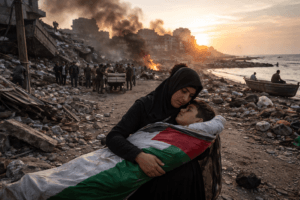
In the shattered streets of Khan Younis, where a fragile ceasefire holds in name only, the killing of three Palestinians—including a 15-year-old boy and a fisherman—feels both tragically routine and profoundly symbolic. This incident, reported on January 4, 2026, is not an anomaly. According to Gaza’s Health Ministry, over 420 Palestinians have been killed since the current ceasefire began in October 2025, with Israel and Hamas trading blame for near-daily violations. Each casualty underscores a brutal truth: the very violence that necessitates talk of a Palestinian state simultaneously erodes the foundations required to build one. The question of why there is no Palestinian state is answered not just in failed summits and UN resolutions, but in the relentless rhythm of violence, diplomatic inertia, and a profound leadership vacuum that together form a prison of the present, paralyzing any move toward a viable future.
The Ceasefire That Wasn’t: How Sustained Violence Erodes the Ground for Statehood
The current U.S.-brokered ceasefire, part of President Donald Trump’s “Comprehensive Plan,” was designed to be the first step toward a new stability. Its first phase called for a cessation of hostilities, hostage and prisoner exchanges, and a partial Israeli withdrawal, leaving the Israel Defense Forces (IDF) in control of an estimated 53-58% of Gaza’s territory. Yet, from its inception, this calm has been a mirage.
- A Pattern of Violations: Independent tracking reveals that since the ceasefire took effect, Israel has attacked Gaza on 72 out of 87 days, with incidents ranging from shootings and raids to aerial bombardments. These are not merely technical breaches. They represent a continuous state of insecurity that makes the concept of sovereign governance a distant fantasy. When a fisherman can be killed outside officially occupied areas and a teenager shot in a city under a supposed truce, it demonstrates that Palestinian life and agency remain subject to lethal, unpredictable control.
- Humanitarian Catastrophe as a Barrier: The ceasefire promised a flood of humanitarian aid to address a man-made disaster. While the volume of aid has increased, the reality remains “catastrophic”. Over 500,000 people in Gaza still face “emergency” food insecurity, with more than 100,000 experiencing “catastrophe/famine” conditions. Israel’s complicated registration process for international NGOs threatens to force dozens of aid groups to close, which would have a “catastrophic impact” on essential services. A state cannot be built upon a population that is starving, displaced, and wholly dependent on an externally constrained lifeline for survival. The systematic blocking of nutritious food, allowing only snacks and soft drinks through checkpoints, speaks to a control that is antithetical to sovereignty.
This ongoing reality creates a vicious cycle: the violence and humanitarian blockade that followed the war continue to prevent the normalization and recovery necessary for state-building, ensuring that the underlying despair and instability persist.
The Diplomatic Mirage: Recognition Without a State
Paradoxically, while the ground in Gaza remains inhospitable for statehood, the diplomatic map has increasingly shifted in Palestine’s favor. A historic diplomatic wave in late 2025 saw major Western powers, including the United Kingdom, Canada, Australia, and France, formally recognize the State of Palestine. This brought the total number of recognizing UN member states to 157 out of 193—over 80% of the international community.
Yet, this recognition is largely symbolic without the concomitant attributes of statehood. Palestine’s status at the UN exemplifies this limbo.
- Observer, Not Member: Palestine has been a UN non-member observer state since 2012, a status that grants it a seat and the right to speak in the General Assembly but not the right to vote. Full membership, which would solidify its sovereign equality under international law, remains blocked.
- The American Veto: The primary obstacle is political. The United States, a permanent member of the UN Security Council with veto power, has consistently blocked Palestine’s path to full UN membership. All other permanent members—China, France, Russia, and the United Kingdom—have already recognized Palestine. This American stance, unwavering across administrations, creates a critical gap between global opinion and the enforceable mechanisms of international law.
The recognition by Western states is a powerful political signal, but it does not translate to the lifting of Israel’s occupation, control over borders, airspace, and resources, or the end of security control in the West Bank. It is statehood as a diplomatic concept, divorced from the territory, people, and authority that define a nation.
The Core Obstacles: A Trifecta of Vetoes
Beyond the immediate violence and diplomatic stalemate lie three deep, structural obstacles that have thwarted Palestinian statehood for generations.
- The Internal Leadership Vacuum
The Palestinian political arena is fractured and dysfunctional. The split between Hamas, which governs Gaza, and the Fatah-led Palestinian Authority (PA), which holds limited authority in parts of the West Bank, has been frozen since a bloody civil war in 2007. Neither body has held a national election in nearly two decades, and both are accused of autocracy and corruption. As scholar Hussain Abdul-Hussain argues, Palestinians have historically been led either by “weak” leaders who cannot deliver peace, like Mahmoud Abbas, or by “enemy dictators” and militias ideologically opposed to Israel’s existence. There is currently no unified, legitimate Palestinian leadership with the capacity to govern a state, negotiate a final agreement, or enforce it—a fundamental prerequisite that remains unfulfilled.
- The Israeli Security Veto
Israel’s position, particularly under the long tenure of Prime Minister Benjamin Netanyahu, has hardened into a firm rejection of Palestinian sovereignty. Netanyahu’s government has vowed that a Palestinian state “will not be established,” a stance codified in a 2024 Knesset resolution. The Israeli demand is for overarching security control, which is incompatible with Palestinian sovereignty. Past offers, like Prime Minister Ehud Olmert’s 2008 proposal to withdraw from most of the 1967 territories, foundered on the issue of the Palestinian “right of return” and recognition of Israel as a Jewish state. After the trauma of the October 7, 2023 attacks, Israeli public and political tolerance for risk has evaporated, making any concession perceived as endangering security a political impossibility.
- The American Plan and Its Fault Lines
The current U.S. framework, while proposing a pathway to statehood, is fraught with unresolved tensions that may doom it. The plan envisions a “Board of Peace” chaired by President Trump and an “International Stabilization Force” (ISF) to oversee Gaza’s transition. However, no country has yet agreed to contribute troops to the ISF, with potential contributors like Indonesia and Azerbaijan insisting it be a peacekeeping force, not one tasked with fighting Hamas.
Furthermore, the U.S.-Israeli alliance is showing deep cracks. Offstage from their public displays of unity, Trump and Netanyahu are deeply divided over the plan’s implementation, including the role of Turkey (which Israel vehemently opposes), the pace of reconstruction, and the disarmament of Hamas. This fragile American-Israeli consensus is paper-thin, and without genuine cooperation, the plan is likely to stall.
Conclusion: Trapped in the Status Quo
The killing of three men in Khan Younis is a microcosm of the Palestinian condition. It occurs in a territory divided between Israeli control and militant governance, under a ceasefire violated with tragic regularity, amid a humanitarian crisis managed by external actors, and in the shadow of diplomatic recognition that confers dignity but not power.
The path to a Palestinian state is not merely blocked; the very road is being dismantled day by day. It is eroded by settlement expansion in the West Bank, by the failure to reconcile Palestinian political factions, by an Israeli security paradigm that cannot envision a sovereign neighbor, and by an international community whose recognition lacks the courage of enforcement.
Until a Palestinian leadership emerges that can truly govern, until Israel’s existential fears are addressed in a way that allows for Palestinian sovereignty, and until the international community can match its words with actionable, unified pressure, the makeshift arrangement will persist. The future will remain a hostage to the present—a present of policing, periodic wars, and profound human suffering, where statehood is not a destination, but a receding horizon.
You must be logged in to post a comment.