
Startup India at 10: Analyzing a Decade of Entrepreneurial Revolution and Its Future Trajectory
Startup India at 10: Analyzing a Decade of Entrepreneurial Revolution and Its Future Trajectory
From Vision to Global Force
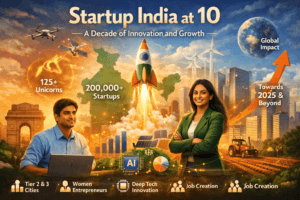
Ten years after its launch on January 16, 2016, India’s Startup India initiative has evolved from an ambitious policy framework into one of the world’s largest entrepreneurial ecosystems. With over 200,000 government-recognized startups and 125 active unicorns as of 2025, India now stands as the third-largest startup hub globally. This remarkable growth from fewer than 500 startups in 2014 represents more than statistical progress—it signifies a fundamental transformation in India’s economic structure and cultural mindset toward innovation. This decade-long journey reflects a unique interplay of strategic policymaking, regulatory innovation, and demographic energy that has positioned India at the intersection of technological progress and inclusive development.
The Evolution and Scale of Impact
The Startup India initiative was conceptualized as a multi-dimensional platform supporting ventures from ideation through scaling, managed by the Department for Promotion of Industry and Internal Trade (DPIIT). Its growth trajectory has been extraordinary:
- Geographic Democratization: Approximately 50% of recognized startups now originate from Tier II and Tier III cities, indicating a significant geographical spread of entrepreneurial activity beyond traditional metropolitan hubs.
- Economic Contribution: Startups have generated an estimated 1.7 million direct jobs, with approximately 40% concentrated in technology-related sectors. Their impact extends through extensive gig work opportunities and supply chain developments.
- Sectoral Diversity: Beyond the technology sector, startups are making substantial inroads into agriculture, healthcare, education, and manufacturing, creating cross-sector innovation pathways.
- Global Recognition: India’s startup ecosystem valuation now exceeds $350 billion, with 22 startups achieving unicorn status specifically through the Fund of Funds for Startups (FFS) program.
The Policy Infrastructure: Beyond Funding to Ecosystem Building
The initiative’s success stems from a comprehensive policy architecture addressing multiple dimensions of entrepreneurial support:
Financial Mechanisms
The Fund of Funds for Startups (FFS) with a ₹10,000 crore corpus has emerged as a cornerstone, committing funds to over 140 Alternative Investment Funds that have collectively invested ₹25,500+ crore in more than 1,370 startups. Specific impact includes:
- ₹2,145 crore invested in 185 startups from Tier 2/3 centers
- ₹3,547 crore invested in 184 women-led/co-led startups
- ₹3,533 crore invested in 220 deep-tech focused startups
Complementary schemes like the Startup India Seed Fund Scheme (SISFS) with ₹945 crore support early-stage concept development and prototyping. The newly approved Fund of Funds 2.0, with an additional ₹10,000 crore corpus, specifically targets deep tech sectors including artificial intelligence, quantum technologies, and defense.
Regulatory Transformation
Parallel Ease of Doing Business (EoDB) reforms have created the necessary regulatory environment. The Jan Vishwas Act decriminalized over 180 provisions, while initiatives like SPICe+ forms consolidated multiple registrations into a single interface, reducing incorporation time from nearly 27 days to 5-10 days. Specific startup-focused reforms include:
- Simplified compliance through self-certification under six labor and three environmental laws
- Fast-tracked patent applications with reduced fees for intellectual property protection
- Extended timelines for ESOPs and sweat equity from 5 to 10 years
- Flexible capital structures allowing differential voting rights up to 74%
Support Infrastructure
Digital platforms like the Startup India Hub serve as connection points for entrepreneurs, mentors, and investors, while the MAARG mentorship portal provides structured guidance. The Atal Innovation Mission (AIM) established over 10,000 Atal Tinkering Labs across 733 districts, engaging more than 11 million students in innovation projects. Sector-specific initiatives like iDEX in defense and IN-SPACe for space startups have opened traditionally restricted sectors to private innovation.
Cultural Transformation and Inclusivity
Beyond economic metrics, Startup India has catalyzed profound sociocultural shifts:
Changing Mindsets
Entrepreneurship has moved from being viewed as an alternative career path to a mainstream aspiration, particularly among India’s youth. Risk-taking, once stigmatized, now carries social respectability, fundamentally altering the job-seeking to job-creating transition.
Gender Inclusion
Women’s participation has become a notable feature, with over 45% of recognized startups having at least one woman director or partner. This makes India the second-largest ecosystem for women-led startups globally. Women investors are increasingly shaping funding decisions, bringing focus to sectors like health tech, education, and sustainable businesses.
Grassroots Innovation
Programs like AIM’s Community Innovator Fellowship and Atal Community Innovation Centers specifically target grassroots problem-solving. Rural entrepreneurship initiatives such as SVEP, ASPIRE, and PMEGP enable micro-enterprises and local job creation, ensuring the startup revolution addresses regional developmental disparities.
Strategic Positioning in Global Technology
Startup India increasingly focuses on securing India’s position in the global technology landscape:
AI Sovereignty and Deep Tech
The government’s emphasis on developing indigenous AI solutions using Indian talent and servers reflects a strategic approach to technological autonomy. The IndiaAI Mission aims to deploy 38,000 GPUs and establish 600 AI Data Labs, democratizing access to computing power. Three Centres of Excellence foster research in healthcare, agriculture, and sustainable cities.
Global South Leadership
India positions itself as a voice for the Global South in technology governance, leveraging its 2026 hosting of the India-AI Impact Summit and BRICS Presidency to advocate for development-oriented AI cooperation. This approach recognizes that while AI could add $15.7 trillion to global GDP by 2030, over 84% of gains currently concentrate in North America, China, and Europe.
Sectoral Breakthroughs
Policy reforms have enabled startups to enter strategic sectors previously dominated by public entities:
- Defense: Over 400 startups are developing technologies through iDEX
- Space: Approximately 200 space startups have gained global approvals
- Drones: Regulatory simplification unlocked significant innovation potential
- Government Procurement: Nearly 35,000 startups are onboarded on the Government e-Marketplace, receiving over 500,000 orders worth ₹50,000+ crore
Challenges and Future Imperatives
Despite remarkable progress, structural challenges persist:
Funding Gaps and Sustainability
While early-stage funding has improved, only 12% of total 2023 funding went to early-stage startups, with the remainder directed toward growth-stage ventures. Long-term sustainability remains a concern, with startups facing scalability challenges beyond initial phases due to evolving tax liabilities and compliance costs.
Talent and Infrastructure Deficits
Approximately 55% of startups report difficulties hiring skilled professionals, particularly in technology. Deep tech sectors face acute shortages in specialized areas like AI, quantum computing, and semiconductor design. Physical infrastructure—advanced laboratories, testing facilities, and manufacturing capabilities—lags behind innovation needs.
Regional and Sectoral Imbalances
Despite geographical spread, funding concentration persists in metropolitan hubs. Startups in non-digital sectors face greater regulatory complexity regarding labor laws, land acquisition, and sector-specific restrictions. Cybersecurity vulnerabilities increase alongside digital adoption, requiring robust data governance frameworks.
The Next Decade: From Scale to Strategic Depth
As Startup India enters its second decade, priorities are shifting from quantitative expansion to qualitative deepening:
Deep Tech Commercialization
The ₹10,000 crore Deep Tech Fund of Funds represents a strategic bet on technologies with long gestation periods but transformative potential. Success requires patient capital, enhanced academia-industry collaboration, and international technology partnerships.
Integration with National Missions
Startups will increasingly align with broader national priorities—AI Mission, semiconductor self-reliance, defense indigenization, and climate technologies. The focus will be on creating globally competitive products rather than import substitution.
Global Market Integration
With a maturing domestic ecosystem, startups must increasingly target global markets and value chains. This requires enhanced export orientation, intellectual property creation, and strategic integration with international innovation ecosystems like Silicon Valley, Israel, and Germany.
Inclusive Innovation Framework
Future efforts must address regional disparities through targeted interventions in aspirational districts, strengthened digital and physical infrastructure in rural areas, and specialized support for women entrepreneurs beyond current levels.
Conclusion: Redefining India’s Development Trajectory
Startup India’s first decade represents one of independent India’s most successful economic policy initiatives, creating a dynamic innovation ecosystem that harnesses demographic advantages through digital infrastructure and regulatory reform. The initiative has moved beyond creating startups to fostering an entrepreneurial society where innovation addresses both economic growth and social challenges.
As India advances toward its $7.3 trillion economy goal by 2030 and the broader Viksit Bharat 2047 vision, startups are poised to remain central to its development narrative. Their evolution from disruptive innovators to strategic national assets reflects India’s broader transition from a policy-driven to an innovation-led economy. The next decade’s success will depend on translating this remarkable scale into sustainable competitive advantages across global technology value chains while ensuring innovation remains a force for inclusive and equitable growth.
You must be logged in to post a comment.