
Skies of Deterrence: How Four Days in May Redefined Warfare and Diplomacy in South Asia
The 2025 India-Pakistan aerial confrontation, a brief but intense four-day engagement, has become a seminal case study in modern warfare between nuclear-armed states, demonstrating a definitive shift to beyond-visual-range combat where network-centric integration and long-range missiles outweigh close dogfights. It served as a global proving ground for rival technologies, notably testing advanced Chinese systems like the PL-15 missile against Western counterparts, thereby influencing defense strategies worldwide. Crucially, the aftermath proved that post-conflict diplomatic maneuvering and narrative shaping—such as Pakistan’s calculated diplomatic outreach—can often outweigh battlefield outcomes in determining strategic advantage, highlighting that in contemporary conflicts, victory is as much about perception and international diplomacy as it is about military action.
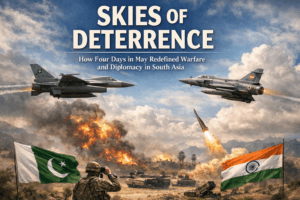
Skies of Deterrence: How Four Days in May Redefined Warfare and Diplomacy in South Asia
The New Anatomy of a Crisis
The four-day military confrontation between India and Pakistan in May 2025 has already secured its place as one of the most significant case studies in modern warfare. Dubbed the “Four-Day Conflict” by analysts, this engagement was notable not for decisive territorial gains or staggering casualties, but for what it revealed about the future of conflict between nuclear-armed states in the 21st century. Beyond the immediate border tensions, the clash served as a rare, real-world testing ground for competing military technologies, exposed critical vulnerabilities in air defense systems, and demonstrated with stark clarity how diplomatic maneuvering in a conflict’s aftermath can be more impactful than battlefield events. This was not a war of grand offensives, but a calibrated exchange of stand-off precision strikes that may have permanently rewritten the rulebook for regional confrontation.
The Fog of War in the Information Age
One of the defining and most challenging aspects of analyzing the conflict has been the pervasive “fog of war,” amplified to extraordinary levels by digital misinformation. Both nations issued sweeping, often contradictory, claims of operational success—from aircraft kills and missile interceptions to assertions of electronic dominance. Independent verification remains difficult. For instance, while Pakistan claimed to have shot down several advanced Indian jets, including Rafale fighters, India has been circumspect, with a senior official stating, “We are in a combat scenario and losses are a part of it”. This informational battleground underscores a core lesson: modern conflicts are fought as relentlessly in the digital and perceptual domains as in the physical skies.
The table below contrasts the traditional perceptions of warfare with the new reality demonstrated by this conflict:
| Dimension of Warfare | Traditional Perception | Reality Demonstrated in 2025 Conflict |
| Aerial Engagement | Close-range “dogfights” and visual combat | Beyond Visual Range (BVR) stand-off exchanges, with aircraft never crossing borders |
| Primary Battlefield | Physical territory and airspace | The information domain, dominated by competing narratives and digital disinformation |
| Key Advantage | Platform superiority (better individual jets) | Network-centric integration of sensors, data fusion, and long-range munitions |
| Escalation Dynamic | Linear progression to broader war | Calibrated, reciprocal strikes under the heavy shadow of nuclear deterrence |
| Conflict Conclusion | Military victory or decisive outcome | Ceasefire brokered by third-party diplomacy, with post-conflict narrative shaping being critical |
The Silent Dogfight: A Revolution in Air Combat
Analysts have described the aerial engagement as among the largest since World War II, not due to casualties but because of the scale of modern assets deployed—dozens of fourth and 4.5-generation fighters, airborne early warning aircraft, and sophisticated missile systems operated simultaneously. Yet, in a telling break from the past, there were no classic “dogfights.” The entire engagement occurred Beyond Visual Range (BVR), with pilots on both sides launching missiles at targets detected on screens from distances up to 100 miles away, all while carefully remaining within their own airspace.
This shift has profound implications. It signals the near-total dominance of sensor technology and data fusion over traditional piloting attributes like speed and maneuverability. The advantage now lies with the force that can best integrate information from satellites, ground radar, and airborne warning systems to “see” first, target first, and fire first. As one analysis noted, if two modern fighter jets see each other in visual range today, “something has probably gone wrong”. The conflict proved that future effectiveness depends less on individual aircraft and more on how seamlessly an entire ecosystem of systems communicates and operates in a fiercely contested electronic environment.
The Arsenal Tested: PL-15 vs. Meteor and the China Factor
The skies over South Asia became an involuntary proving ground for two of the world’s most advanced air-to-air missiles: the Chinese PL-15, carried by Pakistan’s J-10CE fighters, and the European Meteor, integrated into India’s Rafale fleet. The performance of these systems is of intense global interest, particularly to Western and allied nations assessing Chinese military technology.
- The PL-15’s Coming-Out Party: Pakistan’s use of the PL-15 represented a milestone for China’s defense export ambitions. With an estimated range exceeding 124 miles and an active electronically scanned array radar, it allowed Pakistani jets to engage Indian aircraft at formidable distances. Its reported success in combat has boosted confidence in Chinese weaponry and will undoubtedly influence global defense procurement decisions.
- Questions for the Meteor: The Meteor, powered by a unique ramjet engine that provides sustained thrust and a large “no-escape zone,” is considered a crown jewel of Western missile technology. The conflict has, however, prompted scrutiny. Defense experts are now asking whether the PL-15 can match or outperform the Meteor in real-world conditions, a question with multi-billion-dollar implications for global security and defense sectors. This real-world test has moved the debate from theoretical brochures to hard, tactical analysis.
- A Testing Ground for China: For observers in Washington, Tokyo, and Canberra, the conflict provided invaluable, if unsettling, data. It was the first major combat test of advanced, integrated Chinese military systems—including the J-10 fighter, PL-15 missile, and possibly the HQ-9 air defense system—outside of China’s direct control. As one Indian analysis starkly put it, Chinese weapons were transformed from “instruments of defence into vectors of provocation”. This performance review will shape military planning across the Indo-Pacific for years to come.
The Unseen Battlefield: Drones, Diplomacy, and Doctrine
Beyond the fighter jet duel, the conflict featured significant “firsts” that mark a new chapter in regional warfare. It witnessed the first large-scale drone battle between the two nations, with both sides deploying armed drones and loitering munitions in attempts to strike behind enemy lines. India also employed cruise missiles like the BrahMos for the first time in this context, while Pakistan responded with conventionally armed short-range ballistic missiles. These developments indicate a troubling trend: each new crisis sees an escalation in the reach, precision, and diversity of weaponry used, raising the inherent risk of any future confrontation.
The Diplomatic Aftermath: Where the Real Victory Was Sought
Perhaps the most striking lesson was that the conflict did not end on the battlefield but in the arena of global diplomacy and strategic narrative. Following the ceasefire, Pakistan’s calculated diplomatic offensive—including the symbolic nomination of the U.S. President for a Nobel Peace Prize—appeared to yield more immediate dividends than its military operations. This “soft power” play helped Pakistan cultivate access and shape the narrative in key international capitals, particularly Washington.
India, by contrast, chose a different path, relying on its structural position as a massive economy and long-term strategic partner in the Indo-Pacific. However, the episode revealed how short-term political incentives and personal diplomacy can sometimes override long-term strategic logic, leaving even a nation of India’s stature navigating a less favorable diplomatic terrain in the immediate aftermath. The conflict proved that in the modern era, managing the perceptions and reactions of powerful third parties like the United States is as crucial as managing escalation with the direct adversary.
Conclusion: A Prototype for Future Conflict
The Four-Day Conflict will not be remembered as a war that redrew maps. It will be studied as a prototype of constrained warfare in the nuclear age—a high-tech, calibrated, and psychologically intense engagement where the primary goal was not annihilation but sending a message without triggering an uncontrollable spiral.
It highlighted the critical importance of integrated networks over isolated platforms, the global reverberations of technology rivalry, and the paramount need for robust electronic warfare and cyber defenses. Most importantly, it underscored that for nuclear-armed adversaries, the most critical battles may be fought in the silent spaces between kinetic strikes: in the electronic spectrum, on social media platforms, and in the diplomatic corridors of world powers. The skies over South Asia have quieted, but the strategic lessons from those four days in May will echo through war colleges and foreign ministries for a generation.
You must be logged in to post a comment.