
Silencing Hind: How India’s Ban on a Child’s Story Exposes the Price of a Geopolitical Alliance
India’s decision to ban the Oscar-nominated docudrama The Voice of Hind Rajab—which tells the true story of a five-year-old Palestinian girl killed by Israeli forces in Gaza—reveals the uncomfortable lengths to which the government will go to protect its strategic alliance with Israel. The Central Board of Film Certification explicitly cited the threat the film posed to India-Israel relations, a justification that exposes the fragility of a partnership built on billion-dollar defense deals and shared security doctrines. By censoring a child’s story to appease a foreign ally, India has not only suppressed artistic expression but also signaled that its geopolitical ambitions now outweigh its historical commitment to human rights and the Palestinian cause, turning the ban itself into a powerful testament of how threatening the truth can be to those in power.
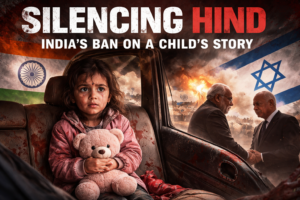
Silencing Hind: How India’s Ban on a Child’s Story Exposes the Price of a Geopolitical Alliance
When the five-year-old voice of Hind Rajab crackled through the last phone call to emergency services in Gaza, it was a plea for a salvation that never came. Trapped in a car with the bodies of her relatives, surrounded by Israeli tanks, she whispered her final, desperate words to the world: “Come and take me.”
Months later, that voice has been amplified into an Oscar-nominated docudrama, The Voice of Hind Rajab. But while the film has received standing ovations in Venice and accolades across Europe, it has been met with a wall of silence in India. In a decision that has sent shockwaves through the artistic and diplomatic communities, India’s Central Board of Film Certification (CBFC) has refused to certify the film for release. The official rationale, whispered behind closed doors and reported by Variety, is as chilling as it is candid: the film poses a threat to the relationship between India and Israel.
In a nation that prides itself on being the “world’s largest democracy,” the decision to ban a film about the death of a child under occupation is not merely an act of censorship. It is a political statement—one that prioritizes realpolitik over humanism, and military alliances over the truth of a genocide.
A Story That Frightens the Powerful
The film, directed by the acclaimed Tunisian filmmaker Kaouther Ben Hania (The Man Who Sold His Skin), reconstructs the final hours of Hind Rajab’s life. On January 29, 2024, the five-year-old was trapped in a vehicle with six relatives after an Israeli tank fired on their car. For hours, she was on the phone with the Palestine Red Crescent Society, begging for rescue. When a rescue team was finally dispatched, they too were killed. Forensic investigations later revealed that the car was struck by 335 bullets fired by Israeli forces.
Ben Hania’s docudrama is a visceral attempt to reclaim that narrative, blending archival audio with reenactments to ensure the world does not forget. But for the Indian government, it seems, remembering is a diplomatic liability.
Manoj Nandwana, the film’s India-based distributor, told Middle East Eye that the timing of the censorship was particularly brutal. The film was screened for the CBFC on February 27, just one day after Indian Prime Minister Narendra Modi concluded a high-profile state visit to Israel. During that visit, Modi and Israeli Prime Minister Benjamin Netanyahu showcased a friendship built on defense contracts and strategic alignment, presenting a united front despite the ongoing war in Gaza.
“Bad timing,” Nandwana noted dryly, hinting at the political sensitivities that derailed his plans for a March release.
Badie Ali, co-founder of Watermelon Pictures, the Palestinian-American production company behind the film, articulated the absurdity of the situation in stark terms. “When we heard the Indian film board’s justification, that releasing this film could damage India-Israel relations, our first thought was: since when is a five-year-old girl’s cry for help a diplomatic threat?”
He added, “Censoring this film doesn’t serve India’s interests. It only tells the world that Hind’s story still frightens those in power.”
The Unbreakable Bond: Weapons, Trade, and Ideology
To understand why a film about a child in Gaza is deemed a threat to Indian sovereignty, one must look at the deepening alliance between New Delhi and Tel Aviv. While India historically championed the Palestinian cause—being one of the first non-Arab nations to recognize the Palestine Liberation Organization—the last decade has seen a dramatic pivot.
Since Narendra Modi came to power in 2014, India’s foreign policy has adopted a de-hyphenated approach, treating Israel and Palestine as separate entities. Modi became the first Indian Prime Minister to visit Israel in 2017, a trip that conspicuously skipped Ramallah.
Today, India is the world’s largest purchaser of Israeli weapons. The relationship is a cornerstone of India’s defense infrastructure, involving everything from drones and missile defense systems to surveillance technology. Many of these same weapons systems, designed for urban warfare and counter-insurgency, are deployed by Indian security forces in the disputed territory of Kashmir. The shared language of “security threats” and “counter-terrorism” forms the ideological bedrock of the Modi-Netanyahu alliance.
Throughout Israel’s war on Gaza—which has claimed the lives of over 45,000 Palestinians, nearly half of them children—India has maintained a carefully calibrated silence. While it abstained from or voted in favor of certain UN resolutions calling for humanitarian pauses, it did not condemn the military offensive. Meanwhile, Indian companies reportedly supplied labor to fill a gap left by the exclusion of Palestinian workers, and defense trade continued unabated.
In this context, The Voice of Hind Rajab is not just a film; it is a counter-narrative. It humanizes the casualties of a war that the Indian government has refused to name as a genocide. By allowing the film to release, the CBFC would be sanctioning a story that directly contradicts the official stance of an ally upon whom India relies for its own military supremacy.
A Pattern of Suppression
The ban on The Voice of Hind Rajab is not an isolated incident. Nandwana noted that the film had already been barred from several prestigious film festivals across India, including the International Film Festival of India in Goa, as well as festivals in Bangalore, Pune, and Kerala.
This pattern reflects a growing intolerance in India for artistic expressions that deviate from the government’s geopolitical or ideological line. In recent years, filmmakers, journalists, and activists who speak out against the government’s policies—whether on Kashmir, citizenship laws, or religious polarization—have faced harassment, legal threats, and censorship.
Yet, the censorship of a foreign film about a Palestinian child is perhaps the most blatant admission of the government’s priorities. As Indian activists Shrishti Khanna and Prashant Pundir observed, the film resonated deeply with local audiences during an independent screening they organized before the ban.
“There are many Hinds in Gaza right now that we need to show up for, and around the world,” they told Middle East Eye. “We were also thinking of the children martyred in Iran and Lebanon recently, as well as lives violently lost to communal violence in India.”
For them, the ban is part of a larger system of suppression. “It is part of the larger pattern of suppressing the genocide of Gaza and the reality of Palestine,” they said, drawing a direct line between the silencing of Palestinian voices and the suppression of dissent within India.
The Director’s Defiance
Kaouther Ben Hania, the director, did not let the Indian board’s decision pass in silence. In a pointed Instagram post, she questioned the fragility of the “honeymoon” between India and Israel.
“Is the honeymoon between the ‘world’s largest democracy’ and the ‘only democracy in the Middle East’ so fragile that a film could break it?” she wrote.
Her words cut to the heart of the matter. If the diplomatic relationship is so strong, why is a cinematic work a threat? The logical conclusion is that the relationship is not fragile; it is brittle. It is built on a foundation that cannot withstand the scrutiny of public conscience. The fear is not that the film will break the alliance, but that it will awaken the Indian populace to the true nature of that alliance—one forged in shared military doctrine and the suppression of dissent, stained by the blood of children.
What Happens Next?
Nandwana’s team has applied for a revision of the CBFC’s decision. He holds out hope for a “miracle” that will allow “maximum people” to see the film. But given the political climate and the government’s deep investment in its relationship with Israel, a reversal seems unlikely.
In the meantime, the ban has achieved the opposite of its intended effect. By blocking the film, the Indian government has guaranteed it a level of global attention it might not have otherwise received. More importantly, it has cemented the story of Hind Rajab as a symbol not just of Palestinian suffering, but of the moral compromises made by nations in pursuit of power.
In the end, the censorship of The Voice of Hind Rajab is a testament to the power of storytelling. Governments ban films not because they are irrelevant, but because they are dangerous. A five-year-old girl, speaking from a bullet-ridden car, asking for her mother, is dangerous because she represents a truth that cannot be negotiated away by diplomats or buried under defense deals.
Hind Rajab’s voice was silenced in Gaza by the bullets of an occupying army. Now, that same voice is being silenced in India by a film board afraid of offending the army’s patron. But as history has shown, you cannot kill an idea. And you cannot permanently silence a story that the world has already heard.
The Indian government may succeed in keeping the film off screens, but it cannot prevent the question from echoing through the halls of its democracy: If the story of one child is a threat to the nation, what does that say about the nation itself?
You must be logged in to post a comment.