
Siemens Sells Motors Business: A Strategic Shift Toward High-Tech Focus
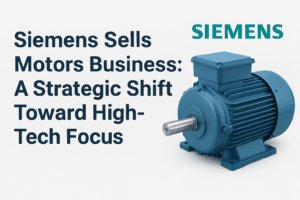
Siemens Sells Motors Business: A Strategic Shift Toward High-Tech Focus
In the complex calculus of corporate strategy, sometimes subtraction is the most powerful form of addition. Siemens’ ₹2,200 crore divestiture isn’t an admission of failure but a deliberate recalibration toward higher-margin technology domains.
In a significant corporate realignment, Siemens Limited has approved the sale of its Low Voltage Motors and Geared Motors business to Innomotics India Private Limited for ₹2,200 crore. This transaction, structured as a “slump sale” — meaning the business is transferred as a going concern without assigning individual values to assets and liabilities — represents more than a routine portfolio adjustment. For Siemens, this move continues a global strategic pivot that began with the sale of Innomotics GmbH to private equity firm KPS Capital Partners in October 2024.
The deal, expected to close by June 2026 pending regulatory approvals including potential clearance from the Competition Commission of India, saw Siemens shares decline 3.6% on the announcement day to ₹3,204.70. Yet beneath this immediate market reaction lies a sophisticated strategy that reveals how global industrial giants are reshaping themselves for a digital future.
The Transaction at a Glance
| Aspect | Details |
| Transaction Type | Slump Sale (transfer as going concern) |
| Buyer | Innomotics India Private Limited (subsidiary of Innomotics GmbH) |
| Seller | Siemens Limited |
| Enterprise Value | ₹2,200 crore (approximately $264 million) |
| Valuation Basis | Cash-free, debt-free basis with mutually agreed adjustments |
| Valuation Advisors | Grant Thornton Bharat LLP and KPMG Valuation Services LLP |
| Expected Closing | June 2026 (within 6-8 months from execution) |
| Business Revenue (12 months to Sept 2025) | ₹967 crore |
| Business Operating Profit (12 months to Sept 2025) | ₹35 crore |
| Current Employees | 89 personnel engaged in sales of Innomotics brand products |
Strategic Rationale: Why Siemens Is Letting Go
The official explanation from Siemens Managing Director and CEO Sunil Mathur states simply that the company found “the right home for the business with Innomotics” given “limited synergies with Siemens Limited’s core businesses”. But this understates a more profound strategic calculation.
The business being divested — which designs, develops, and sells low voltage AC motors and geared motors including ranges like 1LE7, 1SE0, and 1LA2 — contributed approximately 4.5% of Siemens Limited’s revenue in FY2023-24. However, with operating margins around 3.6% based on disclosed figures, it represented a relatively low-margin operation in Siemens’ broader portfolio.
More critically, the business functioned largely as a sales organization with outsourced manufacturing, heavily dependent on intellectual property now controlled by KPS Capital Partners following their acquisition of Innomotics GmbH. This created a structural vulnerability in Siemens’ control over the business.
The global context is equally telling. Siemens AG has been systematically reshaping its portfolio toward higher-growth, higher-margin technology domains. In its Q4 FY2025 earnings release, the company highlighted its “ONE Tech Company” program aimed at “stronger customer focus, faster innovations and higher profitable growth,” alongside strategic acquisitions like software companies Altair and Dotmatics.
Valuation Insights: The Numbers Behind the Deal
Two independent valuation reports from Grant Thornton Bharat LLP and KPMG Valuation Services LLP as of September 30, 2025, formed the basis for negotiations. The ₹2,200 crore enterprise value represents:
- Approximately 2.3 times revenue of the business (based on ₹967 crore 12-month revenue)
- Significantly higher multiple on operating profit, reflecting the strategic value to the buyer
The financial metrics reveal why this divestiture makes sense for Siemens. For the twelve months ended September 30, 2025, the low voltage motors business recorded a net capital employed of negative ₹1.38 billion. Essentially, the business was consuming more capital than it was generating — a situation at odds with Siemens’ stated focus on cash generation as “the ultimate yardstick for business performance”.
Notably, Siemens reported that in fiscal 2025, it achieved record free cash flow and has been returning capital to shareholders through an increased dividend and accelerated share buyback program. The proceeds from this sale will further strengthen this capital return capacity.
The Buyer’s Perspective: Innomotics’ Strategic Expansion
Innomotics India Private Limited, despite its historical ties to Siemens, is now part of a different corporate story. As a subsidiary of Innomotics GmbH — which was acquired by KPS Capital Partners from Siemens AG in October 2024 — the Indian entity gains strategic independence.
For Innomotics India, this acquisition represents vertical integration and market consolidation. The company already reported solid financials for the twelve months ended September 30, 2025, with revenue of ₹706.424 crore and profit after tax of ₹88.646 crore. Acquiring Siemens’ low voltage motors business effectively doubles its scale in this segment and eliminates what would have become a competitor with shared technology.
KPS Capital Partners, with approximately $21.4 billion of assets under management, specializes in “controlling equity investments in manufacturing and industrial companies” and working “constructively with talented management teams to make businesses better”. Their ownership suggests Innomotics may pursue a more focused growth strategy in motors and drives than was possible within the broader Siemens portfolio.
Market Reaction and Analyst Sentiment
The immediate market response saw Siemens shares decline 3.6% on December 8, 2025. This reaction may reflect investor uncertainty about divesting a business that, while not core, still contributed measurable revenue. However, Siemens’ stock has shown volatility throughout 2025, trading between ₹2,376.45 and ₹4,182.44 over the preceding 52 weeks.
Analyst sentiment toward Siemens Limited has been mixed but generally positive. Among 24 analysts covering the stock, 12 recommend “Buy” or “Strong Buy,” 7 suggest “Hold,” and 5 recommend “Sell”. The company’s valuation metrics — including a price-to-earnings ratio of 54.23 — indicate the market has been pricing in future growth expectations rather than current earnings alone.
Siemens Limited’s financial performance has faced headwinds, with sales declining 22.58% in its most recent reporting period — the first revenue contraction in three years. In this context, portfolio optimization through divestiture of non-core, lower-margin businesses becomes a logical strategic response.
The Human Element: Employees and Customers
Corporate transactions often treat human capital as an afterthought, but Siemens has explicitly addressed this dimension. According to the announcement, the business employs 89 personnel engaged in sales of Innomotics brand products, and the company emphasized “ensuring continuity for our customers and employees” as a key consideration.
Sunil Mathur’s statement that they “found the right home for the business with Innomotics” suggests an attempt to position the transaction as protective rather than disruptive to the workforce. Since the business was already operating as a sales organization for Innomotics-branded products, the transition to direct ownership by Innomotics India may prove relatively seamless for employees.
For customers, the transaction ideally creates stability by aligning brand ownership with business operations. Previously, customers were buying Innomotics products from Siemens — a company that no longer controlled the underlying technology. Post-transaction, they will purchase directly from the technology owner, potentially streamlining support and innovation pipelines.
Broader Implications for Corporate India
This transaction exemplifies several trends reshaping corporate India:
- Portfolio Rationalization: Even market leaders are scrutinizing business units for strategic fit rather than mere revenue contribution.
- Focus on Core Competencies: The shift toward “technology company” identity reflects the premium markets place on innovation-led growth versus traditional manufacturing.
- Strategic Divestitures as Value Creators: Well-executed divestitures can unlock value for both seller and buyer when assets find more strategic homes.
- Global-Local Interplay: Global portfolio decisions (Siemens AG selling Innomotics worldwide) create ripple effects that necessitate local adjustments (Siemens Limited selling the Indian motors business).
The transaction also demonstrates sophisticated corporate structuring. The “slump sale” approach allows for cleaner separation than asset-by-asset transfer, while the “cash-free, debt-free” basis with adjustments provides mechanisms to handle working capital changes between signing and closing.
Looking Ahead: Siemens’ Future in India
For Siemens Limited, this divestiture follows earlier portfolio moves including the demerger of its Energy business effective March 1, 2025. The company appears to be sharpening its focus on segments where it can leverage technology differentiation — particularly in industry automation, smart infrastructure, and mobility solutions.
The company’s stated purpose — “to create technology to transform the everyday, for everyone” — increasingly aligns with digitalization and sustainability megatrends. Siemens’ leadership in industrial software, factory automation, and building technologies positions it for India’s manufacturing growth story and urban infrastructure development.
Financially, the ₹2,200 crore inflow will strengthen Siemens Limited’s balance sheet, providing flexibility for potential investments in higher-growth areas or additional returns to shareholders. With a net worth of ₹15,210 crore as of FY2023-24, the transaction represents a meaningful capital event.
Conclusion: Strategic Subtraction as Growth Strategy
The Siemens-Innomotics transaction transcends a simple business transfer. It represents a case study in contemporary corporate strategy, where industrial giants must continually evaluate what belongs at their core versus what might thrive better elsewhere.
For Siemens, letting go of a ₹967 crore revenue business requires confidence in its remaining portfolio and future growth prospects. The company’s recent financial communications emphasize “record results,” “profitable growth,” and “stringent portfolio management” as foundations of success. This divestiture aligns perfectly with that narrative.
In an era where focus creates competitive advantage, Siemens’ decision exemplifies how mature industrial companies can renew themselves not just through acquisitions, but through deliberate, strategic divestitures. The true test will be how effectively the company redeploys the capital and management attention freed by this move toward its stated ambitions of “accelerating digital and sustainability transformations”.
As global industries navigate digital disruption and sustainability imperatives, we may see more such transactions where established players shed good businesses to focus on great opportunities. In this context, Siemens’ ₹2,200 crore divestiture may be remembered not for what was sold, but for what it enabled the company to become.
You must be logged in to post a comment.