
Siegwerk’s Landmark Acquisition of Hi-Tech Inks Reshapes India’s Flexible Packaging Landscape
Siegwerk’s acquisition of Hi-Tech Inks creates a dominant force in India’s flexible packaging market, combining Siegwerk’s global R&D and sustainability expertise with Hi-Tech’s local manufacturing agility and specialty product portfolio to capture over 20% market share. The deal enhances supply chain resilience through expanded production sites in Bhiwadi and Vapi, positions the combined entity to lead the industry’s transition toward recyclable mono-material packaging, and signals a broader consolidation trend as India’s packaging sector matures into a strategic hub for innovation and scale.
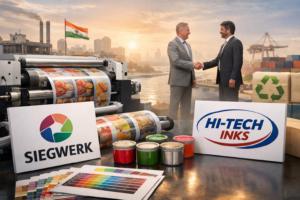
Siegwerk’s Landmark Acquisition of Hi-Tech Inks Reshapes India’s Flexible Packaging Landscape
In a move poised to redefine the competitive dynamics of one of the world’s fastest-growing packaging economies, Siegwerk has announced a definitive agreement to acquire Hi-Tech Inks. The deal, announced on March 26, 2026, marks the German-headquartered printing inks and coatings giant’s largest acquisition since it purchased SICPA’s packaging inks business two decades ago.
While the press release outlines the mechanics of the deal—combining production sites in Bhiwadi and Vapi with a workforce of approximately 1,700—the true story lies in what this consolidation means for the Indian flexible packaging industry, the broader supply chain, and the future of sustainable packaging in the subcontinent.
The Emergence of a Market Leader
The most immediate takeaway from this acquisition is the creation of a dominant market entity. By integrating Hi-Tech Inks’ established portfolio, Siegwerk will command over 20 percent of the Indian flexible packaging market. This isn’t merely a numerical milestone; it signals a shift in market leadership. For years, the Indian printing inks sector has been characterized by fierce competition between global giants and agile domestic players. This acquisition effectively creates a new tier of market influence, combining Siegwerk’s global R&D infrastructure with Hi-Tech Inks’ deep-rooted local manufacturing agility.
For brand owners and packaging converters—the lifeblood of India’s burgeoning FMCG and e-commerce sectors—this consolidation promises a consolidation of supply chains. In an industry where color consistency, chemical compliance, and supply chain resilience are paramount, having a single entity capable of delivering such a significant share of the market volume reduces friction. It allows for standardized quality control across a wider network, potentially setting a new benchmark for technical service levels in the region.
Strategic Synergies: Beyond the Balance Sheet
The deal is structured around a classic “complementary strengths” thesis, but the specifics reveal a sophisticated strategy to address the unique demands of the Indian market.
- Expanding the Product SpectrumHi-Tech Inks brings to the table a robust portfolio that includes metallic and special-effect inks, varnishes, and overprint varnishes (OPVs). While Siegwerk has long been a powerhouse in solvent-based and water-based systems for flexible packaging, the addition of these specialty products allows the combined entity to offer a “total solution” approach. In India’s highly visual and competitive retail environment, the demand for high-impact, aesthetic packaging—think vibrant metallics for confectionery or tactile coatings for luxury goods—is surging. By integrating Hi-Tech’s specialty capabilities, Siegwerk can now capture more value per customer, moving from being a supplier of base inks to a strategic partner for high-value decorative effects.
- Geopolitical Resilience in ManufacturingThe addition of manufacturing sites in Bhiwadi (Rajasthan) and Vapi (Gujarat) to Siegwerk’s existing footprint is a masterstroke in operational resilience. India’s packaging industry has historically grappled with logistical bottlenecks. By expanding its presence across key industrial corridors—particularly in Gujarat, a major hub for chemical manufacturing and packaging conversion—Siegwerk is insulating its supply chain against regional disruptions. For customers, this translates to reduced lead times and a lower risk of production stoppages due to raw material shortages or logistical delays, a critical factor in an industry moving toward just-in-time inventory models.
A Barometer for India’s Packaging Ambitions
The timing of this acquisition is telling. India is currently experiencing a packaging renaissance. With rising disposable incomes, the rapid formalization of the retail sector, and a massive push toward food safety and shelf-life extension, flexible packaging is outpacing rigid alternatives. Moreover, the Indian government’s focus on “Make in India” and the subsequent shift of global supply chains away from China has positioned India as a critical manufacturing hub for multinational consumer goods companies.
Ashish Pradhan, President of Siegwerk Asia, framed this as a long-term commitment to the region. However, the scale of this investment suggests that Siegwerk is betting heavily on India not just as a market for consumption, but as a manufacturing base for export. By consolidating a 20% market share, the company gains the scale necessary to drive innovation in areas where India has traditionally lagged, particularly in high-speed printing and sustainable material science.
The Sustainability Imperative
One of the unspoken pressures driving this consolidation is the sustainability transition. The global packaging industry is currently grappling with a complex shift away from multi-material, non-recyclable laminates toward mono-material structures (such as all-polyethylene or all-polypropylene packaging) that are easier to recycle.
Printing inks and coatings are often the bottleneck in this transition. Adhesion, de-inking properties, and chemical compatibility with new substrates are highly technical challenges that require massive R&D investment. By uniting the R&D capabilities of Siegwerk—a global leader in de-inking technologies and bio-based materials—with the scale of Hi-Tech’s local production, the combined entity is better positioned to help Indian converters migrate their legacy production lines to meet Extended Producer Responsibility (EPR) regulations.
For Indian brand owners facing increasing scrutiny from both domestic regulators (like the Central Pollution Control Board) and global sustainability commitments, having a single ink supplier with the capacity to manage complex substrate transitions is a significant advantage. The acquisition essentially fast-tracks the availability of “future-ready” solutions—low-migration inks for food safety, energy-curable technologies for efficiency, and de-inkable solutions for circularity—to the broader Indian market at a competitive scale.
Cultural and Leadership Alignment
Beyond the balance sheets and production capacities, the success of such a high-profile acquisition often hinges on cultural integration. Karan Mahajan, Managing Director of Hi-Tech Inks, noted the alignment in values, specifically mentioning quality, sustainability, and customer focus. This is not a case of a global behemoth swallowing a local competitor for market share; it is presented as a union of like-minded technical experts.
Hi-Tech Inks has built a reputation in the Indian subcontinent for agility and customer-centric service. Siegwerk, despite its global scale, has been aggressively localizing its leadership and operations in Asia. The retention of Hi-Tech’s leadership and talent base is likely intended to preserve the entrepreneurial agility that made the company an attractive acquisition target, while injecting the global safety, regulatory, and technical standards that Siegwerk is known for.
Implications for the Competitive Landscape
The reverberations of this deal will be felt across the entire printing and packaging supply chain. For competitors, the creation of a 20% market share leader raises the bar for entry and scale. Smaller, regional ink manufacturers may find it increasingly difficult to compete on R&D, especially as sustainability regulations tighten. For converters, the deal reduces the number of strategic partners they need to manage for high-end applications, offering a “one-stop-shop” model that simplifies procurement but also requires careful supply chain diversification to avoid over-reliance on a single giant.
Moreover, this acquisition sets a precedent for further consolidation. As the Indian packaging market matures, we may see a trend similar to that in Europe and North America, where the market consolidates into a few large players capable of investing heavily in automation, AI-driven quality control, and closed-loop recycling initiatives.
Looking Ahead: The Next Phase of Growth
As the transaction heads toward closure in the coming weeks, the focus will shift to integration. The combined entity now has the scale to push the boundaries of what is possible in flexible packaging. From developing coatings that enable higher recyclability to creating intelligent packaging solutions that integrate with digital supply chains, the Siegwerk-Hi-Tech union is positioned to lead the charge.
For the Indian economy, this is a validation of the packaging sector’s maturity. It signals to global investors that India’s print and packaging industry is not just about low-cost labor, but about strategic scale, technical sophistication, and a clear vision for sustainable growth. For Siegwerk, it is a definitive statement: India is not just a growth market; it is the cornerstone of the company’s future in Asia.
In an industry where margins are often razor-thin and innovation is the only constant, the Siegwerk acquisition of Hi-Tech Inks represents a bold bet on the future of Indian manufacturing—a future defined by scale, sustainability, and an unyielding commitment to serving the world’s most dynamic consumer markets.
You must be logged in to post a comment.