
SEW-EURODRIVE’s Chennai Power Play: Why a Gearbox Factory Signals a New Era for Indian Manufacturing
SEW-EURODRIVE’s Chennai Power Play: Why a Gearbox Factory Signals a New Era for Indian Manufacturing
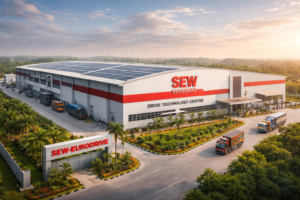
On March 23, 2026, a seemingly routine industrial inauguration took place in Chennai. German drive technology giant SEW-EURODRIVE opened its new Drive Technology Centre (DTC) on the outskirts of the city. On the surface, it was a press release detailing square footage, assembly lines, and sustainability checkboxes. But beneath the ribbon-cutting ceremony lies a story that speaks volumes about the shifting tectonic plates of global manufacturing and India’s ascent as a production powerhouse.
While the headlines focus on the “state-of-the-art facility” spread across 12.27 acres, the real narrative is about velocity. In the world of industrial automation, time is the most expensive commodity. For SEW-EURODRIVE, a company synonymous with geared motors, drives, and electronic controllers, establishing this hub in Chennai is less about expanding real estate and more about compressing the supply chain to near-zero latency for the South and East Indian markets.
More Than Just a Factory: The Logic of “South First”
For decades, industrial infrastructure in India was heavily skewed toward the western corridor—Pune, Mumbai, and Ahmedabad—and the northern belt around Gurugram and Faridabad. Southern India, despite hosting a booming automotive corridor (Chennai being the “Detroit of India”) and a rapidly expanding electronics and engineering cluster, often played second fiddle in terms of heavy industrial warehousing and assembly.
The Chennai DTC changes that equation. By establishing a facility designed for “faster response times,” SEW-EURODRIVE is acknowledging a hard truth in B2B manufacturing: customers no longer just want the best technology; they want the best technology yesterday.
Consider the automotive giants in Oragadam and the industrial machinery manufacturers in Coimbatore. Previously, a breakdown or a critical order might have meant waiting for components to be shipped from the company’s Bangalore facility or farther north. With this new centre, SEW-EURODRIVE is effectively placing a pit stop in the middle of the action. This strategic positioning reduces lead times significantly, which for a plant manager dealing with downtime translates directly to saved revenue.
Unpacking the “Scale” Factor: 12.27 Acres of Intent
Real estate in industrial Chennai is expensive and highly competitive. The acquisition of 12.27 acres is a massive bet on the long-term trajectory of the region. The facility boasts a 21,350-square-metre assembly and service unit. But what does that mean for the average customer?
It means spare parts availability. One of the biggest pain points for Indian manufacturers using high-end European automation is the dreaded “waiting for imports” syndrome. By housing a massive inventory and assembly unit, SEW-EURODRIVE is localizing the supply chain. The “future expansion” flexibility mentioned in the release is crucial here. As the Indian economy moves toward Industry 4.0 and IIoT (Industrial Internet of Things), the demand for smart drives and mechatronic systems will skyrocket. This facility is designed not just to house gears and motors but to adapt to the modular, software-driven future of manufacturing.
The Silent Revolution: Manufacturing Ergonomics and Climate Control
One paragraph in the press release stands out as a quiet game-changer: “energy-efficient construction and advanced climate control systems help reduce shopfloor temperatures by up to 3°C.”
In a country where summer temperatures on a shop floor can cross 40°C (104°F), a 3°C reduction is a radical improvement in worker welfare and productivity. This is a nuanced insight often overlooked in coverage of industrial expansion. By stabilizing the environment, SEW-EURODRIVE is addressing two critical issues:
- Quality Consistency: Heat and humidity are the enemies of precision engineering. Metal expands, lubricants behave differently, and electronic components can suffer stress. A climate-controlled assembly environment ensures that a gearbox made in Chennai adheres to the exact tolerances of one made in Germany.
- Talent Retention: In the war for skilled labor, a factory with a cooler, cleaner, and safer environment will always win. By investing in “a more comfortable working environment,” the company is signaling that they view their workforce not just as operators, but as long-term engineering partners.
The Digital and Aesthetic Leap: Single-Piece Flow and Semi-Automated Painting
The mention of a “digitisation-ready” assembly shop operating on a “single-piece flow” concept is a subtle but significant nod to lean manufacturing principles. Traditional manufacturing often relied on batch processing—making 100 units of one part before moving to the next. Single-piece flow, however, reduces inventory waste, improves quality control (because defects are caught immediately), and allows for extreme customization.
Furthermore, the introduction of a “semi-automated painting booth” for the first time in India is about more than aesthetics. Surface coating is a critical barrier against corrosion, especially in coastal cities like Chennai where salt air can wreak havoc on industrial equipment. By automating this process, SEW-EURODRIVE ensures a uniform thickness and adhesion quality that manual painting cannot guarantee. This extends the lifecycle of the equipment, reducing total cost of ownership for the end-user.
Green Engineering as a Business Strategy
Sustainability in industrial settings is often viewed as a compliance burden. However, SEW-EURODRIVE is positioning it as a feature. The incorporation of “natural daylight, solar power generation, and rainwater harvesting” serves a dual purpose.
On one hand, it aligns with the Indian government’s push for green manufacturing and helps the company navigate increasingly stringent environmental regulations. On the other hand, it’s a sales tool. When SEW-EURODRIVE sells its energy-efficient drives to clients, they can now point to their own facility as a living case study. They are essentially saying, “We don’t just sell sustainability; we live it.” This authenticity resonates strongly with modern engineering firms that are under pressure to reduce their own Scope 2 and Scope 3 emissions.
Implications for the Indian Industrial Sector
The inauguration of this Drive Technology Centre is a harbinger of a broader trend: the maturation of India’s industrial ecosystem. For decades, India was seen as a market for assembled goods. Now, it is becoming a hub for advanced engineering and localized manufacturing of complex components.
For small and medium enterprises (SMEs) in the region, this facility lowers the barrier to entry for automation. Previously, implementing European drive technology might have involved long lead times and complicated import logistics. With a local assembly and service hub, these SMEs can now access world-class German engineering with Indian-level service agility.
Moreover, the focus on “long-term industrial partnerships” suggests that SEW-EURODRIVE is moving beyond the transactional vendor-customer relationship. They are positioning themselves as a knowledge partner. In an era where manufacturers are struggling to retrofit their existing plants with smart technology, having a local centre that can provide training, troubleshooting, and rapid customization is invaluable.
Conclusion: The Engine Room of the Future
As the press release notes, this facility is designed to serve “southern and eastern India.” This geographic split is telling. While the South is the automotive and tech hub, the East (Odisha, Jharkhand, West Bengal) is the backbone of heavy industry, steel, and mining. By establishing a modern assembly and service centre in Chennai, SEW-EURODRIVE is positioning itself at the fulcrum of India’s industrial transformation—serving the high-tech factories of the South and the heavy industries of the East with equal efficiency.
The SEW-EURODRIVE Drive Technology Centre is not just an assembly line; it is a statement. It says that global industrial leaders are no longer treating India as merely a cost-effective market, but as a critical node in their global manufacturing network. For Indian engineers, operators, and manufacturers, it represents a shift from being recipients of imported technology to being partners in a localized, sustainable, and highly efficient industrial future.
In the noisy landscape of Indian infrastructure development, where announcements of “state-of-the-art” facilities are common, this one stands out because it focuses on the fundamentals: speed, precision, sustainability, and people. It turns a gearbox factory into a symbol of India’s maturing manufacturing narrative.
You must be logged in to post a comment.