
Service or Profit? How India and Cuba Forge Two Kinds of Doctors
India and Cuba represent two opposing philosophies in medical education that produce starkly different outcomes for global health. India’s system, increasingly privatized and profit-driven, prioritizes high-stakes exams and expensive training, creating doctors burdened by debt and incentivized to seek lucrative careers abroad or in urban private hospitals, resulting in a severe brain drain and maldistribution that leaves rural and poor populations underserved.
In contrast, Cuba’s model, built on the principle of health as a human right, selects students for character and solidarity, trains them primarily within community clinics with a focus on preventive care, and instills an ethic of public service, producing a massive, dedicated workforce that serves both Cuba’s poorest neighborhoods and provides international medical aid, demonstrating how systemic values directly shape where doctors choose to work and whom they serve.
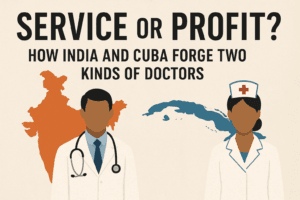
Service or Profit? How India and Cuba Forge Two Kinds of Doctors
The training of a doctor is more than the transfer of medical knowledge; it is the creation of a worldview, a set of values that determines whether a physician sees a patient in a remote village or a profitable clinic in London.
A striking paradox exists in global health: India produces some of the world’s most sought-after medical graduates, yet its own rural and poor populations struggle to find care. Cuba, a middle-income country, has built a system where its doctors are famous for serving the world’s most disadvantaged communities. This is not an accident of history but the direct result of two fundamentally different philosophies in medical education.
As India grapples with a severe and unevenly distributed doctor shortage, with only 70 physicians per 100,000 people, a closer examination of these two models reveals how the selection, training, and ethics instilled in medical students can determine the very soul of a nation’s healthcare system . The contrast between a system that has become a “lucrative business” and one built on “equity-driven” service offers critical lessons for the future of healthcare everywhere .
The Indian Paradox: Abundant Training, Scarce Service
India’s story is one of remarkable output coupled with profound internal failure. It boasts the world’s largest number of medical colleges, yet this quantity does not translate into quality or equitable care for its citizens. The system is engineered to produce skilled clinicians, but it lacks a mechanism to ensure those skills serve the public good.
The journey begins with an intensely competitive and financially burdensome gate. Over two million candidates vie annually for just over 100,000 MBBS seats through the National Eligibility cum Entrance Test (NEET-UG) . Success often requires years of expensive private coaching, creating a first major economic barrier that favors affluent families. The system’s narrow focus on a high-stakes exam, with no assessment of a candidate’s empathy or commitment to service, sets the stage for a transactional view of medicine .
Once admitted, students face a stark financial reality. The privatization of medical education since the 1990s has turned it into a lucrative investment, with nearly half of all MBBS seats in private colleges that charge exorbitant fees . The consequence is a heavy debt burden that shapes career choices from day one. As noted in an essay on malpractice in medical education, students learn early that “earning money has become the major priority,” with many pressured to “over-investigate and over-treat” future patients to recover their educational investment .
This system has led to three critical outcomes for India:
- Massive Brain Drain: India is the single largest source of migrant doctors for wealthy OECD nations, with over 98,000 Indian-born doctors working abroad . The exodus is most pronounced among the elite: a study found that 54% of graduates from the prestigious All India Institute of Medical Sciences (AIIMS) from 1989-2000 now reside outside India .
- Internal Maldistribution: Of the doctors who remain, approximately 80% work in the private, for-profit sector, primarily in urban areas. This leaves a skeletal public system struggling to serve the majority of the population .
- A Corruption Crisis: The intertwining of high costs and profit-seeking has deeply corrupted the sector. A Transparency International survey ranked health among India’s most corrupt services, with payments to doctors and staff for hospital admissions being a common practice .
The Cuban Model: Medicine as a Mission of Solidarity
Cuba stands as a radical counterpoint. Starting from a point of crisis after its 1959 revolution—when it had only one medical school and half its doctors left the country—Cuba redesigned medical education from the ground up with one core principle: health as a human right and a duty of social solidarity .
The process begins with a different kind of selection. While academic merit is considered, **Cuban medical schools prioritize “the mettle of character”**—evaluating a candidate’s sense of vocation, responsibility, and commitment to community. This foundational step ensures the pipeline is filled with individuals predisposed to service .
The curriculum itself dismantles the traditional hospital-centric model. Up to 80% of training occurs in community settings—polyclinics and neighborhood family doctor offices—rather than tertiary care hospitals. Students are embedded in communities from the start, learning to understand health holistically and focusing on preventive care and public health. The goal is to train a “comprehensive general doctor” who acts as a caregiver, community leader, and health educator.
This model has yielded extraordinary results. Cuba now has the highest doctor-to-population ratio in the world and achieves health outcomes comparable to wealthy nations . Crucially, almost all graduates volunteer for service in underserved rural areas within Cuba .
Furthermore, this education fuels Cuba’s renowned medical internationalism. Through programs like the Henry Reeve International Medical Brigade, established in 2005, Cuba has sent over 325,000 health professionals on missions to 158 countries, responding to disasters from the 2005 Pakistan earthquake to the COVID-19 pandemic . This “army of white coats” is a point of national pride and a significant source of foreign revenue, but it is fundamentally rooted in an educational system that instills solidarity as a core professional ethic .
Contrasting Philosophies, Contrasting Outcomes
The differences between the two systems can be distilled into their core objectives. Indian medical education, in its current privatized form, often operates as a high-cost individual investment, with success measured by personal financial and geographic mobility. Cuban medical education is treated as a public good for social return, with success measured by community health outcomes and service.
The following table highlights key differences in their approaches:
| Aspect | India’s Model (Current Trend) | Cuba’s Model |
| Primary Selection Criterion | Performance on a single, highly-competitive entrance exam (NEET-UG) . | Holistic review prioritizing character, vocation, and commitment to solidarity, alongside academics . |
| Core Training Environment | Large, urban, tertiary-care hospitals. | Decentralized; majority of training in community polyclinics and family doctor clinics . |
| Curriculum Emphasis | Curative, specialty-oriented medicine, and mastery of clinical technology. | Preventive medicine, public health, and comprehensive community care . |
| Defining Graduate Ethos | Recovery of educational investment and pursuit of high-income opportunities (domestic or foreign). | Social solidarity and service as a professional duty; graduates pledge to renounce private practice . |
| Key Systemic Outcome | Severe internal brain drain (to private sector/abroad) and urban clustering. | High retention in public system and willingness to serve rural/underserved areas, both domestically and globally . |
Conclusion: Reclaiming the Soul of Medicine
The divergence between India and Cuba is more than a policy difference; it is a reflection of what each society values in healthcare. India‘s system, despite its world-class institutions, risks reducing medicine to a commodity, exporting its best talent while leaving its most vulnerable citizens behind. The economic barriers and profit-centric incentives have created a workforce crisis that more seats in medical colleges alone cannot solve .
Cuba demonstrates that in medicine, purpose can be systematically taught and cultivated. By selecting for character, training in community, and elevating service above profit, it has built a system where doctors see themselves as guardians of public health.
For global health equity, the lesson is clear. Training more doctors is not enough. The challenge is to train a certain kind of doctor—one whose skill is matched by a commitment to serve where the need is greatest, not where the reward is largest. As nations worldwide struggle with healthcare shortages and access, the fundamental question posed by these two models remains: Is healthcare a business or a public good? The answer determines where doctors will go, and whom they will ultimately serve.
You must be logged in to post a comment.