
Sensex Crashes 500 Points: The ‘Anthropic Shock’ Wiping Out ₹2 Lakh Crore from IT Stocks
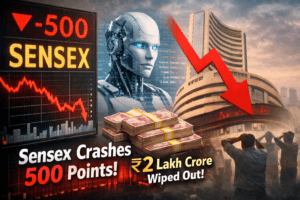
Sensex Crashes 500 Points: The ‘Anthropic Shock’ Wiping Out ₹2 Lakh Crore from IT Stocks
The three-day party on Dalal Street came to an abrupt halt today.
By 11:39 AM, the Sensex had surrendered 515 points to trade at 83,718, while the Nifty slipped below 25,850. But if you think this is just another routine correction, look closer. This isn’t broad-based selling. This is a targeted ambush.
And the weapon of choice? Artificial intelligence.
The IT Bloodbath: Not Just Another Selloff
When Infosys drops 4.97% in a single session, when TCS sheds 4.30%, when the entire Nifty IT Index plunges 4.40%—something bigger than quarterly earnings or RBI policy is at play.
Let’s put this in perspective. The last time IT stocks bled this profusely was during the US banking crisis in March 2023. Before that, it was the post-COVID taper tantrum. Each time, the trigger was external, structural, and deeply unsettling for investors who had grown accustomed to Indian IT’s seemingly unshakeable dominance.
Today’s trigger has a name: Anthropic shock.
What Exactly Is ‘Anthropic Shock’?
If you’re scratching your head over this term, you’re not alone. Until yesterday, most retail investors had never heard of it. Here’s what you need to know.
Anthropic is a San Francisco-based AI safety and research company founded by former OpenAI executives. Earlier this week, the company unveiled a breakthrough in automated coding—AI systems capable of writing, debugging, and deploying complex software with minimal human intervention.
This isn’t GitHub Copilot on steroids. This is something fundamentally different.
Anthropic’s latest model doesn’t just suggest code snippets. It understands entire codebases, identifies inefficiencies, rewrites entire modules, and tests them autonomously. For enterprise clients, this translates to one uncomfortable question: Why am I paying an Infosys or a TCS $150 per hour for something an AI agent can do in seconds?
The market’s math is brutal.
Indian IT services firms generate roughly 75-80% of their revenue from the US and Europe. A significant portion of this comes from application development and maintenance—precisely the work Anthropic’s technology threatens to automate. Even a 10-15% reduction in addressable market translates to billions in lost revenue visibility.
Dr. VK Vijayakumar of Geojit Investments didn’t mince words: “Tech stocks, reeling under the Anthropic shock, are unlikely to recover soon.” When a chief investment strategist uses the word “shock,” it’s not hyperbole. It’s a warning.
Why This Disruption Feels Different
Indian IT has survived multiple existential scares. Y2K didn’t kill the industry. Offshoring criticism didn’t stop it. H-1B visa restrictions merely bent the trajectory.
But AI-driven automation feels different for three reasons.
First, the speed of capability expansion. Previous waves of automation took years to mature. Anthropic’s model, by contrast, has improved more in the last 12 months than traditional coding assistants did in the previous five. The gradient is terrifyingly steep.
Second, the client mindset has shifted. US corporations spent 2024 and 2025 experimenting with AI tools. In 2026, they’re ready to cut contracts. CFOs who once viewed IT outsourcing as a fixed cost are now treating it as a variable expense—and variable expenses are the first to go during efficiency drives.
Third, Indian IT’s defensive moats are narrowing. Scale? AI scales better than human labour. Domain expertise? Large language models now absorb entire industry knowledge bases overnight. Cost advantage? When the alternative is near-zero marginal cost, even Bengaluru’s wage arbitrage looks expensive.
The ADR Warning Nobody Heeded
If you follow US markets closely, today’s fall wasn’t a surprise. It was a delayed reaction.
On Tuesday night, American Depositary Receipts (ADRs) of Indian IT majors tanked on the NYSE and Nasdaq. Infosys ADR fell over 6%. Wipro dropped 5.4%. HCL Technologies followed suit.
Indian markets, historically, take cues from ADR movements with a 12-to-24-hour lag. Today’s carnage was merely the local settlement of a trade that began on US soil.
Yet, somehow, the message didn’t sink in until the opening bell rang on Dalal Street. Perhaps it was the three-day winning streak. Perhaps it was selective attention. Whatever the reason, retail investors who woke up today expecting continuation were met with continuation of the wrong kind.
Beyond IT: Who’s Bleeding and Who’s Holding
A falling Sensex often masks diverging fortunes. Today was no exception.
The Casualties
- Coforge: -5.24%
- Infosys: -4.97%
- Tech Mahindra: -4.56%
- Persistent Systems: -4.45%
- LTIMindtree: -4.37%
- TCS: -4.30%
Every single name on this list shares a common thread: heavy exposure to North American financial services, retail, and technology clients—precisely the sectors most aggressive in adopting AI-driven development tools.
The Survivors
- ICICI Bank: +1.35%
- NTPC: +0.64%
- SBI: +0.61%
- Axis Bank: +0.54%
- HUL: +0.53%
Notice something? Private and public sector banks are actually up while the market craters. So are select FMCG names.
This isn’t random. This is capital rotation.
Institutional investors aren’t exiting equities. They’re exiting overvalued, structurally challenged IT names and redeploying into domestic consumption stories. Banks benefit from steady credit growth, improving asset quality, and valuations that never quite recovered from the pandemic. FMCG offers defensive earnings and pricing power.
The trade of 2026, it appears, is long India consumption, short global technology dependence.
Broader Markets: Pain Spreads Unevenly
While the headline indices fell 0.5-0.6%, broader markets took deeper cuts.
- Nifty Midcap100: -0.80%
- Nifty Smallcap100: -0.89%
This divergence matters. Midcaps and smallcaps are traditionally more retail-dominated. When they fall harder than largecaps, it suggests that individual investors—who entered IT stocks late, attracted by 40-50% corrections from all-time highs—are now capitulating.
The India VIX, up 1.29%, confirms rising anxiety. But at 13.5 levels, we’re nowhere near panic territory. Fear is present. Panic is not.
What Seasoned Investors Are Doing Right Now
I spoke with three portfolio managers this morning. None were selling indiscriminately. All were making distinctions.
One is increasing allocation to Nifty Auto, which gained 0.19% even as IT tanked. His logic: domestic demand remains robust, commodity costs are stable, and premiumisation is expanding margins. Companies like Maruti and Tata Motors aren’t immune to global slowdowns, but they’re insulated from AI disruption in ways IT services aren’t.
Another is selectively adding to Nifty Private Bank, up 0.11% today. His view: HDFC Bank, Kotak, and ICICI are trading at reasonable multiples with 15-18% ROE trajectories. “I’d rather own a bank at 2.5x book than an IT stock at 25x earnings facing structural headwinds,” he told me.
The third is doing something counterintuitive: holding his IT positions but trimming systematically. Not selling everything, but removing the risk of single-sector concentration. “Infosys at 1,400 was a sell. At 1,550, it was a stronger sell. At 1,200, I’m not selling into panic,” he said.
What Retail Investors Should Understand Right Now
If you’re an individual investor watching your IT portfolio turn red, the temptation is either to panic-sell or to double down, convinced this is another buying opportunity. Both responses, in isolation, are incomplete.
Here’s what you need to ask yourself:
Do I understand the Anthropic shock well enough to assess whether it’s transitory or permanent?
If the answer is no, you’re not equipped to make bottom-fishing decisions.
Is my IT exposure disproportionate relative to my overall portfolio?
If IT constitutes 30-40% of your equity allocation, today is a reminder—however painful—that concentration creates asymmetric risk.
Am I prepared for this narrative to persist for quarters, not days?
The market isn’t pricing a one-quarter earnings miss. It’s pricing a multi-year repricing of growth expectations. Recovery, when it comes, will be slow and selective.
The Sectors Quietly Moving Higher
While attention fixates on the IT wreckage, several sectors are behaving constructively.
Nifty Financial Services 25/50 is up 0.02%. That’s not accidental. This index excludes the largest private banks, focusing on second-tier lenders, NBFCs, and insurance names. Money is rotating not just out of IT, but within financials—from crowded largecaps to relatively under-owned mid-sized players.
Nifty FMCG is down just 0.06%, barely changed despite the broader selloff. HUL, Britannia, Nestlé—these aren’t exciting holdings, but they’re proving their defensive credentials yet again.
Nifty Pharma fell 0.61%, but that’s largely profit-taking after a strong run. The structural story for Indian pharma—US generic pricing stability, complex molecule capabilities, CDMO opportunities—remains intact.
The Bigger Picture: Adaptation, Not Extinction
Here’s what the Anthropic shock is not: an immediate death sentence for Indian IT.
Large enterprises won’t rip out existing outsourcing contracts overnight. Legacy systems won’t be refactored by AI agents in one quarter. Data security concerns will slow adoption. And Indian IT firms themselves are investing heavily in AI capabilities.
But here’s what it is: an acceleration of a trend that was already underway.
IT services have been migrating from “body shopping” to “outcome-based pricing” to “platform solutions” over the past decade. AI doesn’t eliminate this industry. It compresses the timeline for transformation.
The winners will be firms that figure out how to sell AI-enabled services, not fight them.
The losers will be those that cling to labour-arbitrage models while the labour gets automated.
What Comes Next
Between now and the next earnings season, three things will determine whether today’s fall is a one-day event or the beginning of a deeper IT bear market.
First, US commentary. When Accenture, Cognizant, and EPAM report, their management teams will face blunt questions about AI impact. Their answers will set the tone for Indian IT valuations.
Second, deal flow visibility. Indian IT majors entered FY27 with relatively soft order books. If clients delay decisions or reduce scope amid AI uncertainty, consensus earnings estimates will need to move lower.
Third, valuation recalibration. Nifty IT currently trades at 22-23 times one-year forward earnings. Historically, structural de-ratings have taken multiples to 15-18 times. We may not be there yet, but the direction is clear.
A Final Thought
Stock market corrections are rarely comfortable, but they perform an essential function: they reallocate capital from vulnerable business models to resilient ones.
The 515-point drop on Sensex today is painful for those holding IT stocks bought at higher levels. But it’s also clarifying. It forces investors to distinguish between companies with durable competitive advantages and those simply riding industry tailwinds.
Anthropic didn’t invent AI coding. It just proved that the technology has reached an inflection point.
The market’s job is to price that inflection before it becomes obvious.
Today, it did its job.
You must be logged in to post a comment.