
Seeds of Synergy: How the India-Argentina Agricultural Partnership is Forging a New Food Security Blueprint
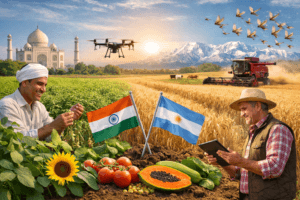
Seeds of Synergy: How the India-Argentina Agricultural Partnership is Forging a New Food Security Blueprint
While separated by over 15,000 kilometres and vastly different landscapes, India and Argentina are writing a new chapter in South-South cooperation—one rooted not in geopolitics, but in the soil. The recent exchange of the ICAR-INTA Work Plan for 2025–2027 is far more than a routine diplomatic accord. It represents a strategic convergence of two agricultural powerhouses, aiming to pool their distinct strengths to address some of the most pressing challenges in global food production: productivity, sustainability, and resilience.
At first glance, the partnership seems a study in contrasts. India, with its millennia-old farming traditions, feeds over 1.4 billion people on a limited arable land base through intensive, often smallholder-driven cultivation. Argentina, the “breadbasket of the South,” thrives on vast, mechanised expanses, specialising in large-scale production of oilseeds and grains for global export. Yet, this very contrast is the source of its potency. It’s a partnership not of competition, but of complementary genius.
Beyond the Signing Ceremony: The Historical Roots of a Growing Partnership
The ICAR-INTA agreement is not born in a vacuum. For decades, India has looked to Argentina’s prowess in oilseeds, particularly soybeans and sunflower, to help bridge its yawning domestic edible oil deficit, which sees the nation spending billions on imports annually. Argentina, in turn, has recognised India’s unparalleled success in pulse production—making it the world’s largest producer and consumer—and its advanced expertise in tropical horticulture, dairy management, and precision farming for small plots.
This new Work Plan formalises and dramatically expands these threads of exchange into a cohesive fabric of collaboration. It moves past trade-centric dialogue into the realm of shared knowledge, co-creation, and technological symbiosis.
Decoding the Work Plan: Key Pillars of Collaboration
The signed document outlines a multidimensional partnership. Let’s delve into the core areas where this exchange will translate into tangible impact.
- The Oilseeds and Pulses Imperative: A Direct Line to Food SecurityThis is the cornerstone of the economic and strategic partnership. India’s quest foroilseed self-sufficiency is a national priority. Argentine germplasm of soybean and sunflower, honed for high yields and specific climate adaptations, can be a game-changer. The collaboration isn’t about mere import substitution, however. The focus on value chain development implies learning from Argentina’s efficient, technology-driven processing, storage, and logistics systems for these crops.
Conversely, Argentina stands to gain from India’s pulse wizardry. India’s vast repository of genetic diversity in crops like chickpeas, lentils, and pigeon peas, coupled with agronomic practices for diverse growing conditions, can help Argentina diversify its formidable cropping system. Introducing pulses into Argentina’s crop rotations can improve soil health (through nitrogen fixation) and offer a nutritious, high-demand export product, creating a new revenue stream for farmers.
- Mechanisation and Precision: Scaling Wisdom, Preserving ResourcesHere, the exchange is beautifully bidirectional on the principle of appropriateness.
- From Argentina to India: Argentine expertise in large-scale zero-tillage systems and cotton harvesting machinery offers models for enhancing efficiency and reducing soil degradation in India’s larger farm belts. The knowledge transfer on drone technology for monitoring vast acreages can be adapted for Indian conditions.
- From India to Argentina: India is a global leader in micro-irrigation and fertigation systems, crucial for water-scarce regions. This technology is increasingly relevant for parts of Argentina facing water stress. Furthermore, India’s innovation in small and affordable farm machinery tailored for small and marginal holdings presents a market and a model for Argentina’s own small-farm sector.
- Horticulture and Germplasm: A Genetic Treasury OpensThe planned germplasm exchange reads like a culinary and agricultural wishlist:blueberry, citrus, wild papaya, guava, temperate fruits, and vegetables. For India, access to Argentina’s superior temperate fruit and vegetable varieties can boost production in its Himalayan states. For Argentina, tropical fruits like improved guava and disease-resistant papaya varieties open new possibilities in its northern regions. The collaboration on greenhouse technologies and post-harvest physiology is critical. Reducing post-harvest losses, which can be staggering in both countries, is as vital as increasing production. India’s cost-effective greenhouse designs and Argentina’s experience in long-supply-chain management can create powerful hybrid solutions.
- The One Health Frontier: Animal and Plant VigilanceThe Work Plan’s focus onFoot-and-Mouth Disease (FMD) elimination strategies is a profound step. India has a massive livestock population and is working towards FMD control. Argentina, recognised by the OIE as an FMD-free country with vaccination, offers a proven playbook. This collaboration can accelerate India’s national livestock health mission, improving farmer incomes and export potential. Similarly, joint efforts on locust surveillance and management leverage both nations’ experiences. Desert locust swarms are a transcontinental threat; sharing early warning data, biocontrol methods, and aerial management tactics builds a continental defence line.
- Digital Agriculture and Waste-to-Wealth: The Future FarmThe inclusion ofdigital agriculture, precision livestock farming, and waste-to-wealth technologies signals a forward-looking vision. This is where research institutes shine. ICAR and INTA can co-develop data analytics platforms for soil health, climate-resilient cropping patterns, and livestock monitoring. India’s innovations in converting agricultural residue into biofuel, biogas, and organic compost can address Argentina’s growing focus on circular agro-economy.
The Human Element: Capacity Building as the Engine
A signed plan gathers dust without people to animate it. The commitment to expert exchanges, structured training, and study visits is the lifeblood of this partnership. Imagine Indian scientists studying precision livestock farming on the Argentine pampas, while Argentine technicians learn subtropical fruit grafting techniques in Bengaluru. This creates lasting professional networks and fosters mutual understanding that transcends technology transfer.
The Bigger Picture: Strategic Autonomy and Global Stability
In a world of climate volatility and supply chain disruptions, this partnership is a move towards strategic autonomy in food systems. By sharing technological sovereignty, both nations reduce dependency on a narrow set of global inputs and solutions. It strengthens the Global South’s capacity to feed itself and the world sustainably.
Furthermore, it sets a benchmark for international agricultural cooperation—one based on mutual respect, complementary strengths, and a shared commitment to solving problems rather than selling solutions. The annual review mechanism ensures accountability and adaptive management, a lesson many bilateral agreements overlook.
Conclusion: Cultivating a Shared Future
The ICAR-INTA Work Plan is more than a document; it’s a seed. Planted in the fertile ground of shared need and complementary strength, its success will be measured not just in exchanged germplasm or joint papers, but in more resilient farms, healthier soils, secure livelihoods, and more sustainable food systems in both hemispheres.
For the Indian farmer, the promise lies in accessing robust oilseed varieties and smarter mechanisation. For the Argentine producer, it opens doors to pulse cultivation and water-saving tech. For the global community, it offers a model of collaborative, solution-oriented diplomacy. As this partnership deepens from 2025 to 2027, the world will witness an experiment in agricultural synergy that, if nurtured, could yield a harvest of innovation for decades to come. The fields of Punjab and the Pampas are now connected by a bridge of knowledge, and the journey has just begun.
You must be logged in to post a comment.