
Seed Bill 2025: Modernization at What Cost to India’s Farmers and Food Sovereignty?
Seed Bill 2025: Modernization at What Cost to India’s Farmers and Food Sovereignty?
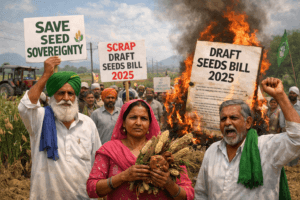
India stands at an agricultural crossroads with the Draft Seeds Bill 2025, a long-awaited attempt to replace the outdated 1966 Seeds Act. Promising a digital revolution in the fields with QR codes and traceability portals, the government hails it as a farmer-centric update for the modern seed industry. Yet, for millions of farmers and agricultural advocates, the bill represents not progress, but a grave threat to their autonomy, livelihoods, and India’s rich seed biodiversity. Their response has been swift and fierce: nationwide protests and the symbolic burning of the draft bill, declaring it a “corporate charter disguised as reform”.
This clash reveals a fundamental dissonance in Indian agriculture. On one side is a booming, formal seed market—worth an estimated $8.2 billion (₹34,000 crores) and dominated 70% by the private sector. On the other is the vast, informal world of farm-saved seeds, community exchanges, and a quiet but powerful revival of indigenous varieties, which still provides most staples like cereals and pulses. The Seeds Bill 2025 sits squarely in the middle of this divide, and its journey over two decades reveals why finding common ground has been so difficult.
What Does the Draft Seeds Bill 2025 Propose?
At its core, the bill aims to create a unified, modern regulatory framework. Its key technological and regulatory pillars include:
- Mandatory Registration & Digital Traceability: All seeds for sale must be registered after passing multi-location Value for Cultivation and Use (VCU) trials. Every seed packet must carry a QR code, linked to a National Seed Traceability Portal (SATHI), for end-to-end tracking.
- Centralized Accreditation: A new system will allow companies accredited at the national level to be automatically recognized across all states, aimed at easing compliance for large, multi-state businesses.
- Graded Penalty System: It introduces a three-tier penalty structure, decriminalizing minor offences while imposing fines up to ₹30 lakh and imprisonment for major violations like selling spurious seeds.
- Farmers’ Rights (on paper): The bill affirms a farmer’s right to “save, use, exchange, share, or sell” farm-saved seed, provided it is not sold under a brand name.
A 20-Year Legislative Saga of Stalemate
The current draft is not a new idea but the latest chapter in a two-decade-long struggle. The first major rewrite attempt came in 2004, two years after the controversial introduction of Bt cotton, which marked the arrival of proprietary seed technology. That bill faltered under opposition for favoring companies and clashing with the landmark Protection of Plant Varieties and Farmers’ Rights (PPV&FR) Act, 2001. Subsequent drafts in 2010 and 2019 similarly stalled, each failing to resolve core issues like farmer compensation and state powers.
The 2025 version emerges into a landscape shaped by a strong government emphasis on “ease of doing business,” a phrase critics note is unusually explicit in the bill’s own text. This shift in emphasis, from pure quality control to market facilitation, lies at the heart of the current controversy.
The Core of the Conflict: Four Contentious Flaws
Farmers’ groups, civil society organizations, and even state governments have leveled profound criticisms against the draft. Their concerns coalesce around four major themes, illustrated in the table below.
- The Federalism Fault LineAgriculture is astate subject under the Indian Constitution, but the bill aggressively centralizes power. Key functions—registration, accreditation, rule-making—are vested with the central government. A particularly contentious provision (Section 17(8)) mandates that states must “forthwith” accept companies accredited at the national level, stripping them of the power to reject firms unsuitable for local conditions.
States like Kerala and Telangana have officially objected, arguing this structure sidelines regional agro-ecological needs and violates federal principles. Furthermore, by replacing the older Seeds (Control) Order, states lose a critical legal tool they have used to cap seed prices and royalties.
- The Empty Promise of CompensationPerhaps the most glaring omission is the lack of astatutory, farmer-friendly compensation mechanism. While the bill prescribes hefty penalties for companies selling sub-standard seeds, these fines are paid to the state treasury, not to the farmer who suffered the crop loss.
As agriculture expert Dr. G.V. Ramanjeneyulu notes, the bill “remains silent on compensating farmers for losses caused by sub-standard seeds”. In practice, a farmer facing seed failure must navigate the expensive and delayed process of consumer courts, a path often impossible for smallholders. Farmer unions demand an automatic, time-bound compensation system within the seed law itself, a provision present in earlier drafts but absent here.
- Threat to the Living Library: Community Seed SystemsWhile the bill carves out an exemption for “farmers’ varieties,” it fails to recognize the vitalcollective ecosystem of community seed banking and exchange. For years, a grassroots movement led by women’s collectives, NGOs, and farmer groups has revived heirloom varieties, creating decentralized networks that preserve climate-resilient biodiversity outside the commercial market.
Critics warn that by treating Farmer Producer Organisations (FPOs) or seed collectives as commercial entities, the bill subjects them to the same digital compliance and licensing burdens as multinational corporations. This could criminalize traditional sharing practices and, as seed rights advocate Kavitha Kuruganti warns, “strengthen corporate seed systems while weakening the very community seed networks that sustain diversity”.
- Sovereignty and Safety: The Global Market’s ShadowThe bill allows the recognition offoreign organizations for VCU testing and certification. Critics see this as a backdoor for genetically modified or gene-edited seeds to enter the Indian market based on data from dissimilar agro-climatic zones, bypassing robust, localized public evaluation by bodies like the ICAR.
This provision, combined with the centralizing thrust, is viewed as a threat to national seed sovereignty. As Bharat Mansata of the Bharat Beej Swaraj Manch cautions, this could “effectively legalise biopiracy of our rich genetic heritage” and multiply hazards to ecosystem health.
The Government’s Defense and the Road Ahead
The government maintains that the bill is “farmer-centric” and aligns with current needs. Officials emphasize that its provisions are not applicable to farmers saving their own seeds and that quality regulation and traceability will protect farmers from widespread spurious seeds—a real problem evidenced by 43,000 failed samples out of 600,000 tested recently.
However, with pre-legislative consultations concluded, the path forward is turbulent. Major unions like the All India Kisan Sabha (AIKS) and the Samyukta Kisan Morcha (SKM) have already mobilized nationwide protests, demanding the bill’s complete withdrawal and labeling it a “triple assault” on sovereignty.
Conclusion: What Is a Seed Law For?
After 20 years and four drafts, the debate over the Seeds Bill 2025 transcends technicalities. It forces a national reckoning with a basic question: What is the fundamental purpose of a seed law?
Is it merely to regulate a market—streamlining commerce, ensuring transaction transparency, and facilitating business? If so, the 2025 draft, with its QR codes and central portals, fits the bill.
Or is it to secure a food system—protecting the cultivator’s livelihood, empowering communities as custodians of biodiversity, and building agro-ecological resilience against climate change? If this is the goal, then the bill’s silence on compensation, its threat to federalism, and its blindness to community systems are fatal flaws.
Seeds are not mere industrial inputs; they are living, evolving capsules of culture, ecology, and survival. A law that modernizes traceability but weakens the foundations of diversity and justice may achieve a semblance of order at the profound cost of sovereignty and trust. The final verdict on this bill will determine not just the future of India’s seed industry, but the very soul of its agriculture.
You must be logged in to post a comment.