
SCOTUS Rebukes Trump on Tariffs: A Defining Moment for Executive Power in America
The recent U.S. Supreme Court ruling that struck down President Trump’s unbounded use of emergency powers to impose tariffs underscores a fundamental divergence in constitutional design between the United States and India: while America’s strict separation of powers creates dramatic, high-stakes confrontations between a president who tests limits and a judiciary that must police them—often relying on fragile norms of compliance—India’s fusion-of-powers model, where the executive is drawn from and accountable to Parliament, channels such tensions into institutionalized political processes rather than existential constitutional crises, though both nations ultimately grapple with the same core question of how to constrain an executive that resists judicial oversight.
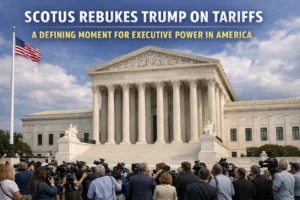
SCOTUS Rebukes Trump on Tariffs: A Defining Moment for Executive Power in America
In a landmark 6:3 ruling delivered on February 21, 2026, the Supreme Court of the United States (SCOTUS) fundamentally redefined the boundaries of executive power, declaring that President Donald Trump overreached his authority by using the International Emergency Economic Powers Act (IEEPA) of 1977 to unilaterally impose sweeping, unbounded tariffs during peacetime . The case, Learning Resources Inc v. Donald J Trump, struck down the administration’s interpretation that a national emergency could be used to control any and all economic transactions with other countries, a power the court found had never been intended by Congress .
The ruling arrived with the force of a constitutional thunderclap, sending shockwaves through Washington and across the globe. For the first time in the IEEPA’s nearly 50-year history, the judiciary clipped the wings of the executive in the realm of emergency economic powers. President Trump’s immediate reaction was characteristically defiant; he took to social media to lambast the justices as “very unpatriotic and disloyal to the Constitution,” suggesting the ruling was influenced by “foreign interests” . Hours later, in a move that seemed to dare the court, he issued a new proclamation raising the global tariff rate from 10% to 15%, vowing to find another legal pathway .
Half a world away, in New Delhi, the timing of the American judgment caused acute political whiplash. Just three weeks prior, Prime Minister Narendra Modi’s government had announced a high-stakes interim trade deal with the Trump administration. That deal, which opened India’s sensitive agricultural markets and included a pledge to cease purchases of Russian oil, was secured in exchange for relief from the very tariffs the Supreme Court just declared illegal . The opposition Congress party immediately demanded the deal be put on hold, arguing that its legal and economic foundations had collapsed .
This moment is more than a transatlantic trade squabble. It is a vivid, real-time case study in comparative constitutional law. The American drama—a president wielding a broad grant of power, a court pushing back, and the resulting political chaos—throws the unique design of India’s own constitutional framework into sharp relief. Why does the U.S. system seem to lurch from one separation-of-powers crisis to another, while India, despite its own intense political arguments, rarely faces a similar constitutional paralysis?
The answer lies not in the personalities of leaders, but in the foundational blueprints of the two republics.
The American Crucible: A “Strict Separation” Under Stress
The United States Constitution is often described as an “invitation to struggle” between the branches . Born of a revolutionary’s distrust of concentrated power, it establishes a government of strict separation of powers. The President (Executive) is elected independently of Congress (Legislature). Cabinet members cannot serve simultaneously as legislators. The President serves a fixed four-year term, largely immune from the whims of the legislative majority .
This model was designed for efficiency and liberty. By giving each branch a distinct, non-overlapping mandate, the Framers believed they could prevent tyranny. As James Madison wrote in Federalist No. 51, “you must first enable the government to control the governed; and in the next place oblige it to control itself” . The President commands the military and executes the laws, Congress holds the purse strings and the power to declare war, and the judiciary interprets the law .
The recent IEEPA ruling exposed the profound stress lines in this system. The law, by its text, grants the President vast discretion during a national emergency. The Trump administration argued this discretion was unlimited. The Supreme Court, in a 6-3 ruling, disagreed, asserting its “province and duty to say what the law is,” a duty first staked out in Marbury v. Madison (1803) .
Yet, the ruling is merely a judicial pronouncement. It relies entirely on executive compliance. As the Cato Institute noted, the U.S. system depends heavily on unwritten rules and good-faith adherence to norms . When those norms erode, the “checks and balances” can look threadbare. Vice President J.D. Vance has publicly stated that “Judges aren’t allowed to control the executive’s legitimate power,” a statement that begs the question of who decides what is legitimate .
This has led to what observers call the “rise of the King President,” where the occupant of the Oval Office treats Congressional oversight and judicial review as obstacles to be overcome rather than constitutional mandates to be respected . The system’s strength—its rigidity—becomes its weakness, leading to gridlock, government shutdowns, and an unhealthy reliance on the courts to resolve fundamentally political questions .
The Indian Approach: A “Fusion of Powers” with a Final Arbiter
India’s framers, led by B.R. Ambedkar, surveyed the world’s constitutions and made a deliberate choice. Rejecting the American model’s potential for deadlock, they opted for the British Westminster model, adapted for a newly independent republic. The result is a system based on a fusion of powers, not a strict separation .
In India, the executive (the Council of Ministers, headed by the Prime Minister) is drawn directly from the legislature (Parliament). Under Article 75(3), the government exists only so long as it enjoys the confidence of the Lok Sabha, the lower house . This creates a permanent, powerful link between the law-making and law-enforcing branches. Responsibility is prioritised over stability—a government that loses its majority falls immediately, avoiding the kind of prolonged paralysis seen in U.S. shutdowns .
This does not mean the doctrine of separation of powers is absent. The Supreme Court has famously held it to be part of the “basic structure” of the Constitution, which even a constitutional amendment cannot destroy (Kesavananda Bharati v. State of Kerala, 1973) . However, it is a separation of functions, not a hermetic separation of personnel. The Indian President, the constitutional head of state, may have ordinance-making powers (Article 123), but they must act on the aid and advice of the Prime Minister and Council of Ministers .
This “checks and balances within a fusion framework” creates a different kind of institutional tension. While the U.S. sees battles between co-equal branches, India’s primary friction point is often between the judiciary and a powerful, fused executive-legislative entity.
A perfect example is the ongoing dispute over the role of state Governors. In April 2025, the Supreme Court took the extraordinary step of setting a timeline for Governors and the President to act on Bills passed by state Assemblies, seeking to end the practice of indefinitely withholding assent . The government pushed back aggressively. Solicitor General Tushar Mehta argued before the court that issuing a “mandamus” (a judicial command) to a constitutional functionary like the President or a Governor violates the separation of powers . Vice President Jagdeep Dhankhar, the Chairman of the Rajya Sabha, has publicly accused the judiciary of acting like a “super Parliament,” wielding Article 142 (which allows the court to pass any order necessary for “complete justice”) as a “nuclear missile against democratic forces” .
Unlike the U.S., where a Vice President might simply vent on social media, the Indian executive has institutional tools to respond. Parliament can, and has, passed laws to reverse the effect of judicial pronouncements. In 2011, Parliament passed the Customs Amendment and Validation Bill to nullify the impact of a Supreme Court ruling on the authority of customs officials . More dramatically, in 2014, Parliament passed a constitutional amendment to create the National Judicial Appointments Commission (NJAC), a direct response to the court’s collegium system for appointing judges. The Supreme Court, in turn, struck down the NJAC in 2015, reasserting its primacy and highlighting the intense, unresolved debate over who has the final word .
Two Systems, One Tension: The Uncomfortable Truth
Despite their structural differences, both nations are grappling with the same fundamental question: What happens when the executive refuses to be checked?
In the U.S., the confrontation is stark and public. A federal appeals court judge, J. Harvie Wilkinson, recently issued a searing opinion accusing the Trump administration of “lawlessness” for defying court orders, warning of a descent into “anarchy” . President Trump, in turn, has called for the impeachment of judges, labeling them “lunatics” and “radical left lunatics” . The conversation is about open defiance and the fragility of the rule of law.
In India, the confrontation is more institutionalized, playing out through presidential references to the Supreme Court, parliamentary debates, and public speeches by constitutional functionaries . The friction is intense, but it remains largely within the constitutional arena. As one analysis noted, India’s model allows “instability to be resolved within the constitutional framework,” whereas the U.S. model’s only recourse is political negotiation or judicial intervention, both of which can be ignored .
A 2025 analysis in The Tribune captured the shared discomfort perfectly: “At the heart of both situations is one uncomfortable truth: the executive doesn’t like being told what to do, especially not by unelected judges” . The executive branch, whether led by a President or a Prime Minister, is an institution of action. It sees judicial restraint as an impediment to its mandate. In the U.S., this has led to accusations of a “unitary executive” theory, where the President claims near-total control over the administrative state . In India, it manifests in Vice President Dhankhar’s argument that the President, who takes an oath to “defend” the Constitution, holds a higher duty than judges who merely swear to “abide” by it .
Conclusion: A Question of Constitutional Culture
The U.S. Supreme Court’s rejection of Trump’s emergency tariffs is a landmark defense of legislative power against executive overreach. It reaffirms that even a national emergency does not grant the President a blank check. Yet, the victory may be fleeting if the executive simply refuses to accept the court’s legitimacy.
India’s constitutional design, with its fusion of powers, was built to avoid such paralyzing confrontations. It ensures accountability by making the executive’s survival dependent on the legislature’s confidence. This creates a more fluid, politically-driven form of governance, but one with a built-in release valve for political crises .
The current tensions in both countries reveal that a constitution is more than a document; it is a culture. The American system, for all its checks and balances, relies on a spirit of forbearance and respect for norms that is currently under immense strain . The Indian system, while more resilient to political shocks, faces the challenge of an ever-expanding judiciary and an executive that chafes against judicial scrutiny .
As the U.S. lurches from one constitutional crisis to the next, India’s choice of a parliamentary democracy—a “noisy ensemble” over a “solo act” —looks less like a compromise and more like a profound act of constitutional wisdom. The American drama serves as a powerful reminder: a system designed to prevent tyranny by dividing power can only function if all players agree to play by the rules. When they don’t, the “world’s greatest democracy” can find itself looking for a king.
You must be logged in to post a comment.