
Santhali Constitution Release: A Historic Step for Tribal Recognition in India
On December 25, 2025, President Droupadi Murmu released the Constitution of India in the Santhali language at the Rashtrapati Bhavan, marking a historic step for the empowerment and inclusion of India’s tribal communities. Translated into the indigenous Ol Chiki script, this version makes the nation’s foundational legal document accessible in the mother tongue of approximately 7.5 million Santal people across Jharkhand, West Bengal, Odisha, and Bihar. The release, occurring in the centenary year of the Ol Chiki script’s creation, fulfills the recognition granted to Santhali when it was added to the Constitution’s Eighth Schedule in 2003, enabling citizens to directly understand their rights and deepening the practical reach of Indian democracy.
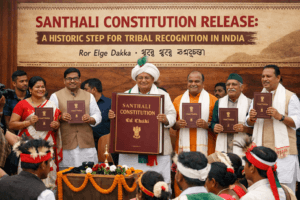
Santhali Constitution Release: A Historic Step for Tribal Recognition in India
The Constitution of India, now translated into one of the nation’s most ancient living languages, represents more than just words on paper—it signifies the arrival of constitutional rights in the mother tongue of millions.
On December 25, 2025, at Rashtrapati Bhavan in New Delhi, President Droupadi Murmu presided over a ceremony that marked a transformative moment for India’s tribal communities. The release of the Constitution of India in the Santhali language, written in the distinctive Ol Chiki script, represents the culmination of a centuries-long struggle for recognition by the Santal people. This event, timed with the centenary celebration of the Ol Chiki script’s creation, symbolizes a significant shift in how India’s foundational legal document reaches its diverse population.
A Language Finds Its Constitutional Voice
Santhali, an Austroasiatic language distinct from the Indo-Aryan and Dravidian language families that dominate India, is spoken by approximately 7.5 million people across several Indian states and neighboring countries. Before this translation, Santal people could only access India’s Constitution in languages that were not their own—a significant barrier to understanding the rights and responsibilities it guarantees.
The newly released Santhali Constitution uses the Ol Chiki script, a writing system invented specifically for the language in 1925 by Pandit Raghunath Murmu. Unlike traditional Indic scripts, Ol Chiki was designed from the ground up to accurately represent Santhali phonetics, with its 30 letters reflecting natural shapes and common Santali words. For instance, the letter representing the sound /l/ is derived from a simplified drawing of a hand holding a pen, reflecting its name “ol”—the Santali word for “writing”.
Historical Context: From Rebellion to Recognition
The Santal community’s journey to constitutional recognition has been marked by both resilience and resistance. In 1855, Santals led what became known as the Santal Hul rebellion—a massive uprising against exploitative landlords, moneylenders, and British tax policies that had dispossessed them of their lands. Led by Sidhu and Kanhu Murmu, approximately 30,000 Santals participated in this rebellion, which was eventually suppressed by British forces but resulted in the creation of the Santal Parganas—a semi-autonomous administrative region.
The Santal community constitutes the largest tribal group in Jharkhand and West Bengal and maintains significant populations in Odisha, Bihar, Assam, Tripura, Bangladesh, and Nepal. Despite their numbers and historical presence, their language struggled for official recognition throughout much of India’s post-independence history.
The Constitutional Journey: Timeline of Recognition
| Year | Milestone | Significance |
| 1925 | Creation of Ol Chiki script by Pandit Raghunath Murmu | Provided a writing system specifically designed for Santali language phonetics |
| 2003 | 92nd Constitutional Amendment passed | Added Santhali to Eighth Schedule alongside Bodo, Dogri, and Maithili |
| 2004 | Amendment came into force | Granted Santhali official recognition and government development responsibility |
| 2025 | Constitution released in Santhali | Made India’s foundational document accessible in the language of approximately 7.5 million people |
The 92nd Amendment of 2003 marked a critical turning point, adding Santhali to the Eighth Schedule of the Constitution alongside Bodo, Dogri, and Maithili. This inclusion obligated the government to develop and promote the language, setting the stage for eventual constitutional translation. The parliamentary debate surrounding this amendment revealed complex linguistic politics, with concerns raised about resource allocation and the distinction between languages and dialects.
Why This Translation Matters Beyond Symbolism
President Murmu emphasized that this translation enables Santal people to “read and understand the Constitution in their own language”. This practical benefit cannot be overstated—for many Santali speakers, particularly in rural areas, accessing legal rights in a comprehensible language represents real empowerment. Prime Minister Narendra Modi echoed this sentiment, stating the translation would “help deepen constitutional awareness and democratic participation”.
The timing of this release—coinciding with the centenary year of the Ol Chiki script—adds layers of historical resonance. It represents not just linguistic recognition but celebrates a century of cultural preservation through a writing system that emerged from within the community itself.
Linguistic Landscape: Where Santhali Fits In
| Feature | Details |
| Language Family | Austroasiatic (Munda subfamily) |
| Script | Ol Chiki (specifically created for the language) |
| Primary Regions | Jharkhand, West Bengal, Odisha, Bihar |
| Speaker Population | Approximately 7.5 million (2011 estimate) |
| Eighth Schedule Status | Added in 2003 through 92nd Amendment |
The release comes amid ongoing debates about India’s linguistic diversity management. Currently, 38 additional languages have pending demands for Eighth Schedule inclusion, including Gondi, Ho, Kumaoni, Rajasthani, and Tulu. Each inclusion brings questions about resource allocation, educational implementation, and administrative complexity.
Broader Implications for India’s Democratic Framework
This translation represents a significant advance in making India’s democracy more inclusive. When citizens can access foundational documents in their mother tongues, the social contract becomes more tangible. For Santal communities who have historically faced marginalization—from colonial-era dispossession to contemporary challenges of land rights and economic development—reading about equality, justice, and fundamental rights in their own language carries profound meaning.
The event also highlights the evolving nature of India’s constitutional identity. The Eighth Schedule originally contained 14 languages in 1950. Through subsequent amendments, this has expanded to 22, reflecting an understanding that linguistic recognition is integral to cultural dignity and political inclusion. Each addition represents a negotiation between national unity and regional diversity—a balance that has characterized India’s democratic experiment since independence.
Looking Forward: Implementation and Inspiration
The true test of this constitutional translation will lie in its implementation and accessibility. Will copies reach remote Santal villages? Will legal professionals be trained to reference the Santhali text? Will it be integrated into civic education? These practical considerations will determine whether this historic release translates into substantive empowerment.
For other linguistic communities awaiting recognition, the Santhali Constitution offers both inspiration and a precedent. It demonstrates that persistent advocacy—from the 19th century rebellions to 20th century script creation to 21st century constitutional amendments—can eventually yield institutional recognition. The journey from Raghunath Murmu’s creation of the Ol Chiki script in 1925 to President Murmu releasing the constitutional translation in 2025 encapsulates a century of cultural resilience.
As India continues to navigate its extraordinary linguistic diversity—with hundreds of languages belonging to several distinct language families—the Santhali Constitution release reaffirms a foundational principle: a living democracy must speak in the voices of all its people. In making its supreme legal document accessible in one of its most ancient living languages, India has strengthened the constitutional promise of justice, liberty, and equality for one more segment of its diverse population.
You must be logged in to post a comment.