
Russia’s S-350 Offer to India: Strategic Boon or Technological Trap?
Russia’s renewed offer to supply India with the S-350 Vityaz air defense system, now including full technology transfer, presents a strategic dilemma between immediate capability enhancement and long-term sovereign ambition. While the system would effectively fill a critical medium-range gap within India’s layered air defense network—seamlessly integrating with existing S-400s to counter sophisticated threats from Pakistan and China—the promise of tech transfer risks creating new dependencies on Russian supply chains for core components and could divert vital resources and focus from India’s own indigenous programs like Project Kusha. Furthermore, the system’s demonstrated vulnerabilities in modern combat to low-cost drones raise operational concerns. Ultimately, for India, the choice transcends a simple arms purchase; it represents a definitive test of its “Atmanirbhar Bharat” policy, forcing a decision between the expediency of a proven foreign platform and the more arduous but sovereign path of developing and future-proofing its own defense industrial ecosystem.
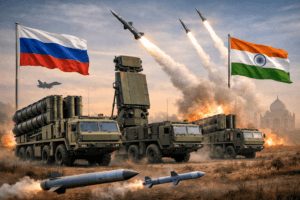
Russia’s S-350 Offer to India: Strategic Boon or Technological Trap?
In the high-stakes arena of global defense procurement, a renewed Russian proposal is sparking intense debate within India’s strategic community. Following the contentious S-400 deal, Moscow has once again extended an offer to New Delhi—this time for the S-350 Vityaz medium-range air defense system, now sweetened with the promise of full technology transfer (ToT). This proposal arrives at a critical juncture for India, balancing its long-standing defense partnership with Russia against its ambitious “Atmanirbhar Bharat” (self-reliant India) initiative and evolving strategic autonomy.
The central question for India’s defense planners is whether this deal represents a genuine leap towards self-sufficiency and layered security, or a sophisticated ploy to integrate India deeper into a Russian technological ecosystem, potentially at the expense of burgeoning indigenous programs.
The S-350 Vityaz: Technical Capabilities and Role in Layered Defense
At its core, the S-350 “Vityaz” (Knight) is a mobile, medium-range surface-to-air missile system developed by Russia’s Almaz-Antey corporation to replace older S-300PS systems. Designed with roots in a joint Russian-South Korean project, the system entered service with the Russian military in 2019-2020 and is built around highly mobile BAZ-6909 8×8 truck chassis, allowing for rapid deployment and repositioning.
The system’s primary strength lies in forming a critical middle layer within an integrated air defense network. In Russia’s own doctrine, the long-range S-400 serves as the outer shield, while the S-350 provides denser coverage against medium and short-range threats. A single S-350 battery can be formidable: it typically consists of a command vehicle, multifunction radar, and several launchers, capable of carrying up to 12 vertically launched missiles per launcher. Its radar system is reported to detect and track up to 40 targets simultaneously.
Technical Specifications at a Glance
To understand its fit within India’s arsenal, it is crucial to examine its published capabilities:
- Engagement Range:
- Against aircraft: 1.5 to 120 km
- Against ballistic missiles: 1.5 to 30 km
- Engagement Altitude:
- From as low as 10 meters up to 30 km
- Simultaneous Engagement:
- Up to 16 aerodynamic targets (aircraft, drones)
- Up to 12 ballistic targets
The system primarily uses two missile types: the 9M96E/E2 for medium-range engagements (up to 120 km) and the smaller 9M100 (range 10-15 km) for point defense, which can be “quad-packed” on a single launcher tube for increased firepower against saturation attacks.
The Allure: Why the Offer is Tempting for India
From India’s perspective, the offer has several immediately attractive elements that align with pressing national needs.
- Plugging a Critical Gap: India’s air defense has historically had a “patchwork” quality. The S-350 is explicitly designed to operate seamlessly with the five S-400 regiments India is already inducting. It would fill the operational gap between the S-400’s long-range umbrella and India’s short-range systems like the indigenous Akash and the Israeli-origin Barak-8, creating a more robust, multi-layered shield against diverse threats from Pakistan and China.
- The “Full Tech Transfer” Promise: This is the headline-grabbing element. For a nation committed to “Atmanirbhar Bharat,” the prospect of manufacturing, maintaining, and eventually innovating upon a modern air defense system domestically is powerful. It promises local production, reduced foreign dependence for spares and maintenance, and the growth of the domestic defense industrial base.
- Operational Experience and Urgency: The S-350 is not a paper system. It is fielded and has seen combat. Russian sources claim impressive feats, including intercepting 12-16 U.S.-supplied HIMARS rockets in a single engagement in Ukraine and even conducting an AI-assisted interception of an aircraft “without a man-in-the-loop”. For India, facing a two-front threat scenario, acquiring a proven, ready-to-deploy system can seem more attractive than waiting years for indigenous projects to mature.
The Caveats and Strategic Pitfalls
However, beneath the attractive surface, the proposal is fraught with complications and potential long-term costs.
- The “Tech Transfer” Mirage?
Russia’s history with complete technology transfer is checkered. Often, what is transferred is the capability for assembly and maintenance, not the core design knowledge or cutting-edge sub-component technologies (like seeker heads or advanced radar software). India could find itself dependent on Russian supply chains for critical “black box” components, replicating past dependencies seen in other joint ventures.
- Undermining the Indigenous Imperative
India is not starting from scratch. The DRDO’s ambitious “Sudarshan Chakra” mission aims to build a comprehensive, AI-enabled, multi-layered indigenous air defense shield by 2035. A cornerstone of this is Project Kusha, an indigenous Long-Range Surface-to-Air Missile (LR-SAM) system designed to match the S-400 with interception ranges from 150 km to 400 km. A major S-350 procurement, especially with ToT, could divert critical funding, talent, and political attention away from these homegrown efforts, stunting their development just as they gain momentum.
- The Harsh Reality of Modern Battlefield Performance
The combat record of the S-350 in Ukraine is a double-edged sword. While Russian sources tout its successes, open-source evidence paints a more vulnerable picture. In January 2026, Ukrainian Unmanned Systems Forces claimed the destruction of a key 50N6E radar station of an S-350 system in the Donetsk region. This incident highlights a critical vulnerability: even advanced air defense systems are increasingly susceptible to low-cost, precision-guided drones and countermeasures. Investing billions in a system that can be neutralized by asymmetrical threats is a significant operational risk.
- Strategic Alignment and Future-Proofing
India’s strategic future points toward deeper integration with Western partners and its own technological ecosystem. The S-350 would deepen integration with Russian command, control, and data-link architecture. This could complicate interoperability with Western-origin systems (like aircraft or early-warning platforms) and **conflict with the vision of a networked, tri-service “Integrated Air Command and Control System” based on Indian and possibly Western standards.
Comparative Analysis: S-350 vs. The Indigenous Path
The following table contrasts the key considerations of the S-350 procurement against the indigenous development pathway.
| Consideration | The S-350 Procurement Path | The Indigenous Development Path (Project Kusha/Sudarshan Chakra) |
| Time to Deployment | Relatively Fast (2-4 years after contract) | Slower (5-10+ years for full maturity) |
| Technological Control | Limited/Licensed. Core IP remains Russian; potential for supply chain dependency. | Complete. Full design authority, IP ownership, and control over upgrades. |
| Strategic Autonomy | Mixed. Enhances military capability but deepens ties to a single foreign supplier under sanctions. | Maximized. Eliminates foreign political leverage and sanctions risk. |
| Long-term Cost | High upfront acquisition, plus lifecycle costs. Potential for cost escalation in spares. | High R&D investment initially, but lower unit costs and economic spillover in the long run. |
| Operational Integration | Seamless with S-400, but may create challenges with non-Russian Indian systems. | Built for Indian network architecture (IACCS), ensuring smoother tri-service integration. |
| Industrial Benefit | Creates assembly/maintenance jobs. Technology absorption may be limited. | Catalyzes entire R&D and manufacturing ecosystem, fostering innovation across sectors. |
Conclusion: A Defining Choice for Strategic Autonomy
Russia’s S-350 offer is a masterclass in strategic salesmanship, presenting a seemingly perfect solution to India’s immediate air defense anxieties. The promise of full technology transfer cleverly targets India’s deepest aspiration: genuine defense self-reliance.
However, accepting this offer would be a profound strategic choice, not merely a defense purchase. It risks mortgaging India’s future technological sovereignty for present-day convenience. The “transfer” may provide a temporary capability boost but could institutionalize a new form of dependency, just as India’s own defense R&D stands on the cusp of delivering sovereign solutions.
The wiser, albeit harder, path may be to politely decline the knight in shining armor. India should instead double down on Project Kusha and the Sudarshan Chakra mission, using the urgency of the threat environment to accelerate these programs. Should an interim capability gap be deemed unacceptable, any foreign procurement should be framed as a strictly time-bound, stop-gap measure with clear sunset clauses linked to the induction of indigenous systems.
The choice between the S-350 and self-reliance is a defining one. It will signal whether India’s vision of “Atmanirbhar Bharat” is a rhetorical flourish or the foundational principle of its journey to becoming a leading defense power. In the long run, a homegrown shield, developed through struggle and innovation, will prove far more resilient and empowering than the most generously licensed foreign armor.
You must be logged in to post a comment.