
Rewiring India’s Industrial Engine: How AI and Automation Are Key to Closing a $5 Trillion Manufacturing Gap
A recent report by Ionic Wealth warns that India risks a massive $5 trillion manufacturing GDP shortfall by 2047 if it fails to accelerate the adoption of AI, industrial automation, and frontier technologies like robotics and digital twins. While foundational reforms in logistics, labor, and FDI have laid crucial groundwork, the analysis contends that these alone are insufficient to close the gap between a business-as-usual scenario of $2.3 trillion and the full $7.4 trillion potential. To move up global value chains and compete internationally, India must pivot decisively to an innovation-driven model, leveraging AI for productivity and design, automating for scale and quality, and targeting high-growth sectors like advanced electronics and clean energy, supported by a parallel revolution in workforce upskilling to turn technological disruption into economic transformation.
Rewiring India’s Industrial Engine: How AI and Automation Are Key to Closing a $5 Trillion Manufacturing Gap
A new report delivers a powerful, data-driven ultimatum to India’s industrial planners: accelerate the adoption of artificial intelligence and deep automation, or risk falling dramatically short of the nation’s economic potential. The analysis, which comes not from a global consultancy but from domestic firm Ionic Wealth, frames advanced manufacturing not as a futuristic luxury, but as the non-negotiable foundation for achieving the Viksit Bharat (Developed India) vision by 2047.
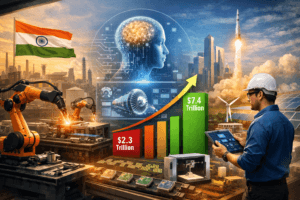
The stakes, as quantified in the December 2025 chartbook The Make-in-India Upgrade: Advanced Manufacturing Trends, could not be higher. On the current trajectory, India’s manufacturing GDP would plateau at around $2.3 trillion by 2047. However, by fully harnessing a suite of frontier technologies, that figure could explode to $7.4 trillion—unlocking a staggering $5.1 trillion in unrealized economic value. This “manufacturing GDP gap” represents more than just a missed target; it symbolizes the difference between incremental growth and a genuinely transformative industrial revolution.
The Foundation Is Laid: Reform as a Springboard
Importantly, the report does not dismiss the significant groundwork already completed. It acknowledges that the past decade has been about constructing the essential plumbing for a modern economy. The implementation of labour codes (aimed at simplifying a complex web of regulations), the rationalisation of the Goods and Services Tax (GST), the easing of Foreign Direct Investment (FDI) norms, and tentative steps toward land reforms have all been critical.
Perhaps most transformative has been the focus on infrastructure and logistics—long the Achilles’ heel of Indian manufacturing. The PM Gati Shakti initiative, with its GIS-based digital portal for integrated infrastructure planning, and the National Logistics Policy aim to dismantle the silos between roads, rails, ports, and utilities. The move toward single-window digital clearances is a direct attack on the legendary “inspector raj” and bureaucratic delays that eroded competitiveness. These reforms are necessary, the report implies, but they are no longer sufficient. They have brought India to the starting line; technology is now needed to win the race.
From “Make in India” to “Invent and Automate in India”
This is where the core prescription lies: a decisive pivot from foundational reforms to technological infusion. The report identifies a powerful triad: AI-led innovation, industrial automation, and the adoption of frontier technologies.
- AI as the New Capital: The narrative moves beyond AI as a buzzword, positioning it as the central nervous system of future factories. AI’s role is twofold. First, it drives productivity gains through predictive maintenance (preventing machine breakdowns before they happen), generative design (creating optimized components), and hyper-efficient supply chain management. Second, it fuels product innovation, enabling Indian firms to move beyond commoditized assembly into high-value design and smart, connected products. This is crucial for moving up global value chains where profitability resides.
- Automation as the Muscle: While automation often raises fears of job displacement, the report frames it as an imperative for scale, quality, and cost competition. Robotics and automated production lines are not about replacing humans en masse, but about augmenting human labour to achieve consistency and volumes that can compete with global powerhouses like China and Vietnam. In sectors like electronics, automotive, and pharmaceuticals, precision automation is already a baseline requirement for export-oriented production.
- The Frontier Toolkit: The report highlights a specific suite of technologies that will define next-generation manufacturing:
- Digital Twins: Virtual replicas of physical assets or processes that allow for simulation, testing, and optimization without costly real-world trials.
- Additive Manufacturing (3D Printing): Enables complex, lightweight part production, reduces waste, and allows for decentralized, on-demand manufacturing—revolutionizing spare parts logistics and prototyping.
- Advanced Materials: Development and use of composites, smart alloys, and nanomaterials for stronger, lighter, and more efficient products.
- Smart Grids & Clean Tech: Essential for powering energy-intensive advanced manufacturing in a sustainable and cost-reliable manner.
Sectoral Vanguards and the Capex Surge
The analysis identifies clear frontrunners poised to lead this charge. Emerging and Production-Linked Incentive (PLI)-linked sectors—such as advanced electronics, clean energy (solar modules, green hydrogen, battery storage), next-generation automotive (EVs and their supply chains), aerospace, and the AI-cloud-cyber stack—are projected to contribute 27% of industrial capital expenditure over the next decade.
This is backed by hard numbers: average annual capital expenditure is forecast to jump from ₹4.3 lakh crore in the FY21-25 period to ₹7.1 lakh crore in FY26-30. Early signals of this momentum are already visible, from Micron’s $2.75 billion semiconductor assembly and test facility to Google’s massive $25 billion commitment to digitisation and AI data centres in India.
The potential payoff is monumental. The report estimates that these focus sectors alone could drive $1.4 to $1.9 trillion in GDP growth by 2035. Furthermore, the pervasive adoption of frontier technologies across all manufacturing verticals could add another $1.1 trillion to manufacturing GDP.
The Human Element: Navigating the Transition
The report’s underlying message, echoed by NITI Aayog’s stance that advanced manufacturing is “no longer optional,” presents a profound challenge for India’s human capital strategy. The transition is not merely about installing robots but about rewiring the workforce. The future factory floor will require fewer hands for repetitive tasks but many more minds for programming, maintenance, data analysis, and system management.
This necessitates a parallel revolution in education and vocational training. The success of the manufacturing upgrade will depend on the rapid scaling of STEM education, industry-linked apprenticeship programs in robotics and AI, and continuous upskilling initiatives for the existing workforce. The goal must be to transition workers alongside the machines, not be displaced by them.
Conclusion: A Historic Inflection Point
India stands at a critical juncture. The hard-won macroeconomic and infrastructural reforms have created a platform of possibility. The choice now is between leveraging that platform for a conventional, linear growth path or using it to launch a technologically-driven exponential leap.
The Ionic Wealth report is essentially a blueprint for the latter. It argues that the fusion of AI, automation, and frontier tech is the most potent catalyst available to bridge the $5 trillion gap, create high-value jobs, and establish India as a genuine global innovation hub rather than just a competitive production base.
The vision for 2047 is clear: a Viksit Bharat must be built on the bedrock of intelligent, efficient, and sustainable advanced manufacturing. The time for incremental adoption is over; the era of accelerated integration has begun. The report’s data makes the cost of inaction abundantly clear, turning a policy recommendation into an economic imperative.
You must be logged in to post a comment.