
Restoring Global Health Balance: How the 2025 WHO Summit is Bridging Ancient Wisdom and Modern Science
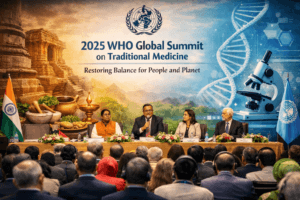
Restoring Global Health Balance: How the 2025 WHO Summit is Bridging Ancient Wisdom and Modern Science
The Second WHO Global Summit on Traditional Medicine in New Delhi, which concluded on December 19, 2025, marked a pivotal moment in the global acceptance of holistic healthcare systems. With the theme “Restoring Balance for People and Planet,” the summit represented more than a conference—it signified the strategic mainstreaming of ancient healing traditions into the fabric of 21st-century global health policy. For billions who rely on traditional medicine as their primary or preferred form of healthcare, this summit heralded a new era of recognition, validation, and integration.
The gathering in India, a nation where traditional systems are deeply woven into the cultural and economic tapestry, was profoundly symbolic. The outcomes—including the landmark Delhi Declaration, the launch of a first-of-its-kind global digital library, and new quality benchmarks—are not merely bureaucratic achievements. They are a collective acknowledgment that achieving true health equity and universal coverage is impossible without embracing the diverse medical knowledge that has sustained humanity for millennia.
A Summit of Substantial Outcomes: Key Announcements Analyzed
The summit was a platform for launching concrete initiatives designed to move traditional medicine from the periphery to the core of global health systems.
The WHO Traditional Medicine Global Library (TMGL): A Knowledge Revolution Perhaps the most technically significant announcement was the official launch of the WHO Traditional Medicine Global Library. This digital repository addresses a critical, long-standing barrier: the fragmentation and inaccessibility of traditional medicine knowledge. It consolidates over 1.6 million scientific records, including full-text research articles, policy documents, and thematic collections from 112 specialized databases and 178 journals.
Its architecture is designed for equitable access. It features a global portal, six regional portals, and country-specific pages for all 194 WHO member states. A partnership with Research4Life provides free or low-cost access to institutions in lower-income countries, directly tackling the knowledge gap between the Global North and South. The library also includes specialized thematic pages, starting with Traditional Birth Assistance in the Americas and expanding to detailed resources on India’s AYUSH systems. This initiative transforms scattered, often orally transmitted knowledge into a structured, evidence-based global public good.
The Delhi Declaration and the Ayush Mark: Setting New Global Benchmarks The summit culminated in the adoption of the Delhi Declaration, which formally recognizes traditional medicine as a “shared biocultural heritage”. This framing is crucial—it moves the discussion beyond mere therapy and positions these systems as integral to cultural identity and biodiversity conservation. The declaration aligns squarely with the WHO Global Traditional Medicine Strategy 2025–2034, which focuses on evidence, integration, regulation, and innovation.
Alongside this political commitment, India proposed the “Ayush Mark,” a prospective global quality benchmark for AYUSH products and services. This initiative aims to build international confidence by standardizing quality, much like organic or fair-trade certifications have done in other industries. For a global market wary of inconsistent standards, a recognizable seal of approval could be a game-changer for consumer trust and trade.
My Ayush Integrated Services Portal (MAISP): Digital Governance at Scale Reflecting India’s digital prowess, the summit saw the launch of the My Ayush Integrated Services Portal (MAISP), a master digital portal for the entire AYUSH sector. This platform is designed to streamline service delivery, practitioner registration, and information dissemination, creating a unified digital ecosystem for India’s vast traditional medicine infrastructure.
India’s AYUSH Ascent: From Cultural Heritage to Economic Powerhouse
The choice of New Delhi as the summit venue was no accident. India has undertaken perhaps the world’s most ambitious project to institutionalize and modernize its traditional medicine systems.
Explosive Growth and Formal Integration India’s AYUSH sector (encompassing Ayurveda, Yoga, Naturopathy, Unani, Siddha, and Homeopathy) has experienced 15-fold growth over the past decade, evolving into a major global wellness force valued in the tens of billions of dollars. This is not just a market statistic; it reflects a profound societal shift. The government has backed this growth with systemic integration:
- Infrastructure and Workforce: The country now boasts 3,844 dedicated AYUSH hospitals and over 36,800 dispensaries, supported by a registered practitioner base exceeding 755,000 professionals.
- Co-location in Public Health: Through the National AYUSH Mission (NAM), AYUSH services have been successfully co-located in over 26,600 Primary Health Centres (PHCs) and thousands of Community Health Centres (CHCs) and District Hospitals. This policy ensures citizens can access traditional medicine within the mainstream public health system.
- Educational Foundation: With 886 undergraduate and 251 postgraduate colleges, India has created a formal educational pipeline that produces nearly 60,000 new AYUSH graduates annually.
A Multi-Pronged Strategy for Quality and Innovation India’s approach extends beyond building clinics. It is a holistic strategy for research, quality control, and global outreach:
- Ayurgyan: A central scheme dedicated to research and capacity building, funding studies in drug standardization, medicinal plant research, and clinical validation.
- AOGUSY (AYUSH Oushadhi Gunvatta evum Uttapadan Samvardhan Yojana): This scheme focuses squarely on drug quality and pharmacovigilance, upgrading testing labs and assisting manufacturers to meet stringent quality benchmarks.
- Global and Digital Outreach: Initiatives like the Traditional Knowledge Digital Library (TKDL), Medical Value Travel (MVT), and Ayush Grid are designed to protect intellectual property, promote wellness tourism, and digitize the entire sector.
Table: Overview of India’s Key AYUSH Systems
| System | Core Philosophical Origin | Primary Therapeutic Approaches | Key Global Recognition |
| Ayurveda | Ancient Indian (Vedic) | Herbal medicine, diet, Panchakarma detox, yoga | Widely recognized; growing global market for products and wellness. |
| Yoga | Ancient Indian | Physical postures (asanas), breathing control (pranayama), meditation | UNESCO Intangible Cultural Heritage; globally practiced for mental & physical health. |
| Unani | Classical Greek (via Arab & Persian scholars) | Herbal remedies, dietetics, regimental therapy (e.g., cupping) | Popular in South Asia and parts of the Middle East. |
| Siddha | Ancient Tamil (South India) | Use of metals/minerals (rasa shastra), herbs, yoga | Primarily practiced in Tamil Nadu and Sri Lanka. |
| Homeopathy | German (18th century) | Highly diluted natural substances based on “like cures like” | Integrated into national healthcare in India; popular in parts of Europe & Americas. |
The WHO’s 2025-2034 Blueprint: A Strategy for Evidence-Based Integration
The New Delhi summit served as a powerful launchpad for the WHO Global Traditional Medicine Strategy 2025–2034. This strategy provides the overarching framework for global action, centered on four strategic objectives:
- Building the Evidence Base: Advocating for the application of rigorous, culturally appropriate scientific research to validate traditional practices. This includes leveraging frontier technologies like AI and genomics.
- Strengthening Regulation: Promoting robust regulatory frameworks to ensure the quality, safety, and efficacy of traditional medicine products and the proper training of practitioners.
- Integrating into Health Systems: Encouraging countries to formally integrate traditional medicine, particularly at the primary healthcare level, to expand access, provide more choice, and advance Universal Health Coverage (UHC).
- Promoting Cross-Sector Collaboration: Fostering partnerships that link traditional medicine to biodiversity conservation, climate resilience, and the respect of Indigenous rights and knowledge.
Dr. Tedros Adhanom Ghebreyesus, WHO Director-General, captured the strategy’s essence: “By engaging responsibly, ethically, and equitably… we can unlock the potential of traditional medicine to deliver safer, smarter, and more sustainable health solutions”.
Navigating the Path Forward: Persistent Challenges and Critical Debates
Despite the summit’s momentum, significant hurdles remain on the path to equitable and effective integration.
- The Evidence and Funding Gap: A stark disparity exists between the widespread use of traditional medicine and investment in its research. Less than 1% of global health research funding is dedicated to this field. Closing this gap is essential to build the robust, peer-reviewed evidence base required for full integration into biomedical systems.
- Quality Assurance and Standardization: The lack of globally harmonized standards for herbal medicines poses risks to consumer safety and impedes international trade. India’s proposed Ayush Mark is a step forward, but achieving global consensus will be complex.
- Ethical Imperatives: Access, Benefit-Sharing, and IP Rights: A central tension revolves around preventing the exploitation of traditional knowledge. As Dr. Shyama Kuruvilla of WHO noted, advancing traditional medicine is an “ethical and environmental imperative”. The summit dedicated sessions to designing equitable frameworks that ensure Indigenous communities and knowledge holders rightfully benefit from the commercialization of their heritage.
- Paradigmatic Integration: Perhaps the deepest challenge is epistemological. Traditional systems like Ayurveda or Unani offer holistic, often personalized models of health, while mainstream biomedicine is largely reductionist and disease-focused. True integration requires more than just offering both services side-by-side; it demands respectful dialogue between these different ways of knowing and creating new, blended models of care.
Conclusion: A Turning Point for Global Health Equity
The 2025 WHO Summit in New Delhi concluded not with an end, but with a clear and urgent beginning. The launch of the Global Library, the solidarity of the Delhi Declaration, and the showcase of India’s AYUSH model collectively signal that traditional medicine has irrevocably stepped onto the world stage.
The ultimate goal, as reflected in the summit’s theme, is restoring balance—balance between ancient wisdom and modern science, between global access and local benefit, and between treating illness and promoting holistic well-being. In a world where 4.6 billion people still lack access to essential health services, ignoring the proven, accessible, and culturally resonant solutions offered by traditional medicine is no longer an option. The journey from the halls of the summit to the implementation in clinics and communities worldwide will be long and fraught with difficulty. However, the commitments forged in New Delhi have provided a indispensable map for that journey, charting a course toward a more inclusive, resilient, and balanced future for global health.
You must be logged in to post a comment.