
“Remain Vigilant”: India Issues Urgent Advisory for Nationals in Palestine as Regional Tensions Boil Over
India has issued an urgent advisory for its nationals in Palestine to “remain vigilant” and avoid unnecessary movement amid escalating regional tensions triggered by reported US and Israeli strikes on Iranian targets, reflecting a rapid deterioration in Middle East security. The Representative Office in Ramallah provided emergency contact details, urging citizens to follow local safety procedures as the crisis threatens to close borders, disrupt airspace, and cause supply chain issues. The advisory underscores India’s dual diplomatic challenge of protecting its citizens while maintaining balanced ties with both Israel and Palestine, as New Delhi publicly calls for de-escalation through dialogue even as it prepares for potential contingency operations in a region bracing for wider conflict.
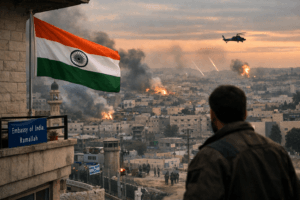
“Remain Vigilant”: India Issues Urgent Advisory for Nationals in Palestine as Regional Tensions Boil Over
In a stark reflection of the rapidly deteriorating security environment in the Middle East, the Indian government has issued an urgent advisory for all its nationals residing in Palestine. The directive, disseminated through the Representative Office of India in Ramallah, urges Indian citizens to exercise extreme caution, restrict their movements, and stay in close contact with local authorities as geopolitical tensions in the region reach a critical point.
The advisory, posted on the official social media channels of the Indian mission, is more than just a routine travel notice. It is a clear signal of the potential for imminent escalation, urging the approximately few dozen Indian nationals—comprising primarily students, aid workers, and those with family ties in the region—to move from a state of normalcy to one of heightened alert.
“The safety and security of Indian nationals abroad is our top priority,” the Representative Office stated in its public communication. “In light of the current situation in the region, all Indian nationals in Palestine are advised to remain vigilant, observe locally advised safety and emergency procedures, exercise caution, and avoid unnecessary movement.”
For those on the ground, these words carry the weight of a population that has lived through cycles of conflict. The “current situation” refers to a volatile mix of recent military actions and retaliatory threats that have diplomats and security analysts worldwide watching with bated breath. While the advisory does not specify an immediate threat, it coincides with a series of high-stakes events that have reshaped the region’s security landscape overnight.
Beyond the Headlines: What “Remain Vigilant” Really Means
To a casual observer, “remain vigilant” might sound like standard bureaucratic language. But for an Indian national living in the West Bank or navigating daily life in a region under strain, it is a practical instruction that fundamentally alters daily routines.
Vigilance, in this context, means:
- Constant Communication: Staying in touch with family in India and with the embassy, ensuring that the mission has updated contact information.
- Situational Awareness: Monitoring local news, heeding the instructions of Palestinian civil defense and security forces, and understanding the difference between a distant siren and one that requires immediate shelter.
- Supply Stockpiling: Ensuring that passports, travel documents, and emergency cash are readily accessible. Many seasoned expats in conflict zones will also ensure they have a “go-bag” with essentials like water, non-perishable food, medications, and power banks.
- Movement Restriction: The advice to “avoid unnecessary movement” is crucial. It means deferring travel between cities like Ramallah and Hebron, avoiding potential flashpoints near checkpoints or settlements, and staying indoors during periods of heightened tension.
The mission has established clear lines of communication to facilitate this state of readiness. In case of an emergency, the office has activated its dedicated helpline and email channels. Indian nationals can seek assistance by calling +970-592-916-418 or by reaching out via email at repoffice@mea.gov.in and cons.ramallah@mea.gov.in.
This dual-channel approach—phone and email—is designed to ensure redundancy. In conflict zones, cellular networks can become congested or fail. Email provides an asynchronous method for the mission to log concerns and track the welfare of its citizens.
The Geopolitical Powder Keg: Context of the Crisis
The advisory cannot be read in isolation. It is a direct response to a seismic shift in regional geopolitics. Unconfirmed reports and breaking news tickers accompanying the advisory mention a massive escalation involving US and Israeli strikes on Iranian targets. While official confirmation on the full extent of the strikes is still evolving, the purported targets—including senior military and political leadership in Tehran—would represent a qualitative change in the long-running shadow war between Israel and Iran.
For the Indian government, such an escalation triggers an immediate protocol for diaspora protection. Palestine, and by extension the broader Levant, sits at the very epicenter of this conflict. Any major military confrontation involving Iran, Israel, and the United States has a direct and almost instantaneous ripple effect on the ground in Palestine.
The proximity is undeniable. If tensions escalate into a full-blown regional war, the West Bank and Gaza—already under immense strain—could face severe repercussions, including:
- Closure of Border Crossings: The Allenby Bridge crossing between the West Bank and Jordan is a vital lifeline for travel and goods. It is often the first thing to close during a crisis, effectively trapping civilians inside.
- Airspace Shutdown: As seen in a related news report mentioning 444 flight cancellations in the region, airspace can be closed with little notice, stranding travelers.
- Supply Chain Disruptions: Essential goods, including food, fuel, and medicine, could become scarce.
- Internal Unrest: Periods of high regional tension often lead to increased friction and instability within the West Bank.
India’s Delicate Diplomatic Dance
Beyond the immediate safety of its citizens, India’s response reflects its complex and carefully calibrated foreign policy in the Middle East. A concurrent report from the same news cycle highlights India’s official stance: a call for “de-escalation through dialogue and diplomacy.”
This statement is classic Indian foreign policy doctrine. New Delhi maintains strong strategic and defense ties with Israel, a relationship built over decades on cooperation in security, agriculture, and technology. Simultaneously, India has historically been a strong supporter of the Palestinian cause, advocating for a two-state solution and maintaining a diplomatic presence in Ramallah.
In a moment of crisis, India’s immediate concern is humanitarian—protecting its people. Its public diplomacy, however, is aimed at urging restraint. By calling for dialogue, India positions itself as a voice of stability in a region where it has vital interests, including a massive diaspora (especially in the Gulf) and critical energy imports. The safety of Indians in Palestine is, therefore, not just a consular issue but a key indicator of the success of India’s regional engagement.
A History of Evacuations and Care
This is not the first time India has had to issue such a warning or mobilize to protect its citizens in the Middle East. The Indian government has a robust and well-practiced mechanism for crisis management, famously demonstrated during operations like “Operation Raahat” in Yemen (2015) and the massive “Operation Ganga” to evacuate students from Ukraine (2022).
While the number of Indians in Palestine is significantly smaller than in Gulf countries or Europe, the government’s approach remains the same: proactive communication and readiness. The advisory serves as the first step in a potential sequence of events. If the situation worsens, this “vigilance” advisory will likely be followed by a formal “advisory to leave” and, if necessary, contingency plans for assisted departure.
What Should Indian Nationals Do Now?
For the Indian nationals currently in Palestine, the advisory transforms theory into practice. Based on standard operating procedures for such scenarios, individuals should take the following steps immediately:
- Register with the Mission: Ensure that your presence is known. If you haven’t already, share your details (full name, address in Palestine, contact number, and local emergency contact) with the mission via the provided email addresses.
- Create a Communication Tree: Designate a point of contact in India. Share the mission’s emergency contact numbers with your family back home so they have a channel to seek information if you are unreachable.
- Review Exit Strategies: Familiarize yourself with the route to the Jordanian border (Allenby Bridge) and understand the requirements for crossing. Monitor its operational status through local news.
- Stay Indoors: Adhere strictly to the advice against unnecessary movement. If you are in Ramallah, stay in Ramallah. Avoid travel to areas known for friction or protests.
- Follow Local Instructions: The advisory explicitly mentions observing “locally advised safety procedures.” If the Palestinian Authority or local municipal authorities issue a curfew or advise staying in specific safe rooms, those instructions must be followed immediately.
Conclusion
The issuance of this advisory is a somber milestone in an already turbulent year for the region. It serves as a reminder that in an interconnected world, geopolitical shocks in one capital can send tremors that reach the streets of Ramallah and the inboxes of Indian citizens living abroad.
For now, the Indian government’s message is one of preparedness, not panic. The mission in Ramallah remains operational and is the first line of defense for the Indian community. As the world watches to see whether the current escalation spirals into a wider war, the priority for India remains clear: ensuring that every single one of its nationals in Palestine has the information, support, and means to stay safe in the days ahead. The vigilance requested is not just a word in a press release; it is the lifeline that connects a citizen in crisis to their nation thousands of miles away.
You must be logged in to post a comment.