
Religious Harassment at Riyadh Trade Show: A Test for Saudi-India Economic Relations
Religious Harassment at Riyadh Trade Show: A Test for Saudi-India Economic Relations
Incident Overview: Mockery at the Trade Booth
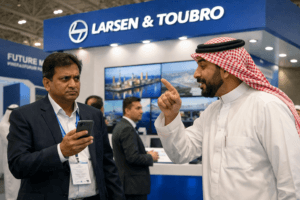
A recently circulated video from a Riyadh business exhibition has sparked international concern, showing an Indian businessman at a Larsen & Toubro (L&T) booth being verbally targeted over religious identity. In the footage, a Saudi individual can be heard mocking the company as “Hindu” and complaining that there was “not even one Muslim” present.
The identity of the individuals involved remains unconfirmed, and the video has not been independently verified by several news organizations that reported on it. According to social media analysis, the incident may have occurred during the Future Minerals Forum held in Riyadh from January 13-15, 2026.
The man at the booth responded by recording the incident on his phone, though he subsequently lowered his device. The video gained traction after UAE-based political analyst Amjad Taha shared it on social media platform X, condemning the act as “blatant racism” and “an assault on dignity, faith, and free enterprise”.
Broader Implications: Business, Discrimination, and Diplomacy
This incident emerges against a complex backdrop of growing economic ties between India and Saudi Arabia, creating tension between business realities and social challenges.
Economic Partnership vs. Social Friction
The table below illustrates this dichotomy between official economic cooperation and on-the-ground social realities:
| Aspect of Relations | Cooperation & Progress | Tensions & Challenges |
| Economic Ties | Strategic partnership in mining, infrastructure, energy; $50 billion West Coast Refinery project | Social media comment: “If you don’t want Hindus, fine, don’t issue visas. But inviting them and then being racist makes no sense” |
| Diplomatic Engagement | High-level bilateral meetings; Saudi Crown Prince attending G20 meetings | This incident potentially undermining people-to-people relations |
| Public Perception | L&T as major Indian conglomerate (60-70 billion USD organization) | Social media characterization of “Saudi Arabia’s ranking second in racism in the Middle East” |
The Business Case for Diversity
The attacker’s complaint about religious composition ironically highlights why diverse workforces benefit companies. Research consistently shows that organizations with inclusive cultures and diverse teams outperform homogenous ones, particularly in global business environments. L&T’s international success—including defense contracts for ballistic missile nuclear submarines—demonstrates how talent and capability transcend religious identity.
Systemic Context: Saudi Arabia’s Human Rights Landscape
To understand this incident more fully, it’s essential to examine the broader human rights context in Saudi Arabia, particularly concerning migrant workers and religious minorities.
Migrant Worker Vulnerabilities
Migrant workers represent approximately 42% of Saudi Arabia’s population, yet they face systemic challenges. The kafala (sponsorship) system ties workers’ legal status directly to their employers, creating dependency that facilitates exploitation.
Recent developments include:
- A June 2025 partnership agreement between Saudi Arabia and the International Labour Organization to advance decent work reforms
- Ongoing complaints filed at the ILO regarding migrant worker rights, including one from the Building and Wood Workers’ International Union related to preparations for the 2034 FIFA World Cup
- Documented cases of migrant workers facing conditions amounting to forced labor
Restrictions on Religious Expression
Saudi Arabia maintains severe restrictions on religious freedom, with authorities using counterterrorism laws to persecute religious minorities. The legal framework offers no protection against religious discrimination in business contexts, creating environments where such incidents can occur without clear recourse.
The country’s Public Investment Fund (PIF), chaired by Crown Prince Mohammed bin Salman, has been linked to human rights abuses including forced evictions and worker exploitation. These systemic issues create a context where discriminatory behavior against non-Muslim businesspeople might occur without institutional checks.
Corporate and Diplomatic Responses
Potential Pathways Forward
For companies like L&T operating internationally, incidents like these necessitate strategic responses:
- Internal Protocols: Establishing clear procedures for employees facing discrimination abroad
- Diversity as Asset: Framing diverse workforces as business strengths rather than vulnerabilities
- Quiet Diplomacy: Leveraging government channels to address systemic issues without public confrontation
The Indian government faces a delicate balancing act—protecting citizens’ dignity while preserving strategic economic partnerships. With India as one of Saudi Arabia’s top trading partners, it possesses significant leverage that could be deployed through diplomatic channels.
The Role of International Frameworks
The 2025 Saudi-ILO agreement mentioned earlier represents a potential mechanism for addressing such discrimination. However, human rights organizations note that meaningful reform requires tackling “the core features of the abusive kafala system” and addressing “severe limits on the freedoms of expression and association”.
Practical Considerations for International Businesses
Companies operating in complex cultural environments should consider several approaches:
- Cultural Training: Preparing staff for diverse business environments while maintaining ethical standards
- Local Partnerships: Collaborating with Saudi businesses that exemplify progressive values
- Transparent Reporting: Documenting incidents through proper channels while avoiding public escalation that might harm broader relations
The business exhibition setting of this incident is particularly significant, as such forums are designed to foster international commerce. When discriminatory behavior occurs in these spaces, it undermines their fundamental purpose.
Conclusion: Navigating Complexity in Global Business
The Riyadh exhibition incident, while involving specific individuals, reflects broader tensions between economic globalization and persistent cultural insularity. For Saudi Arabia, such episodes risk undermining its Vision 2030 diversification goals, which depend heavily on international partnerships.
The viral nature of the video demonstrates how quickly localized incidents can become international reputational challenges in our interconnected world. Social media reactions ranged from calls for accountability to debates about the incident’s authenticity, highlighting how such events become contested narratives.
For multinational corporations and nations alike, the path forward requires balancing principles with pragmatism—condemning discrimination while preserving channels for dialogue and progress. As one social media comment noted, there’s growing hope for Saudi Arabia to become an economic power “much like the UAE,” but regressive behavior threatens this trajectory.
Ultimately, this incident serves as a reminder that economic partnerships must be built on mutual respect, not just mutual interest. As countries and companies navigate increasingly globalized marketplaces, those who recognize human dignity as foundational to sustainable business will likely fare better in the long term.
You must be logged in to post a comment.